Beyond borders: Raphael Rogiński takes a spiritual trip around Eastern Europe
October 2021
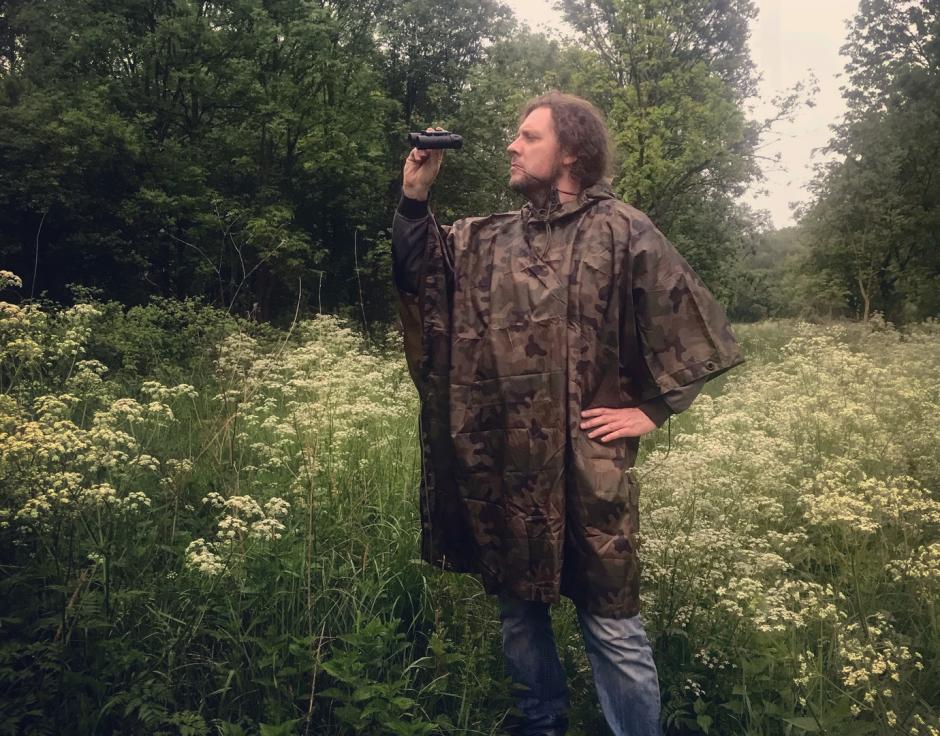
Raphael Rogiński
The Polish guitarist maps traditional and devotional music from the Steppe to Karelia and the Aegean
Maybe let's start with the fact that I see the map and the ’borders’ on it a bit differently. What is West and East is somewhere else for me. There is also, as in everything, something in between – something that is a gate, a passage, but like the Babylonian gate Ishtar, itself becomes a place here and now, a consummate work.
That's what Eastern Europe is for me. Here, spirituality is hidden in landscapes, ancient freedom of nomads, but also a sensitivity for what is close, believes in connection with divine energy and plasticity in the description of this miracle. Here, the Dacian werewolves, running along the Dobruja steppes, pass Scythian horses dressed as sacred deer. Here, the waters of the Black Sea wrap Orpheus's head; and in Bulgarian Strandzha, people walk on the glowing hearth greeting to the sun. To feel at least a substitute of Eastern Europe's spiritual mosaic, let's listen to a few songs.
Haralambie & Hristu Zechiu
“Ti Ni Stăm, Nă Minduim”
The compass makes no sense if you are in the Dobrogea region of Romania. Here’s where the Danube backwaters and the Black Sea shore end and the Steppe begins. This is the interzone. This is one of those places where antiquity is still alive. There are also Old Believers, and it was with them that I got to know this region, fascinated by their music and theology. Tatars, Bulgarians, Cossacks and finally Aromanians, living in isolation from the rest of the world, connected with what was ancient quite naturally. The song title “Why We're Sitting Down And Thinking” says more than any one of many sacred books.
Eter Kakulia
“Tsira”
Jason had once planted dragon teeth in Georgia, and the sheep had gold-covered fur. Prometheus, also associated with this region, created man from clay and tears. That explains a lot. In culture, tears are advisable, and the experience of being deeply moved in the Caucasus is like nowhere else. Here the great Georgian singer Eter Kakulia performs the song of the Lazi, the people of the coast, the people of Colchis – witnesses of more than one miracle.
Susanna Memet & Qaranfil Ansambli
I had a Tatar grandmother. As we ate raw meat, I timidly looked into her eyes, and saw the Scythian steppes and beyond. It was my first experience of meditation. I am often in Odessa. As a tribute to my grandmother, I meditate on the Kalmyks departing from the Steppe around the Black Sea.
Svitlana Nianio
“III Episode From Transilvania Smile”
Svitlana Nianio is a true East European humanist. This music is very old school. I am not sure if it is ancient. Nianio has a direct connection with the mystic from this part of the world.
Unknown soloist
“A Sheinem Cholem”
Hasidism arose in the Ukrainian Carpathians. Baal Shem Tov, while meditating in the mountains, saw the meaning of life. Trance, mysticism, music were to liberate people and bring them closer to God. Today, also in Poland, I go to places associated with Hasidim. Just close your eyes to feel the pulsating idea.
Karol Szymanowski
“Stabat Mater Opus 53”
As Witold Lutosławski said, when you hear Polish composer Karol Szymanowski's music for the first time, it is as if you were entering a secret garden. Szymanowski and his metaphysical and sensual music are like secret knowledge. You are communing with something that is hidden in the fog, under spruce trees or in ancient groves. Although he made music from Poland, he was greatly influenced by ancient Greece. The religious song here is a testimony of faith, in a dark, very Polish style, turned however into pure beauty.
Petr Valek
“Improvisation For Prepared Acoustic Guitar And Prepared Refrigerator”
Czech musician and inventor Petr Valek creates sound images of our chaos, bitterness or love and happiness. Loud noise, broken structures are to not let us forget, a reminder not to be held back in the search. Everything is here because it is our human temple.
Indrė Jurgelevičiūtė
“Sodai”
Nature in Lithuania is like a vine that gets tangled up in every aspect of culture. It thus becomes a hymn to it. Indre Jurgeleviciute knows how to live today and honour the roots.
Repei
“At Festival Wszystkie Mazurki Świata 2017”
The Repei group from Moscow play flutes made of delicate reeds. This ancient technique was often practiced by women. As in, for example, Gabon, women used free time to communicate with nature, to be part of it. Imitating birds, the sound of water, the rustle of birch leaves changed shapes and understood the speech of the birds. Today, this need to direct energy towards nature is getting stronger every year around the world. At least we have the soundtrack ready.
Honeypaw
“Iloidaaks Müö Ihmeen Noored”
Honeypaw are a Finnish band. Finnish mythology is beautifully described and closed in the book Kalevala. It also exists in the messages. Iso Tammi is a legendary oak that has obscured the sky. The god Ukko cut it down and made it into a bridge for the dead. This song is in the Ancient Ingrian language, and made and recorded using trees in the region.
Širom
“Same As The One She Hardly Remembered”
The alchemists from the Širom ensemble find a way to create new instruments or play old ones in a new way. Their music is pure magic. It is like embroidery that is part of the identity in Slovenia. Meeting them is like finding an ancient family.
Vassilis Philippou
“Yearning”
The Persian poet and mystic Rumi claimed that love is the greatest religious experience. Love often goes hand in hand with longing. And the longing in this part of the world is something almost everyone feels. On her beloved island of Cyprus, Aphrodite combined love with magic. Vassilis Philippou is a troubadour of love. He lives at the source. About longing for love, the song "Yearning" is pure mysticism. Love is the spirit of our inner temple.
Raphael Rogiński performs at Krakow’s Unsound festival on 17 October as part of Nicholas Jaar’s ongoing Weavings project. Subscribers to The Wire can read Richard Johnson’s interview as well as Biba Kopf’s feature on Poland’s Hidden Reverse via our online archive.
Leave a comment