Stream tracks from the Tompkins Square Aimer et Perdre compilation
February 2012
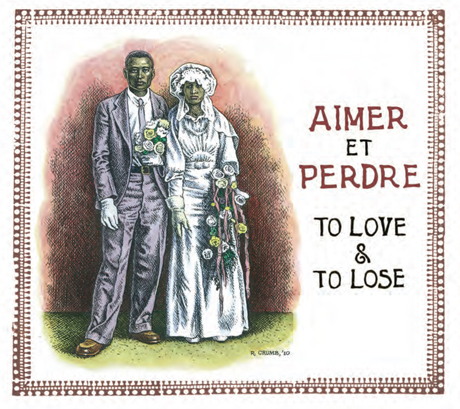
Listen to songs from the Aimer et Perdre album, compiled by Christopher King and Susan Archie.
In the introduction to the accompanying booklet, King and Archie describe the compilation thus: "If humans are by nature social animals, then what makes us unnatural is our inexplicable mulishness in seeking out relationships that we know will ultimately both enrich us and devastate us, more often at the same time: the irresistible yearning that is love. This collection of songs and tunes attempts to encompass this unique contradiction that lives within us, that is simultaneously so absurd and yet so necessary for our humanity. It is the “Sunshine and Shadows” that makes us truly, and forgivably, human and this humble selection of music contains the range of these contrasts."
Joe & Cleoma Falcon
"Aimer et Perdre (To Love and To Lose)"
Recorded April 1929
Joe and Cleoma were the first authentic Cajun musicians from
South-West Louisiana to record commercially. They performed and
recorded, rather prolifically, until Cleoma was involved in an
accident which compromised her health and precipitated her untimely
death soon thereafter. Joe and many other Cajuns mourned her
passing.
Józef Brangel I Wiejska Orkiestra
"Oberek Z Migroda (Oberek From Migroda)"
Recorded December 1928
What a strange and beautiful place Migroda, Poland must have been.
This curious dance of courtship likely features five fiddlers and a
bowed bass. Brangel plays the lead melody with two others,
providing at some times dissonant yet compelling harmonies and two
others playing the rhythmic chords.
Dennis McGee & Sady Courville
"Madame Young, Donnez-Moi Votre Plus Jolie Blonde (Madam Young,
Give Me Your Sweetest Blonde)"
Recorded March 1929
The irresistible charmer Dennis McGee played this song for Madame
Ulysses Young, his first wife’s mother, in order to gain the hand
of young Marie. McGee was one of the rare artists that could
produce a pleading agony and a desperate longing from both his
fiddle and his singing.
Douglas Bellard & Kirby Riley
"La Valse De La Prison (The Prison Waltz)"
Recorded October 1929
Bellard and Riley were the first to record the earthy, raw music of
the black Creoles. This stark masterpiece of fiddle, accordion and
vocal emphasizes the rhythm and beat while understating the melodic
line. Douglas Bellard played with Amede Ardoin and taught this tune
to a younger Canray Fontenot who popularized the song as "Barres De
La Prison". Outside of Geeshie Wiley’s "Last Kind Word Blues", it
is hard to imagine a more dark, moody, and backwoodsy performance
from this time period.
Ukrainska Orchestra Michala Thomasa
"Hutzulka W Semerczyni (Hutzulka From Semerczyni)"
Recorded October 1929
The fiddle, especially in the hands of the masterful Ukrainian
fiddler Thomasa, can produce a remarkably expressive tone, a timbre
that sounds almost bitter and aggressive to my ears. His
sophisticated bowing approach propels the fiddle to its expressive
limits, strengthening the notion that the fiddle is the most vocal
of all instruments, in the right hands.
Richard 'Rabbit' Brown
"Never Let The Same Bee Sting You Twice"
Recorded March 1927
Few American songsters can claim the concise wit and wisdom
contained within Richard 'Rabbit' Brown’s slim opus. Even fewer
artists were more of a cipher than Brown who recorded six sides in
New Orleans and then was swallowed back up by eternity. The diction
and tone of his voice suggest an older man who was well versed in
the music of the medicine shows.
Comments
The music of Nigeria includes many kinds of folk and popular music, styles of folk music are related to the multitudes of ethnic groups in the country, each with their own techniques, instruments, and songs. Little is known about the country's music history prior to European contact, although bronze carvings dating back to the 16th and 17th centuries have been found depicting musicians and their instruments. Olababs Celebration Hymn Medley
Sonshub
The music of Nigeria includes many kinds of folk and popular music, styles of folk music are related to the multitudes of ethnic groups in the country, each with their own techniques, instruments, and songs. Little is known about the country's music history prior to European contact, although bronze carvings dating back to the 16th and 17th centuries have been found depicting musicians and their instruments. Isabella Melodies Holy Spirit Live
sonshub
Leave a comment