Tangerine Dream's deepest trips
July 2020
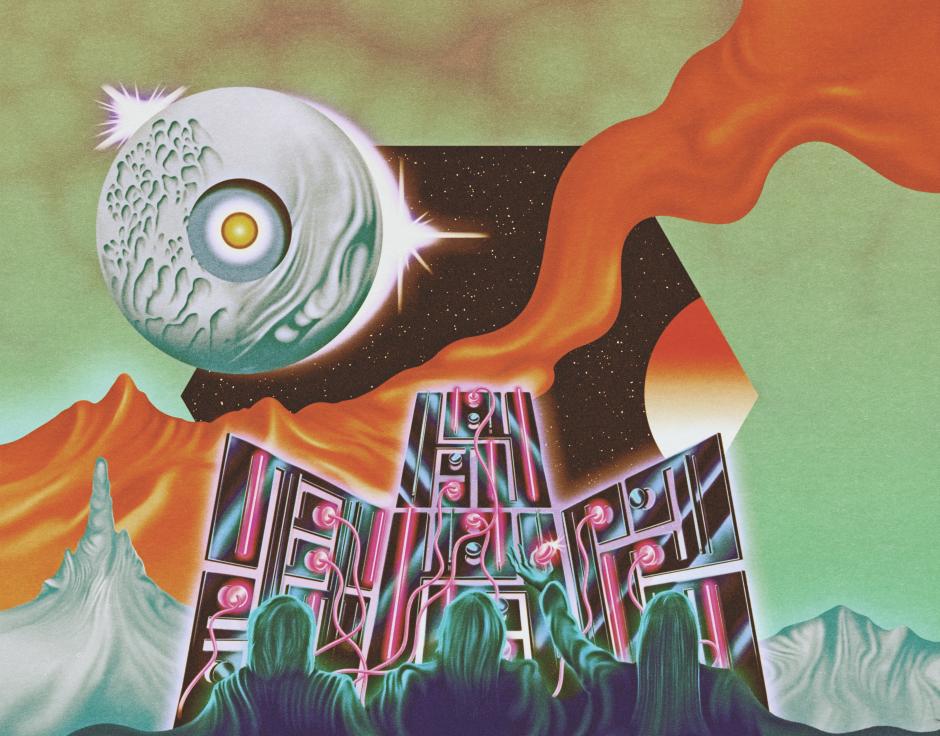
Illustration by Robert Beatty
Matt Krefting selects some of the most psychedelic tracks from the German kosmische music institution's sprawling back catalogue
Tangerine Dream are the subject of a ten page special feature in The Wire 437 July issue. The spread includes an interview with the band's current line-up about deep space, evolution and their late leader Edgar Froese; a special report on the group’s synthesizers; commentary on their 1970s albums, as well as their artwork, and their decades-spanning relationship with cinema. In this additional online feature, The Wire contributor Matt Krefting discusses the group's deepest and trippiest tracks.
“Journey Through A Burning Brain”
From Electronic Meditation (1970)
Tangerine Dream’s long playing debut Electronic Meditation is overtly whacked out. Whatever it lacks in aesthetic cohesiveness it makes up for in wasted audacity. The team of Edgar Froese, Conrad Schnitzler, and Klaus Schulze, with the help of the initially uncredited Jimmy Jackson and Thomas Keyserling, sounds somewhat different to what followed in the careers of kosmische music’s primary team of cosmonauts, but space, loosely defined, is undisputedly a guiding force. This track lives up to its title, using prog rock instrumentation to coyly flirt with form and formlessness, full of blissful disregard for either category.
“Alpha Centauri”
From Alpha Centauri (1971)
Drifting, shimmering organ drones are joined by stately synths trying to politely ask a series of questions they keep forgetting. The guitar and flute are employed with a spaciousness that renders them nearly indistinguishable from the synths and the organ. There are some furtive attempts at something like recognisable rhythm, but the drift is the thing. Concessions to traditional musical structure seem to melt, giving way to physical basics like up, down, then, when, why and how.
“Birth Of Liquid Plejades”
From Zeit (1972)
Any of Zeit’s four sidelong tracks could fit nicely on this list, but the presence of The Cologne Cello Quartet sets the album’s opener apart. The cellos gleam over one another at the outset, and synthesizers swim seamlessly swim in. Zeit on the whole may be slow-moving, yet it’s anything but static. Its seeming stillness is in reality a series of small and subtle shifts. The cellos exit imperceptibly, and then without any announcement of its arrival, an organ guides the piece through the rest of its life. Or birth, as it were.
“Green Desert”
From Green Desert (1986)
Unreleased until 1986, Green Desert is a duo recording from 1973 by founding member Froese and Christopher Franke that helped provide a bridge between the first major chapters of the group’s development. The recording itself helped landed them a deal with Virgin. Over 20 minutes, “Green Desert” employs synthesized tones so thick you can practically see them, augmented by Froese’s guitar and Franke’s drums. With typical disrespect for linear time, this one sounds like a prototype for what they eventually returned after their sequencer-based breakthrough records on Virgin, prefiguring melodic lines and other motifs that soon became enshrined in the minds of many heads.
“Phaedra”
From Phaedra (1974)
Phaedra heralded a new chapter, its title track mapping territory further afield from anything they’d done before. A woozy, iridescent opening goes tumbling without warning into a sequencer pulse riding waves it seems to be producing itself. It’s exhilarating. Melodic lines and textures travel along in fleeting attempts to affix themselves to the unwieldy rush, but it all moves too forcefully for any cliche to even wink an eye. Eventually the piece explodes, bursting into open space. The bottom’s dropped out, the synths take on preverbal personalities, and the music wafts across a cosmic plateau before vanishing as quickly as whatever memory it might have been trying to evoke.
“Rubycon Part II”
From Rubycon (1975)
The second side of their finest album begins in the deepest depths, performing miracles as it works its way out of them. Subterranean tonalities pry themselves from their tectonic limitations and charge skyward – timbre becomes a reflexive epigraph. Then the sequencers kick in, more strident than ever, using rhythm as an intoxicant to draw us into an examination of the contours of sonority.
The Wire 437 is available to buy in print or read online now.
Comments
I used rubycon when doing teaching practice in Manchester in 1974. The 11 year olds seemed to like it!
Paul webster
I started listening to TD while I was out at sea in the Indian Ocean, we were watching Sorcerer. I was blown away by how the music blended so perfectly with the movie. Then I went to watch Tom Cruise on Risky Business, not knowing that TD’s music would also be featured in this movie...I’m a fan for life?...
Vic
Leave a comment