Against The Grain: London’s last jukeboxes
April 2026
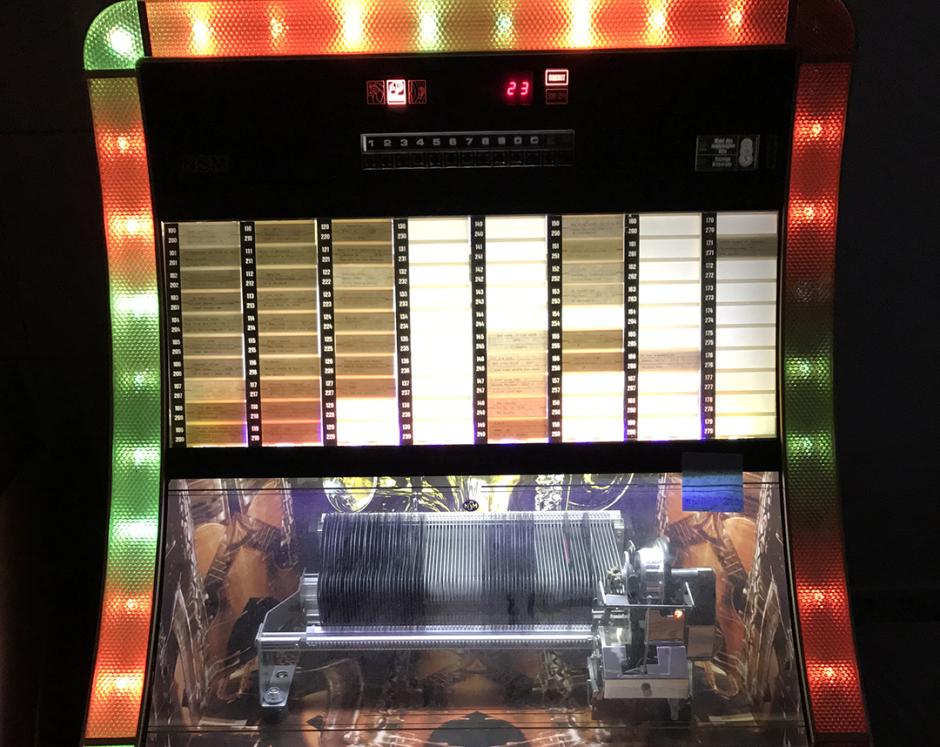
An NSM Prestige II Jukebox, similar to the one in Bradley's Spanish Bar.
The few remaining jukeboxes in London’s pubs and bars salvage a mode of music consumption from the junkyards of history, argues Deborah Nash in The Wire 507
“‘Oranges and lemons, say the bells of St Clement’s, You owe me three farthings, say the bells of St Martin’s!’ It was curious, but when you said it to yourself you had the illusion of actually hearing bells, the bells of a lost London that still existed somewhere or other, disguised and forgotten…”
In George Orwell’s Nineteen Eighty-Four the novel’s protagonist Winston Smith strays into the backstreet neighbourhood of the Proles, where he encounters the owner of a junkshop who recites this nursery rhyme to him. The junkshop is crammed with dusty treasures spilling out in disordered heaps, among them a glass paperweight containing a piece of pink coral. Fascinated by the uselessness of this object, Winston buys it.
Today, turning off Oxford Street in central London into the alleyway of Hanway Street, I escape the flashing neon windows of department stores to arrive at Bradley’s Spanish Bar which, like Orwell’s junkshop, houses its own object of curiosity from bygone times: a 1970s coin-operated NSM Prestige II jukebox. Barely audible above the crowded colliding conversations, the jukebox is playing Peter Sarstedt’s “Where Do You Go To (My Lovely)”.
Bradley’s, the site of a former wine merchant, predates its jukebox by about a decade, but the place looks Victorian, somewhere you might hold a séance, with its tasselled bell lampshades, arabesque-patterned wallpaper, red velvet banquette and assorted memorabilia that includes a framed photograph of the Hanway Club’s pipe-smoking president William Bradley. There is also a bar downstairs, but it is on the ground floor that the ‘jukies’ arrive to feed their coins into the machine on a Saturday night.
“I’ve learned way more about jukeboxes and urinals than I ever thought I would,” Bradley’s manager Jan de Vries tells me. If the machine fails to engage, he can fix it most of the time, otherwise he Zoom calls an engineer in Yorkshire. Since the 1960s, there have been several jukeboxes here and they are so embedded in the bar’s history and identity that one appears in Bradley’s logo.
Before 5pm on Mondays to Fridays the music is free. At the time of my visit it’s much later, so I push my pound coin into the slot to net three songs from the 160 available. The 80 7"s are lined up vertically in a rack, and I watch the direction of travel through the machine’s large sloping concave window: the mechanical carriage slides across to select my record and bring it into contact with the stylus, then plays it upright. This is unexpected, as is the song that materialises, which is not the Blondie track I had picked.
Bradley’s has 20,000 singles, mostly kept in a warehouse, with some 2000 on site. “We change about 20 records every six to eight weeks or so… to keep customers and especially the staff sane,” says de Vries. “If you put in The Smiths, The Clash, artists like Queen, you know it’s going to be overplayed, so we try not to let them stay in there for too long.” But the process of going through boxes of vinyl, making the selection, cleaning the records, and printing and cutting out the labels, is time consuming.
“It’s nice to watch them,” says Margaret Webb of Jukebox London, who has a collection of 1950s and early 60s jukeboxes, objects of American exported glamour in their heyday. “They’re more fun if they have ‘visible play’,” she says, referring to machines where you can see the 45 playing. “If you only have 25 cents, you can discuss with your friend which song to choose. You don’t want to repeat what some guy has been playing all day long.”
Webb argues that when jukeboxes became closed and functional boxes like cigarette vending machines, they lost visual interest as well as value. We are in a room with ten different models, ranging in price from £6500 to £22,000, depending on quality, sound, size and how they have been conserved. Every day, she plays them. “They need exercise,” she explains. “They’re mechanical, and if they don’t get played, they seize up.”
No chance of slacking for Bradley’s jukebox. “In general, the jukebox is as busy as we are,” says de Vries. “It has to go at full speed like everyone else.” While I’m there, more hipsters pile in from the rain. “My dad used to come here with Simon Le Bon,” recollects someone at the bar. It is an anecdote that indicates the squeeze on this ‘in between’ place, straddling the West End and Fitzrovia, once home to secondhand record shops for those working in music and media. Their gradual erasure coincided with the construction of the Elizabeth Line, which saw the demolition of The Astoria venue, now replaced by the Outernet’s advert flashing, brain washing cubicles on Tottenham Court Road.
Many bars and pubs around London had – until fairly recently – a working jukebox. I visited six and, with one exception (King Charles I on Northdown Street), they had all been replaced by gambling machines and football screens.
The jukebox can never be a prosthesis – an extension of self – in the way a pen, phone, bike or car might be. In Nineteen Eighty-Four Winston’s glass paperweight is smashed by the Thought Police, and his yearnings for a different life lead to his ruin. In the present time it can sometimes feel as if the progress clock is running backwards towards ideas I thought long since expunged. We will, however, continue to time travel through old junkshops and pubs like Bradley’s, with the slow, imperfect and easy charm of its jukebox that offers something human-scaled and mercurial, something repaired rather than replaced.
At St Pancras station, I’m making my way across the concourse when I’m stopped in my tracks. There stands a Rocket jukebox on free play. I choose David Bowie and Queen’s “Under Pressure” from the menu and press the buttons. The machine lights up and tells me it is playing, but no sound emits from its speakers. Another juke bites the dust?
This essay appears in The Wire 507. Pick up a copy of the magazine in our online shop. Wire subscribers can also read the essay in our online magazine library.
Leave a comment