Against The Grain: Western modes of criticism overlook music's spiritual dimensions
February 2026
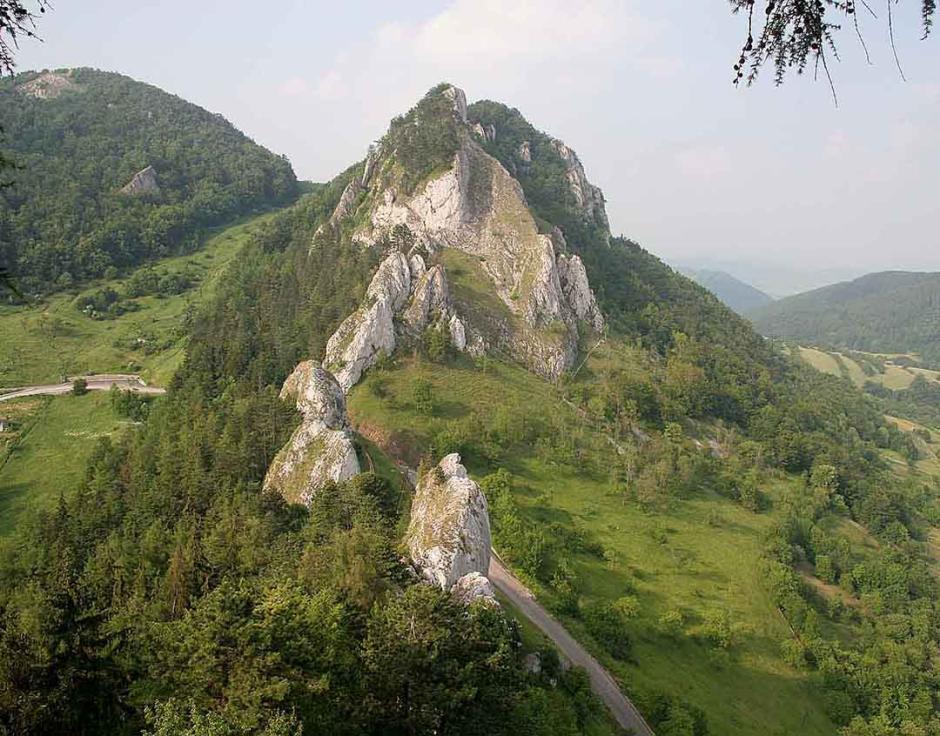
Carpathian mountains in Slovakia. Photo by Zdeněk Pražák.
Music can act on listeners in ways that Western modes of engagement and criticism overlook or erase, argues Moravian composer and vocalist Julia Úlehla in The Wire 505
I’ve just given a keynote presentation at Lines of Flight: Improvisation, Hope and Refuge, a conference hosted by the International Institute for Critical Studies in Improvisation. I’d been invited to talk about my performance research with Dálava, a cross-genre project that is influenced by animist, Slavic cosmology and a land-based folk song tradition that has been in my family for generations. After the presentation a woman approaches me. “There’s something I need to tell you. A spirit entered my body while you were singing and has a message for you.” She delivers the message and hugs me warmly. Once delivered, her demeanour transforms, as if a weight lifts. She promptly and politely says goodbye.
As this encounter suggests, singing is a devotional practice for me, one that connects me to my ancestors and other spirits, and affords an animist experience of reality. Music born of traditional and spiritual practice is increasingly visible in experimental and underground circles. But music of this kind is often at odds with the patriarchal colonial bias that constrains how music is written about and studied. Listeners, practitioners, teachers and writers need to find ways to move beyond this bias and avoid the harms of misrecognition, desacralisation, instrumentalisation, commodification and extraction.
The musical history of Canada, the nation state in which I live, is built on the extraction of Indigenous song and culture and erasure of Indigenous peoples and lifeways. In current music writing about artists who are women and people of colour, exotification, mischaracterisation and assumptions based on gender, race and ethnicity are common. In a letter in The Wire 424 in which she corrected inaccuracies arising from false assumptions based on her ethnic and racial identity, Amirtha Kidambi notes, “this kind of mischaracterisation and looseness with facts is much more common in stories about women and people of colour... we rarely get to dictate even the facts of our own stories, in the way many of our white male colleagues do, and are narrativised time and time again, in inaccurate and uncomfortable ways…”
Throughout my career I’ve seen women, queer, trans and racialised colleagues who work with voice prefer to situate themselves inside movement, dance, theatre or performance art milieus because of the patriarchal, colonial bias in music. During my PhD in ethnomusicology, I researched folk songs from Slovácko, a rural region at the western edge of the Carpathian mountains. In this tradition – which has been sung by generations of my family members – ancestor and other spirits, mountains, rivers, wind, weather, humans, animals and plants are understood as agentive, alive and interrelated. My advisor told me to keep my body, my family and my creative practice out of my research, adding that I should maintain a scholarly distance and satisfy his appetite for facts. He asked me to take spirit out of my writing, warning that it would unpalatable for colleagues.
These statements suggest that knowledge cannot arise in the body, and that one’s family lineages and exploratory musical practices are not viable fields for research. Gatekeepers have appetites that can only be satisfied by facts obtained through the perceptions of an unaffected, distant observer. Spirits are the stuff of an (often feminised or racialised) Other’s belief, fantasy or psychosis. To present them as part of a valid epistemological and ontological field invites ridicule.
I’ll give a few examples of what people thinking outside this dominant ideology have told me that they perceive when listening. Neither platitudes nor praise, these comments open imaginative space for what language about music is, or could be. The encounters they describe bridge across alterity without collapsing difference, foregrounding embodied experience, spiritual encounter and collaborative wondering. These exchanges include modes of listening and giving language to musical experience that avoid reification and instead open towards relationship.
A young woman came up to me after a performance and told me that she “grew up inside a Hindu household where music, devotion and the domestic were inextricably linked”. She continued, “The performance felt like being home. Your music lives in the heart. Depending on the relationship a person has to their own heart influences how they will hear you.”
What if the way we respond to music has more to do with emotional flows and blockages than aesthetic preferences? What would happen if we knew we might be having our hearts worked on when we listened to music, or conversely, when we performed for someone, we might be engaging with their hearts? What does that do to accountability? Would we consent to that? What are we turning away from if we never think about it?
A Syilx woman told me that she palpably felt and saw the land that the folk songs I sing come from and was moved by how beautiful the land was. What if certain songs are inseparable from the lands they grew from, as though the songs themselves contained the land, or could bring the spirit of the land to them? In this diasporic world, what are we asking genus loci to do when we bring them across the world? What are the consequences when songs from faraway lands appear upon stolen, occupied, Indigenous land, and how is each context different? Are we, for example, introducing lands or ancestors to one another in generative ways? Who determines that? Or enacting another form of settler colonialism in the spirit world?
A Serbian woman told me that the performance allowed her to experience “the existential liberation of Slavic melancholy”. She said, “If you travel down to the very bottom of suffering, on the other side lies freedom.” What if songs are medicine, capable of bringing healing to suffering? What if we knew that when we gather to listen to music or perform for others, we could travel to the bottom of suffering and pass through it together?
And as the opening story reveals, song is a powerful way of communing with ancestors and other spirits. What if we went to concerts knowing that our ancestors were gathered in the room with us? What might we want to do together? Do we have issues to heal or celebrate within our lineages, or among those gathered? Do we know how to do this safely and responsibly, and are we all at equal risk?
These exchanges centre ways of knowing and listening that many academicised modes of engagement find hard to tolerate. Yet, many of us have had experiences like these through music; many of us long for them. Music helps us learn how to love, how to honour the land that sustains us, how to heal, how to grieve, how to visit with the dead, how to experience hierophany. No one is authority in these layered entanglements – not the musicians, not the audience, not the unseen. These relational encounters invite everyone to participate but don’t work according to logics of control or distance. You have to let yourself be taken by something bigger. Can music criticism disarm itself enough to make space for this?
Julia Úlehla is a Moravian composer and vocalist. This essay appears in The Wire 505.
Pick up a copy of the magazine in our online shop. Wire subscribers can also read the essay in our online magazine library.
Leave a comment