Bryce Dessner: Humanist Heroics and Masculinised Music
April 2026
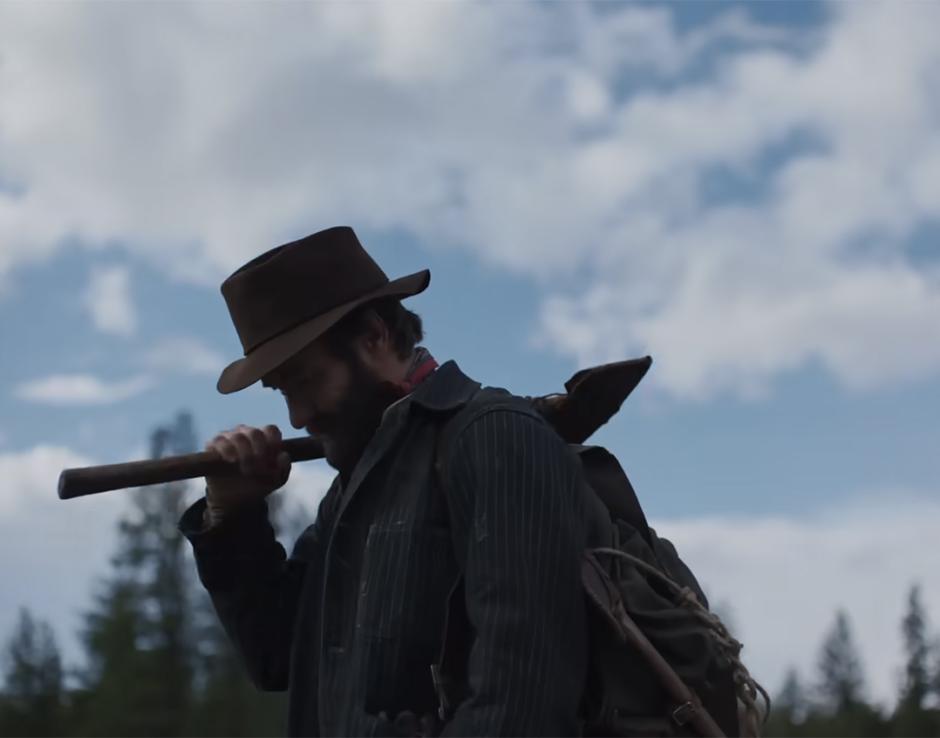
A still from Clint Bentley’s Train Dreams (2025).
In his latest Secret History Of Film Music column, Philip Brophy considers the sound of masculine sensitivity through the scores of Bryce Dessner
When people cry at the movies, it’s usually the music that induces the tears. The magic of music is that it can irrationally, apolitically and even randomly upset you. It can act as a triggering mechanism, artfully deployed to exploit our sentimentality. Some moviegoers pride themselves on always being in control of what they deem good in art, but everyone can be manipulated by music. Personally, I’m comfortable with music overriding my rational control. It’s what allows me to rail against default humanist tacks in film scoring, and also to accept that some composers and directors can collaborate to produce humanist sentiments without being cloying.
That’s a lengthy preamble to contextualise the scores of Bryce Dessner, best known as the guitarist from The National. Importing his band’s shimmering ‘wall-of-indie’ guitar sound, Dresser produces languorous scores shaped by open ended passages of harmonious strumming. The National’s loping Knopfleresque sonics are not my preference, but Dresser’s aesthetic has been clearly and successfully incorporated into a number of independent films.
Mike Mills’s C’mon C’mon (2021) is one. The score’s instrumental aura evokes an Elizabethan broken consort: harmonium, recorders, audible breathing and pumping, spiced with occasional whammy pedal pitch jumps drenched in reverb. Its drone based ambience evokes an acoustic rendering of Brian Eno’s Another Green World, without drum machines or percolating rhythms. The result is an Appalachian Zamfir, conjuring stillness and soft tension. This mirrors the uneasy reservation radio journalist Johnny (Joaquin Phoenix) holds as he is forced to look after his pre-teen nephew Jesse (Woody Norman). The multi-tracked voices and delays (“Who’s Taking Care Of Jesse?”; “The Orphan”) matches the emotional layering which almost suffocates Johnny as he attempts to figure out Jesse’s autistic behaviour, yet the warmth of the music maintains a felt connection to Johnny’s efforts.
Things get decidedly mushy in We Live In Time (2024), a tragic love story involving a wedding, children and ovarian cancer. It’s a tearjerker that hardly requires music to pull the strings. However Dessner’s plaintive guitar suite strikes an elegiac balance with the script’s overdetermined beats of pathos. OK, to be frank, Dessner’s score here does resemble music currently piped on airplanes before take off or through phones on hold. Orchestral Muzak ® died a long time ago, to be replaced by the spirit of humble arthouse harmoniousness. We Live In Time falls in line with this death erotic of beautiful melodies: the unabashedly romantic tenor of chugging cellos, uppity drums and twangy guitars.
Alejandro González Iñárritu’s Bardo, A False Chronicle Of A Handful Of Truths (2022) bears a score by Dessner co-composed with Iñárritu himself. A visually opulent tale of Silverio (Daniel Giménez Cacho), an aged ‘docufiction’ filmmaker returning to Mexico to receive a national cultural honour, the film hovers next to his encounters with Mexican residents who discourse on politics and poetics through their terse dressing down of his return. Like most of Iñárritu’s movies, Bardo explores the human condition while muddying the straits between fantasy and reality. He did so superbly in Birdman (2014), with its drum score by Antonio Sanchez; here the results are bloated and clichéd – though that might be intentional.
In a self-mocking tone, Dessner and Iñárritu’s score features brass band tracks which reference the pomp and pretension of Mexican military music. Numerous historical epoch films from Mexico and Italy have presented Mexican brass ensembles – from the glisteningly professional to the grimly depleted – as a malfunctioning façade of imperial dreams courted by successive Mexican regimes shape-shifting from colony to empire to republic to revolution to federation. Bardo’s ironic brassiness recalls David Byrne’s score for The Knee Plays (1984) and Goran Bregovic’s music for the 1990s films of Emir Kusturica.
The rest of Bardo’s score mimics Morricone at his Cinecitta best. “Mateo’s Freedom” overflows with a religiosity not unlike Sergio Leone’s Once Upon A Time In America (1984): thick with strings, flutes and muted trombones that breathe, sigh, soar and cascade. “Liminal” is Morricone trembling at his own mortality: high violin vibrato crying like a gypsy caravan at a funeral. “Dreaming Of A Dream” sounds two- and three-note lines, uttered as discrete phrases, leaving silences within which a dark resonance rings like a liturgical response deep underground. It’s uplifting and grounding at the same time. Dessner’s touch seems to diffuse Bardo’s self-centred heroics, especially so in “Silverio Last Train” and “Bardo Finale”.
Dessner’s most recent score for Clint Bentley’s Train Dreams (2025) pushes his chordal passages into chamber music forms. The film traces the hard life of logger Robert Grainier (Joel Edgerton) working in the 1910s for the Great Northern Railway. The score’s cues crank the trilling pianos, and cycle the strings on a sugary high. Elsewhere, tracks like “Placing Stones” return to the familiar psychoacoustics of an upright piano doodled with the sustain pedal on, recorded in an old school room, transporting listeners to an imagined childhood at school. That sounds clichéd, but Dessner’s music ennobles the sad plight of Grainier. Taken together, these films recoup masculinity through music. They both feature central male characters who, despite their aspirations, are fragile and insecure, continually falling prey to adverse elements shifting around them.
Literature and theatre has tackled gendered heroics with greater nuance than the younger medium of film. Films tend to inflate heroics through narrative condensation, visceral thrills, fetishised cinematography, and musical slathering. Indeed, film music’s endless French horning of male heroes might have developed through a need to compensate for the vapidity of film scripts, which attempt to deepen a hero’s journey and end up flattening it for blunt audience identification. Arthouse movies which seek to redress the imbalance caused by idolising the male hero often use a similar ‘musical lathering’ to Hollywood spectacles, only they replace grand orchestras with humble ensembles, European classicism with American stylistics, and belted dynamics with massaged touches.
I’m being critical here of the lumpen application of (at its worst) U2-ish Americanazak in scores for indie movies, not of Dessner’s contribution. What is it about ‘strummery’ indie rock that jangles the jollies of filmmakers in love with honouring the fragility of life? Ragnar Kjartansson’s ‘performative installation’ at MoMA PSI in New York in 2013 engaged The National to perform “Sorrow” for six hours continuously. The nine LP limited edition has been uploaded to YouTube: it gives new meaning to the term ‘wallowing’.
Ugo Rondinone’s It’s Late… (1999-2000) is a celebrated six-channel video installation projected around the walls of a room bathed in light from a blue Perspex ceiling. But nowhere do museum catalogues declare the source of the work: sections from Fassbinder’s Gods Of The Plague (1970), accompanied by (if memory serves me correctly) a very long and softly jangling track unreleased by Tindersticks, possibly titled “Happy Hour”. Here the emotional faucet was wedged open in the name of contemporary art, pouring a 4AD/Lynchian sound into the glowing blue room while Harry Baer’s louche photographic stud wanders empty urban environments.
The legacy of reverberant jangly guitars is often used like flock wallpaper to overwhelm the listener with signified emotional weight. Overly sensitive film music can help to tag a film’s independent spirit and its artistic aspirations, but can just as easily deflate it. Bryce Dresser’s scores notably escape this emotional pitfall and still bring on the tears.
Wire subscribers can read Philip Brophy’s original Secret History of Film Music columns from the 1990s online in the digital archive. Previous instalments of this column published on The Wire website can be found here.
Leave a comment