Colin Stetson: Hot Breath and Dark Tones
January 2026
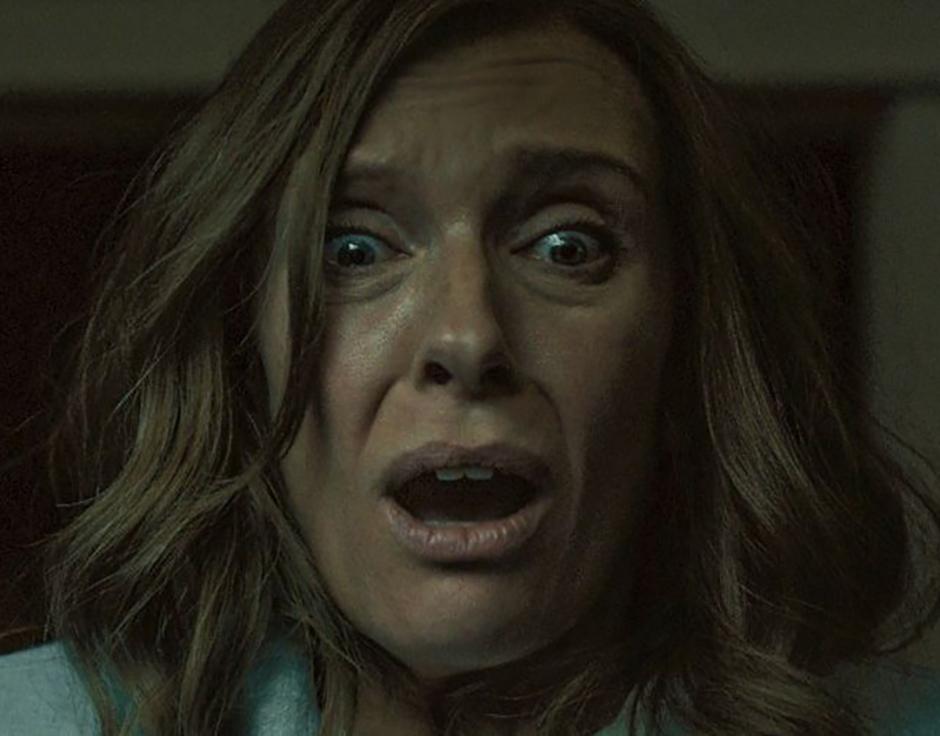
Toni Collette in Hereditary (2018)
Philip Brophy analyses Colin Stetson’s use of the saxophone’s physical dimensions to evoke the disturbed voices and bodies of Texas Chainsaw Massacre (2022) and Hereditary (2018)
As with all post-2010 franchise reboots, Texas Chainsaw Massacre (2022) spins itself dizzy with reflexive stylistics, revisionist story lines and ideological closure. Musician and composer Colin Stetson’s distinctly live improvisations of acoustic and processed brass and woodwinds are exploited for sensational affect. When Leatherface first dons his freshly dead mother’s peeled face, Stetson deploys a growl deep from the bowl of what sounds like his baritone sax (“Sunflowers”, the opening track on the LP release).
Part death metal aping, part psychotic impression, it highlights a key aspect of all monster figurations: the sound of their voice. Much of Stetson’s cues for Texas Chainsaw Massacre combine vague vocal tones with breathy sustains, each overlaid with overtones and submerged in reverberant fog. In violent outbursts like “Sledgehammer”, the score feels cognisant of Tobe Hooper and Wayne Bell’s ‘meat industry metalzak’ for the original Texas Chainsaw Massacre. Stetson carves, sculpts and moulds his compound acoustics with greater turmoil.
Stetson thematically has directed his instrumental performances across the well known New History Warfare volumes (2007, 2011, 2013). He needn’t have pointed out these pieces are recorded live and unedited: they throb with his circular breathing, muscular lungs, and immersion in the swirling sonorum he expels from his mouth. In an unlikely musical merger of Philip Glass arpeggios, ‘acoustic acid’ pulsations and inchoate metal vocalisations, the trilogy swells with a surprisingly emotional undertow. Like much of Stetson’s work, New History Warfare is emotionally hot and performatively anguished. Most ‘dark industrial’ work in this terrain I find highly affected and closer to cabaret than anything else, but Stetson’s grounding in the visceral dynamics of his physical instrumentation colours his compositions and recordings with convincing appeal.
I wonder how many filmmakers have temped their films during editing with tracks by Colin Stetson? His records supply emotional outbursts of debilitating affect which many a director might seek as an appropriate tenor for their hand-wringing tales of woe (a trope too many horror and sci-fi movies embrace). And here’s the rub: Stetson’s music alone conjures these ecstatic states of demolition and destitution, but when combined with visuals intent on evoking identical feelings in a viewing audience, the resulting audiovision can become overbearing, muddled and unintentionally caricatured.
I wonder how many directors realised this, and resolved to pull back the soundtrack to soften its bombast? The contrast between experiencing Stetson’s score in the Texas Chainsaw Massacre and auditing it in isolation on record is stark. This is a generalisation, but the more sonically adventurous a score, the more likely a movie tends to limit its organic energy, as if the music is an untamed entity to be collared. The LP is like a portrait of Leatherface: traumatised, trapped and taunted as if caged in a hellish unending franchise of horror replications.
Three other Stetson scores perform identically: Color Out Of Space (2019), Uzumaki (2024) and Hold Your Breath (2024). Their music alone conveys far more than their accompanying films. Hold Your Breath is an especially lost chance to highlight Stetson’s voice, considering it focuses on a Creepy Pasta-style ‘Grey Man’ whose lore has psychologically infected a woman and daughter struggling to keep their Dust Bowl ranch going during the 1930s climate devastation. The film abounds with some great sound design and voice editing which foregrounds the palpable psychoacoustics of diseased lungs and vocal deterioration. But Stetson’s metallic human tones and breathy granularity are plastered almost indiscriminately, like the showy CGI dirt storm clouds and artsy defocused cinematography.
To play devil’s advocate: is the problem that Stetson’s emotionally ‘hot’ music is a liability due to his inability to rein it in and properly service the film’s narrative? Man, that’s such a conservative view, which cinema continually upholds. A director not the composer is the one tasked with resolving and incorporating such intense energies (visually, performatively, sonically); they can experiment with pushing things or choose to pull back. Stetson’s first major score commission for Ari Aster’s Hereditary (2018) clarifies the benefits in perceptively handling powerful music like Stetson’s within a film’s narrative world.
Hereditary is as showy with its aesthetic gambles as the other films mentioned here. The opening camera creep into a model of a family house raises a reference flag to Stanley Kubrick’s The Shining (1980), whose overhead camera tracks Jack Torrance (Jack Nicholson) roaming the snowed-in hedge maze: the optics are of an animatronic doll in a diorama. His positioning throughout the film had repeatedly alluded to his withering self being a figurine sinking into a dimension governed by ghostly usurpation. Hereditary’s story layers this theme onto the dysfunctional family’s teenage son, Peter (Alex Wolff). But relevant here is how Stetson’s music accompanies that dollhouse opening. A spindly melody from his bass clarinet symbolically traces the claustrophobic contours of the dollhouse bedroom.
Something else floats in the background here and elsewhere in the film: distant harmonics, resonant notes and whirring altissomo squeaks, like chamber music being played in the distance. This vague wallpaper of domesticity – classical, mannered, cultured – is not film music in the normative sense. Rather, it scores how music indifferently occupies familial space, simultaneously placating and irritating a family group (convened with frailty by artist mom Annie – Toni Collette – and psychologist dad, Steve – Gabriel Byrne). Their interactions for the first half of the film are disturbingly devoid of connection; the indistinct musical smearing connotes the absence of emotion. This application of Stetson’s pre-storm calm (beautifully apparent on his 2016 release, Sorrow: A Reimagining of Gorecki’s 3rd Symphony) is cogently mixed into the film’s deliberately empty atmospheres of the deadening household and its dark wooden interiors. The sound of the outside world rarely enters, leaving the household devoid of ‘live’ acoustics bar the muted taps of a ticking clock. This allows the music to similarly signify that all human progress is halted – and for sudden noises to aggressively startle.
The first sign of the domain’s incursion by malevolent spirits occurs when young Charlie (Milly Shapiro) spies laser-like shimmers of blue light swimming across her bedroom (“Charlie”). Stetson layers the earlier snarling bass clarinet line atop a high-pitched bass pulse and multiple bell-ringing drones. Timbres morph as various elements cycle hurriedly and rise in volume before fading away. The impact is as full as any Hollywood orchestral bombast, but the detailing is crisp and lean, not thick and bloated. Film music orchestrations carry on the questionable tradition of being blasted in sound stage hangars; Stetson’s scores are always studiophonic. The Hereditary score is a dark doppelgänger of symphonic grandeur, as Stetson employs his wind instruments to perform like soaring strings, gulping cellos and haunting plucks. It’s a masterful move, using the vulgarity of saxophones – bass, baritone, contrabass – to simulate the symphonia of a traditional orchestra.
In the memorable scene where Charlie suffers anaphylactic shock as Peter desperately drives her to hospital, her breath is mixed like a guttural vocal track atop Stetson’s backing. His sound palette accentuates the mechanics of breath in relation to his instrumental arsenal. Multitracked clicks, taps, spits, coughs and blows rattle and excite Stetson’s instruments, as if they are fretfully possessed by sonic poltergeists. That Stetson’s unique percussiveness and its rippling noisescapes are welcomed onto Hereditary’s soundtrack is a testament to Aster’s grasp of the film score’s outer limits of sonority. In fact, one can interpret Peter as a human who is slowly transformed into a vessel: the music blows and hums through his hollowed being just like Stetson’s aural imaging of Peter. The film’s closing theme (“Reborn”) uses Stetson’s technique of emotive deconstruction from Sorrow, here applied to the euphoric moments of something like Strauss’s Alpine Symphony (1915). The impact is like feeling the full spectrum of emotions occurring simultaneously. Post-human transcendence breathed onto the soundtrack.
Wire subscribers can read Philip Brophy’s original Secret History of Film Music columns from the 1990s online in the digital archive. Previous instalments of this column published on The Wire website can be found here.
Leave a comment