Michael Uzowuru: Broken Soul and Broken Minds
December 2025
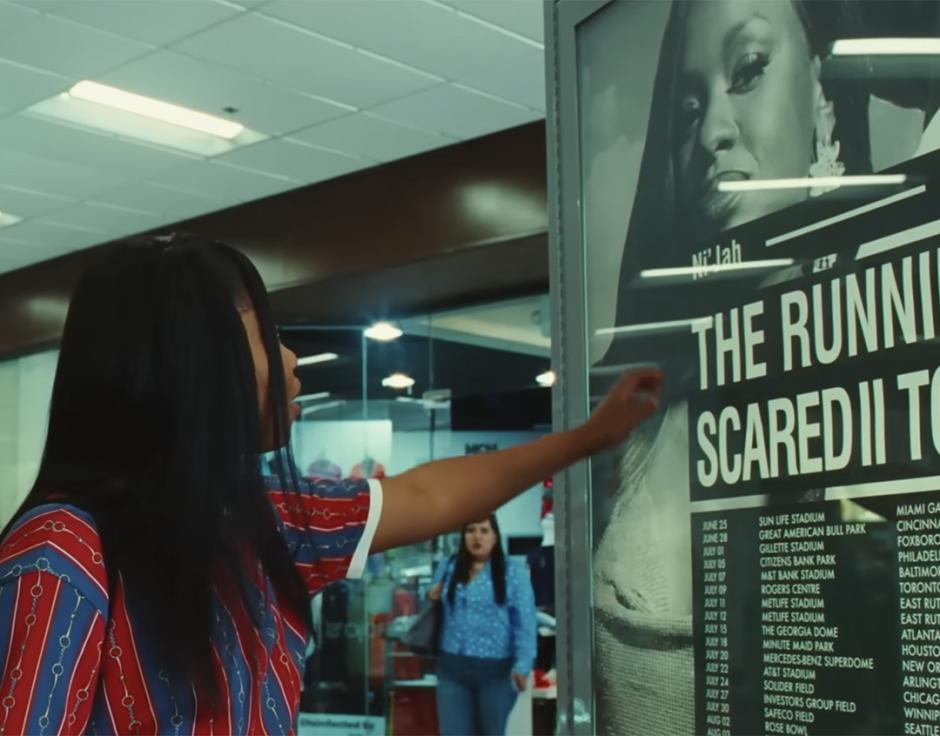
A still from Swarm (2023)
In his latest Secret History of Film Music column, Philip Brophy explores how the signifiers of Black musics in Swarm are fragmented to indicate its main character’s psychosis
What does it mean to compose music today? Is composed music a creative act or a procedural action? An original expression or a contextual response? A conceptual performance or an industrial gameplay? And if it is one or the other, how do we perceive it as positive or negative? I’m perennially excited by these notions – especially when a film score sends my head spinning into their interrogative possibilities. Michael Uzowuru’s score for the Prime mini-series Swarm (2023) spun my head considerably.
The premise is stark. Dre (Dominque Fishback) is a rabid fan of Ni’jah (a twisted simulacrum of Beyoncé and her Beyhive fanbase). She embarks on a killing spree, targeting people on social media who hate on Ni’jah. Graphically unsettling and tonally diffuse, Dre’s picaresque journey turns Dante’s Inferno upside down and pumps it full of Black aspirationalism to exploding point. Created by Donald Glover and Janine Nabers (whose previous series Atlanta is a meltdown of Samuel Beckett, Melvin Van Peebles and OutKast), Swarm pulls an even tighter focus on the sociocultural complexities of Black music, here pivoting from the hemmed-in machismo of trap and rap to the goddess hysteria of R&B and pop.
Ni’jah’s songs are sung and written by Kirby Lauryen, with selected co-writing and production spread between Glover and Uzowuru, among others. Childish Gambino touches are evident, and all tracks are skilled parodies of digital soul, gushing with stacked harmonies. “Something Like That” collapses digital simulations of vocal cooing with gospel-tinged organs and percussive thrumming a la Kate Bush’s ethnographic backings. Kirby’s AutoTuned lines layer female and male tones in a heady pansexual mix. “Agatha” harks back to seminal Timbaland productions for the late Aaliyah, awash in slurred breathiness and lo-fi Ngoni licks. “Big World” fuses microhouse and elegant sophistico vocals. The bouncy Vocoder jaunt of “Adventure” conjures a trappy limo party as remembered by college grads. “Hahaha” and “Sticky” are pumped with multi-genre crosswired stylistics, making both hard to characterise.
Scattered across the series’s seven episodes in disruptive edits and interrupted passages, these songs point to the magical breath of Ni’jah, who has the mystical power of a Black diva to excite her ‘swarm’ of fans. But unlike (for example) the soaring positivity of Hollywood’s flirtations with Black goddess music – from The Bodyguard (1992) to Glitter (2001) to Sparkle (2012) to Trap (2024) – Swarm posits Ni’jah’s songs as a type of ‘broken’ soul music. The polyglottic gumbo of ballads and anthems for Ni’jah do not shy away from how the spiritual Beyoncés and heartache Kanyes of the world produce music that is stylistically fractured, compositionally kaleidoscopic, digitally processed and authorially aggregate. ‘Broken’ soul describes equally this technological shift, its marketplace redefinition, and the psycho-therapeutic aspect of how fandom now links to these mystical figures with impossibly affective voices.
At the core of Swarm’s broken world is the psychotic character Dre. Dominique Fishback’s stellar performance (maddeningly numb and unpredictable) breaks the series’s narrative momentum continually, pushing the shared notion of ‘serial’ story and ‘serial’ killer into hitherto unexplored territory. Uzowuru’s score is a selective rearrangement and reconstitution of the sonic shards of Ni’jah’s songs. Sometimes they seem to be literal fragments from the songs, but mostly they are echoes of recognisably similar elements: single sounds from drum machines, single chords from digital keyboards, processed textures of clipped vocal utterances. An aural ouroboros is formed: the score comes from the songs which are studio-composed from the type of sonics of the score. This acousmatic mirage evokes the bond between Ni’jah and Dre – who in the first episode makes it clear: “Ni’jah knows what we’re thinking and she gives it a name.”
With this declaration, Dre is defending Ni’jah to the sleazy boyfriend of her tweenhood friend, Marissa, with whom she now shares an apartment. Dre’s announcement triggers an ungainly sound: a badly sampled vinyl scratch of an indiscernible source. This squawk is a sonicon for Dre’s cracked personality. Like Grand Mixer DXT’s trademark scratch of the Vocodered “fresh”, it is her call sign. Uzowuru uses it to forecast Dre’s loss of control and unmitigated rage; it will progressively increase in presence and density in the score as the story lurches into widening expanses of psychotic violence. (To my mind it also recalls the pitch-wheel bending of Major Lazer’s “Pon de Floor”, the basis of Beyoncé’s “Run The World (Girls)”.)
When Marissa decides to shift out of their apartment and live with her boyfriend, Dre’s world falls apart. The squawk sample increasingly and erratically haunts the soundtrack, variously merged with kalimbas, cellos, noise drones and symphonies of swarming bees. All of Uzowuru’s ‘cues’ are tied to Dre. Accordingly, they are weird sonic collages desperately trying to pass themselves off as ‘music’, just as Dre masks as sane, always hiding her murderous bent behind inscrutable logic and motives. In fact, each episode takes place in a different time in a different state, presenting their chapters as spatio-temporal ruptures in Dre’s life as she obsessively tracks Ni’jah’s tour schedule in the deluded belief that one day she and Ni’jah will be besties. Dre’s outward appearance, her living conditions, her employment situation all make her nearly unrecognisable in each episode. Uzowuru’s score placement is moulded by these ruptures.
In a radical move that these days seems far more commonplace in television than cinema, Swarm is a meta-textual labyrinth engineered less by plot and character and more by chance and psychosis. Squiggles, not arcs; lesions, not persons. Episode 6, “Fallin’ Through The Cracks”, is a sharp send up of long-running tabloid true crime shows like The First 48 and Snapped. It has no tonal connection with the series, and uses none of the actors, nor any of Uzowuru’s music. Episode 5, “Girl, Bye”, paints an unexpected and unsettling portrait of Dre’s childhood and her relationship to Marissa. A single cue by Uzowuru is sounded right near the end of the mostly silent episode. All the other episodes possess their own equilibrium of song tracks, music cues, and sono-musical collages. The viewer/auditor is refused any thematic musical flow to aid in riding the emotional tides and sociopathic waves of Dre.
The final episode, “Only God Makes Happy Endings”, devolves into the ecstatic, sensual world of Ni’jah’s music, shifting from her disembodied voice to her performative body, when Dre finally gets up close to her idol. Weirdly – magically, even – Uzowuru’s music becomes the world of Ni’jah as embodied within Dre’s schismatic and dissociative headspace. From awkward squawks of scratched audio to the glistening symphony of ‘devangelical’ music, Swarm’s soundtrack stitches together the titbits megastar divas disseminate to their swooning fans: ‘broken’ soul for Dre’s broken mind.
Wire subscribers can read Philip Brophy’s original Secret History of Film Music columns from the 1990s online in the digital archive. Previous instalments of this column published on The Wire website can be found here.
Leave a comment