Robert Aiki Aubrey Lowe: Natural Decay and Reparative Noise
February 2026
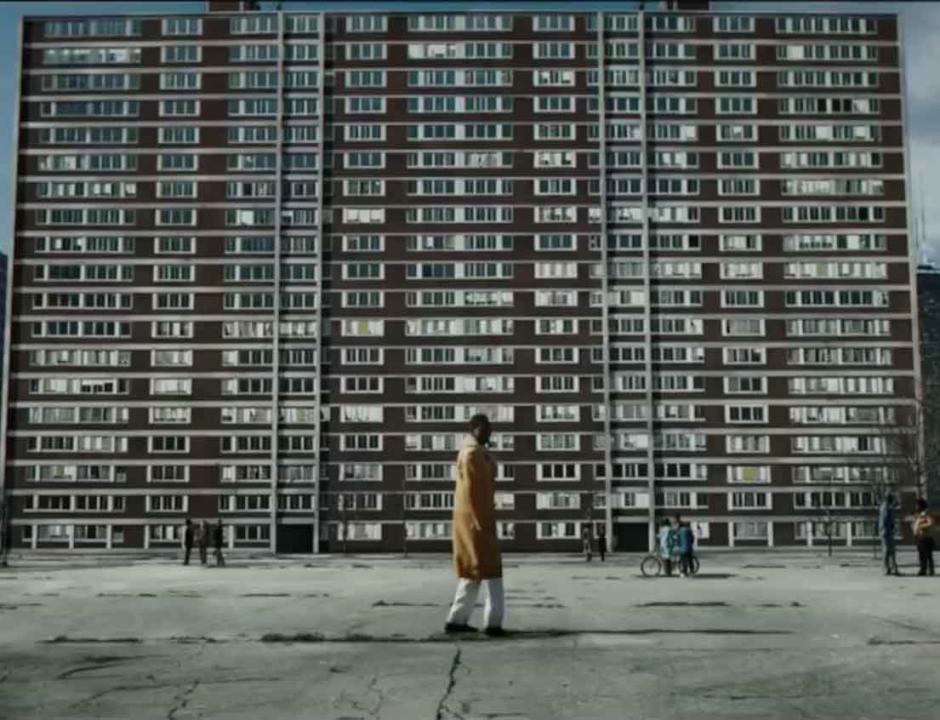
A still from Candyman (2021).
In his latest Secret History of Film Music column, Philip Brophy considers scores by Robert Aiki Aubrey Lowe, who creates an aesthetic of decay for a Black context
Jóhann Jóhannsson’s short video End Of Summer (2014) is freighted with emotion, affect and loss. It captures his short time spent on the South Georgia island and the Antarctic Peninsula, shot on the last roll of decaying Super 8 stock. The edited footage is accompanied by a five part suite, composed and performed by Jóhannsson with Hildur Guðnadóttir and Robert Aiki Aubrey Lowe.
Most readers should be familiar, if not numbed by, the ‘distressed aesthetics’ of corrupting film stock, malfunctioning lens, and unstable processing. The project can be historically traced to Stan Brakhage’s pure abstraction of natural phenomena. His stylistics have been influential on a billion music videos and LP covers since: languorous, sensual, distressed, textural, layered, blurred, fawning, evocative, meditative, elegiac. More recently, they resurfaced in Bill Morrison’s Decasia (2002) with its deteriorated nitrate stock of forgotten silent movie fragments. The popularity of this emotional gamut in audiovision for audiences is not being judged here, but it’s surprising how little critical focus is directed at the legacies, implications and semiotics of such an approach to sensorial image degradation, and (more the focus here) on the artistically corrosive music that synchs to this artistic practice.
End Of Summer features falsetto voices, bowed cello, feedback tones, synth drones and various electronics, blending and melting into each other's timbres. Robert Lowe is involved in “Part 1” and “Part 3”, the latter with multi-tracked harmonic lines utilising nasal intonations to accent frequencies in waves of filtered resonance. It’s reminiscent of Julia Heyward’s ethnographic kit of extended vocal techniques. The difference, though, is the Nordic aura of quasi-liturgical ‘chorality’, evoking a Lutheran congregation observing, remembering or mourning.
This aural imaging of landscape consciousness is philosophically tied to Romanticism and its enthral to the sublime in nature (Jóhannsson claims the film attempts to not romanticise nature; I beg to differ). But in End Of Summer’s reveries, it pinpoints the popularity of non-secular ‘spirit’ music born from Christian and Orthodox church liturgies – meaning non-believers can vibe to the music’s transcendent qualities without having to approve of its ideological underpinning (Enlightenment colonisation through conversion practices).
This type of churchy vocal/organ/strings music is dialled in whenever notions of spirits, souls and the departed are signposted in either a music composition, its record cover, or that music’s incorporation into a film score. The ironically outstanding exception to this rule: Jóhannsson’s rumbling chordal symphonies, sonofying the collapse of humanist awe in the face of non-human presence in Denis Villeneuve’s Arrival (2016). His opulent score features contributions by Guðnadóttir and Lowe.
Here’s the rub: End Of Summer’s modest score is delicate, accomplished and affecting, no doubt. But it is also trope-bound, through its manipulative emotional triggering. Taken as base experience, it links to something like Tangerine Dream’s “Birth Of Liquid Pleiades” from their LP Zeit (1972), and later impressionistic pastorales like Gavin Bryars’s The Sinking Of The Titanic (1975) and Brian Eno’s “Prophecy Theme” for David Lynch’s Dune (1984).
More contemporaneously, it links to Michael Gordon’s score for Decasia (2002) and William Basinski’s The Disintegration Loops (2002) – two works about loss to the point of fetishisation. (Less known is Brian Eno’s “Deep Blue Day”, with Daniel Lanois and Roger Eno, from Apollo Atmospheres And Soundtracks (1983) which offensively accompanies a giant projection of the Nagasaki atomic mushroom cloud in the National WWII Museum in New Orleans.) This all constitutes less a grouping a more a continual flow of output by artists and audiences attracted to the sad aestheticism of feeling sensitivity towards mortality in its many guises.
Robert Lowe’s score to Yance Ford’s documentary Power (2024) gravitates not towards depressing states, but to realms where despair is about to overwhelm hope. Power reads well on paper: a worthy investigation of how the formation of US policing shaped the overreach of police within national, federal and state operations. The focus, inevitably and rightly so, is on the systemic racism which undergirds the will to control African-Americans. But the audiovisual meld in Power is passive-aggressive in the persuasion of its central thesis. Comprised mostly of talking head comments by impressively articulate historians and political scientists, the editing of found footage elsewhere feels overstated, and Lowe’s music (which sounds great on record) is continually buried to a murmur in the aisle at the back of this politicised church of reparation. His sustained humming of voice and unknowable instruments functions like a gridlocked threnody for the ongoing harassment of Black people by the police.
Spike Lee’s When The Levees Broke (2005) uses pre-existing pieces and newly commissioned compositions by Terrence Blanchard. When his music is married to Lee’s masterful collage of news footage, user HandyCam and studio interviews, the effect maximises the scale and scope of his interrogation of what caused Hurricane Katrina to be so devastating to the predominantly Black communities of New Orleans’s lower wards. It also intensifies the trauma by amplifying the smallest emotional details of suffering by the exhausted civvies, zeroing in on their personal predicament rather than grandstanding their plight as ‘universal suffering’.
Filmmakers and composers too easily fall into troughs where they think they must force their hand-wringing in order to alert audiences of wrongdoing in the world. In the process, they can end up caricaturing the human stories they claim they are bringing to the screen. The power of music is often forgotten by those wishing to use it for such purposes.
Blanchard, of course, draws on blues traditions, and uses jazz idioms to assemble sophisticated orchestrations. He harks back to the difficult feats achieved by Duke Ellington, Miles Davis and Quincy Jones. Lowe operates in a comparatively underground realm, where extant music forms are avoided in order to explore alternative sonics. Across his many records Lowe has developed a strange, post-Berberian, Black metal noise-making hybrid. Aspects of this he brings to the nuanced score he delivered for Nia DaCosta’s Candyman (2021). The film is a fascinatingly irritating textbook example of wokeness: entirely welcomed, even though it falls over its feet in trying to maintain its critical composure within its hysterical audiovisuality. The idea of Black radical noisician Lowe undoing the white privileged genius of Phillip Glass by creating a new score to DaCosta’s retake on the original 1994 film by Bernard Rose is an exciting one. Of course, no one will admit that was part of the project, but the new Candyman clearly trades in racial reparation within the symbolic codes of the horror genre.
The original film’s central character is a white anthropologist (played by Virginia Madsen), researching urban legends in Chicago’s Cabrini Green housing projects and the area’s consequential gentrification. The ‘retake’ picks up after further gentrification has ensued, and instates hero Anthony (Yahya Abdul-Mateen II), a contemporary artist pressured into trading in identity politics in order to move up the power pyramid of contemporary art curation and exhibition. Frankly, every person depicted in the film is deplorable in their hipster hustling, modish uppitiness and sardonic acceptance of aspirational side effects. Regardless, the film bears many a stylish and inventive moment, and Lowe’s music makes important contributions to them.
After a prelude set in 1977 where a young boy is attacked by an incarnation of Candyman in the laundry room of the projects, his off-screen scream floats across the grounds, cueing the camera to tilt to the blue sky. In the overhead void, skyscrapers from the present day appear, floating past like levitating sky castles – the result of tracking shots looking up at their fog covered tops as they pass, but with the footage reframed upside-down. Over this title sequence, evidencing the extent of corporate investment and commercial gentrification in contemporary Chicago, Lowe’s most memorable theme “The Sweet” plays. A digital keyboard with a trumpet tone stumbles over itself playing an ostinato with breakages and miscalculations. Wordless falsetto chants swell while deep tones cluster underneath. The piece playfully renders a lo-fi amateur attempt at the minimalist grandeur Phillip Glass composed for Godfrey Reggio’s Koyaanisqatsi (1982). A memorable scene in that film is a series of helicopter tracking shots over and across the Pruitt-Igoe housing projects in St Louis, Missouri, which were demolished in 1975. At that historical moment, the modern programme for equitable housing gave way to the commercial programme of economic gentrification – a key theme that DaCosta’s film tackles.
Lowe’s score, however, feels more connected to the lost soul of Candyman and his lineage of martyred Black men in US history. “The Sweet” returns when, after being told Candyman’s story, Anthony commences a new painting. It kindles something in his dark imagination, as if Candyman is beckoning him. Perhaps the most startling moment sonically is when Anthony – by this stage a meltdown of psychosis – is hiding from everyone, to be finally found by his girlfriend Brianna, only to have the police barge in and shoot him. Prior to the shooting, distant sirens grow in intensity until the police cars arrive; bashing into the derelict space, an unseen officer yells “Put your hands up!”
Three shots are fired: all sound is reconfigured into a submerged miasma of death. A crackling overlay of indiscernible babbles simulating the cacophony of short wave radio commands blasted hysterically into the midst of a heated conflict – the same audio often heard on countless bodycam and smart phone captures of pre-textual stops which lead to shots fired. It’s like Andrew’s spirit now floats into a cloud of conjoined cries of anguish. Soft chords played on an electric piano do little to mollify the injustice. Anthony is a victim not of paranormal cursing, but of being a node caught in the crosshairs of aspiration and gentrification – not just economically, but spiritually and psychologically. The churchy drones (intentionally or not) loop back to the sadness of lost beautiful landscapes, which post-Decasia point to a stubborn sticking point: gentrification creates the space for appreciating ‘distressed aesthetics’.
Whenever Candyman is set in the white corridors of contemporary art’s white cubes, it feels like one is watching some modish relationship drama playing at the Tribeca Film Festival. When scenes occur in the Black zones of Cabrini Green’s derelict enclaves, it feels like one is watching The Wire (2002-2008). But in these latter spaces of graffiti-covered walls and vandalised abodes, it is Robert Lowe’s music that wrenches the audiovisualisation from ethnographic woke aspirationalism (beloved by white cubes and its cultural networks) and rips open a transhistorical portal into an auralisation of the endless reincarnation of horror peculiar to the US.
Wire subscribers can read Philip Brophy’s original Secret History of Film Music columns from the 1990s online in the digital archive. Previous instalments of this column published on The Wire website can be found here.
Leave a comment