(Not) Playing in the Band
December 2025
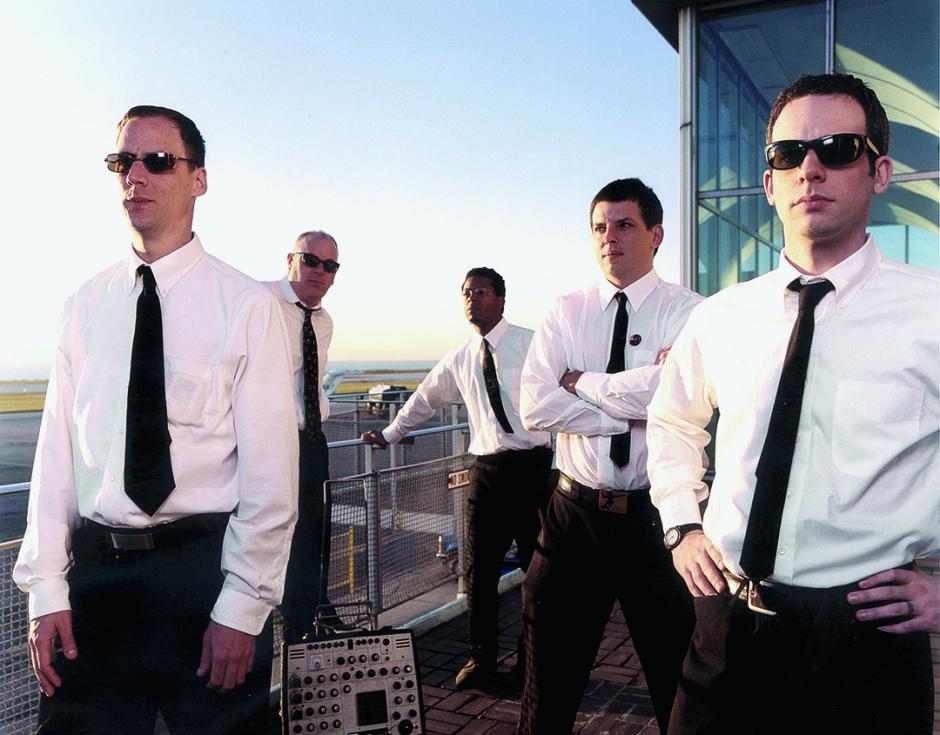
Tortoise, one of just three bands to feature in The Wire’s top 10 releases of 2025.
From the mainstream to the margins, bands were once again in decline in 2025, writes Antonio Poscic
For several years, the supposed death of the band has been cropping up in state-of-the-nation style music discourse. The obvious culprit? Financial hurdles of the sort that even successful bands can no longer overcome. This autumn, Garbage vocalist Shirley Manson launched a diatribe against the unsustainable realities of touring. Meanwhile, UK post-punk four piece Dry Cleaning were forced to postpone their US concerts due to “increasingly hostile economic forces”.
Ignoring the rockist winds that circulate the topic alongside the alleged downfall of guitar music, the cultural decline that band-made music suffered in the mainstream is clear by looking at the 2025 streaming charts. Here, groups are few and far between, relegated to the lower tiers, while higher placed entries are either legacy acts (The Rolling Stones, Coldplay) or K-pop groups.
Around them is a sea of solo projects, across genres from hiphop, to electronic music, to bro country, for which musicians are often motivated to present as cultural icons and social media influencers. Going at it solo, it would seem, is both more profitable and better suited to social currents. However, blaming harsh economic environments alone can obscure the nuances of the situation.
In a 2012 letter announcing the dissolution of his Chicago Tentet, Peter Brötzmann lambasted “the everlasting critical economic situation, actually with no expectation for better times”, musing on how “the financial situation forms and builds sometimes the music”. He closes the announcement with a dejected rhetorical question: “Who can afford to travel with a quintet nowadays?” Surveying the landscape of experimental music 13 years after Brötzmann’s letter, the sobering answer is, not that many. For the 2025 edition of The Hague festival Rewire, one of experimental music’s flagship European festivals, only a fraction of the immense lineup was occupied by bands, even with the definition of the term stretched to its extremes. Further out, the pattern repeats at Utrecht’s Le Guess Who? and Kraków’s Unsound.
Meanwhile, outside the big names (eg Jazzfest Berlin), free jazz and improvisation focused events across Europe are forced to balance their rosters by relying on ad hoc groups. Even avant rock and more audacious metal festivals, such as Roadburn in Tilburg, whose bread and butter are bands, have begun to rely on solo projects.
But, in the same letter, Brötzmann pointed out an overlooked tendency working against experimental bands: the rote and patterns that settle in over time. “Hanging together for such a long time – with just a couple of small changes – automatically brings a lot of routine,” he writes, “for my taste it is better to stop on the peak and look around than gliding down in the mediocre fields of ‘nothing more to say’ bands.” Does the dissolution of the band prompt greater creativity among its ex-members?
If economic challenges brought the band down to its knees, technology gave it a hard kick. Home studio hardware and software, digital workstations and programming languages free artists from the power dynamics and creative restrictions characteristic of bands. Some of the essays in Routledge’s 2024 volume The Ontology Of Music Groups make the case that intra-group relationships can stifle innovation and creativity, and point out that social structures that emerge in a band are often patriarchal in nature, and eventually collapse under the prevailing influence of its most prominent members.
Bedroom pop and black metal led the way, showing the potential for one person, DIY projects to result in a myriad of stylistic permutations, while being conducive to unorthodox experiments and accessible to more marginalised people. Furthermore, the solo practitioner need not pay for prohibitively expensive rehearsal spaces, and much could be achieved even during Covid lockdowns, using the internet as a tool for dissemination. Comparing The Wire’s 2025 Releases of the Year chart with those from 2020, 2015 and 2010 shows the decline in the representation of bands in the latest lists, especially when excluding long-established groups like Stereolab, Tortoise and The Necks.
In theory, the current hyper-local music landscape, shaped by the financial and administrative difficulties associated with touring and encompassing everything from rap micro-scenes in various US cities to sound art communities in Eastern Europe, could present ideal conditions for the formation of bands. But local showcases for up and coming musicians that are open to outfits from the region and beyond, such as Zavod Zavod Za Eksperimentalni Zvuk’s Čuješ?! Drugačije in Zagreb, tend to feature very few.
Much of the music performed on the night of Čuješ?! Drugačije’s 2025 edition fits the ‘this could have been a band’ category – we hear vague avant, prog and post-rock forms meshed with abstract electronics – but the bill shows exclusively solo acts and duos, and is staged in a small and cosy art gallery, not a traditional concert venue. Between sets, the musicians connect and exchange ideas. You can almost sense a network of kindred projects, each of them with its own story, becoming a surrogate for the camaraderie and collectivism found in bands – without any of the compromises?
There is a hint of what a post-band world might look like in the still-emerging fad of cloud rock that, given the current rate of change, might already be over. Amorphous and difficult to define, this variant of alternative rock occupies a hazy dimension between shoegaze, dream pop, post-rock, hiphop and post-internet niches. Artists such as ML Buch, James K, ssaliva and Tom Boogizm’s Rat Heart belong to this particular music, definable through mood rather than style, gesturing broadly towards a rock aesthetic while expanding the vernacular beyond the traditional band.
Reflecting on the success that the likes of Geese and caroline have enjoyed throughout 2025 in their particular niches, it’s obvious that the demand for band music still exists. And if we recognise the millions of Spotify plays attracted by the AI slop of Velvet Sundown as a pilot project, then we can expect the industry to increasingly rely on technofeudalism’s latest force-fed solution for all problems, generative AI, to flood the supply side. In fact, the unscrupulous types found in the tech industry are already hard at work, drafting licensing agreements with the global music brands like Warner, Universal and Sony that would allow them to use generative AI to create all the band music they could ever want while bypassing all the annoying needs of human beings that the form entails.
The music business has never been particularly fair or caring towards artists, but the AI-fuelled divide feels deeper and harsher than ever before. In an optimistic scenario, this moment could mark a turning point, one in which musicians return to bands out of spite, repurposing the basic human connections that exist within a group into acts of revolt. Unmediated by technology, the band becomes a symbol of everything that AI isn’t: creative, messy and human.
You can read more critical reflections on the state of underground music in 2025 in The Wire 503/504. Wire subscribers can also read the issue in our online magazine library.
Leave a comment