“Battered but persisting hope”: Hen Ogledd reviewed
February 2026
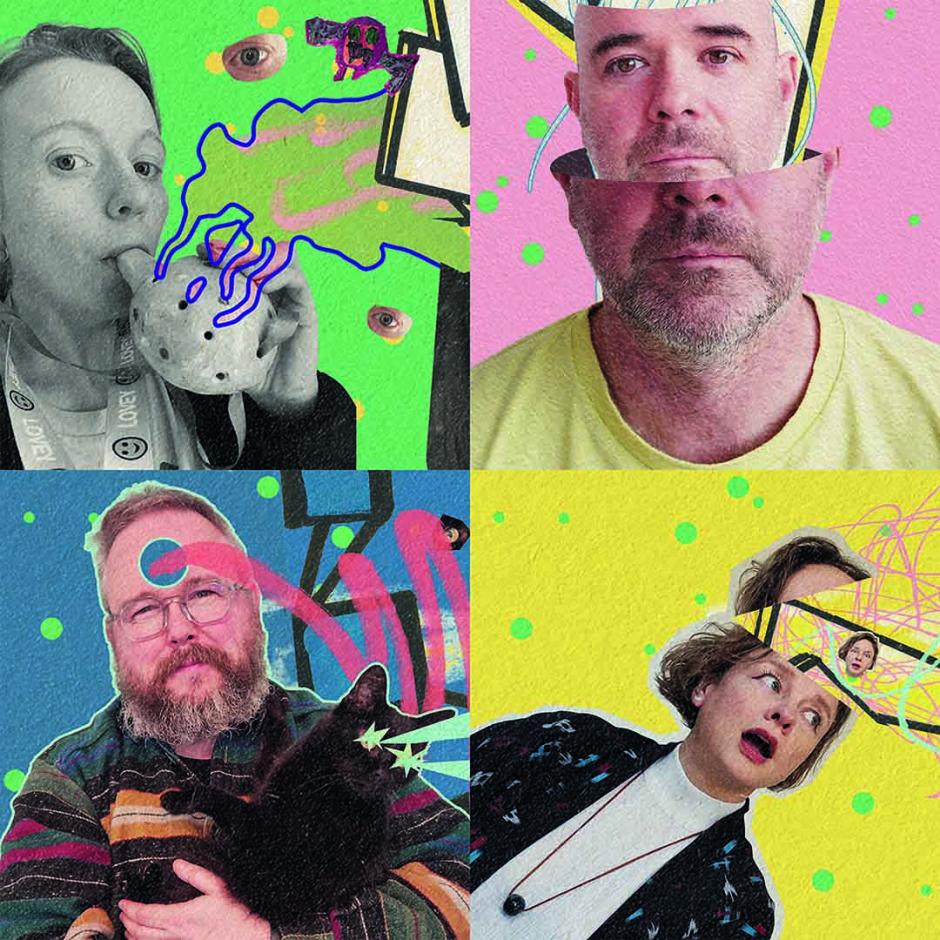
Hen Ogledd. Photo courtesy Hen Ogledd
The latest album from UK ensemble Hen Ogledd is a striking invocation of the mythic and mundane, writes Abi Bliss in The Wire 505
Hen Ogledd
Discombobulated
Domino CD/DL/LP
One of the more unexpected musical evolutions in recent years has been that of Hen Ogledd from the group’s origins as a side project for harpist Rhodri Davies and singer-guitarist Richard Dawson. The knotty, writhing improvisations of the pair’s 2013 album Dawson-Davies: Hen Ogledd were like wrestling a piglet in a barbed wire jacket, but with the addition of multi-instrumentalists Dawn Bothwell and Sally Pilkington, by the time of 2018’s Mogic, Hen Ogledd had become a bold, poppy but still defiantly experimental quartet. With Dawson now on bass, Davies’s electrified strings remained a bubbling, gravelly sonic wellspring around which their musical horizons expanded.
Veering between crisply crafted songs such as “Problem Child” and looser-limbed jams, with lyrics tackling human connection in the digital age, Mogic was inspired but scrappy, as colourfully creative yet jokily deflecting as the appliqué capes each member sported in its videos. If anything, its 2020 sequel Free Humans was too consistent, leaning heavily on neon electropop to tackle the frailties of the heart across a timespan ranging from medieval gossip to future space exploration. But with Discombobulated, Hen Ogledd have grown to fully inhabit their costumes, Sun Ra Arkestra style, with the greatest musical and lyrical realisation yet of their diverse strengths.
Hen Ogledd is Welsh for Old North, and refers to an early medieval region spanning the north of Wales, northern England and southern Scotland. At the fringes of Roman influence and where Brythonic languages – forebears of Welsh, Cornish and Breton – were spoken, the area includes the birthplaces of all four members, highlighting a kinship between parts of the UK often overlooked in Londoncentric narratives. Invoking both the mythic and the mundane, Discombobulated draws upon landscape, folklore, popular dissent and individual struggles, enriched by major contributions from saxophonist Faye MacCalman and trumpeter Nate Wooley, and by passing appearances (ranging from vocal non sequiturs to field recordings) from numerous friends and family members.
After one child recounts a dreamlike vignette of sound-collecting fishermen on opener “Nell’s Prologue”, “Scales Will Fall” raises the protest flag, its call for youth to overturn the institutions of corporate greed delivered in emphatic spoken word by Bothwell, rousingly backed with brassy synth lines, Will Guthrie’s economical yet persuasive drumming and a massed chorus singing “The fire in your soul is only fool’s gold”. The rallying procession is tempered by a melancholy that finds voice in Wooley’s lyrical solo, with a world-weary majesty that wouldn’t be out of place on Super Furry Animals’ downbeat 2000 masterpiece Mwng. Similarly, the Davies-sung “Dead In A Post-Truth World” addresses the far right voices that the BBC’s Newsnight programme is all too fond of platforming – “Mae gamwn ar y teledu/Mae’n amser mynd i’r gwely” (“When gammon is on the TV/It’s time to go to bed”) – its fragmented harmonies, wah-wah harp, twisting sax and fidgeting snares providing a counterpoint of complexity to easy answers.
Elsewhere, the natural world is a place of both wonder and loss. Framed by watery organ chords and what might be a rattling film projector, “Clara” starts with Bothwell’s lilting lullaby of horseriding but stumbles into degraded, polluted landscapes. Davies and his children sing “Land Of The Dead”, a Welsh translation of an enigmatic Dawson lyric in which the veils between nighttime countryside and eldritch realms dissolve more with each verse.
Time itself rejects a linear path in “Amser A Ddengys” (“Time Will Tell”), the line “Dyna oedd ddoe a dyma yw heddiw” (“That was yesterday and this is today”) delivered simultaneously with the song’s other three lines by an a cappella choir of Davies. And in “Clear Pools”, the cycles signify rebirth and renewal, as initial chaos gives way to clean harp chords, MacCalman’s warm, nurturing tones and soft, enveloping textures that wax and wane around the vocals over nearly 20 minutes. But a hot disco can be as transcendent as a cold pond, and the driving “End Of The Rhythm” best encapsulates the album’s mood of battered but persisting hope, trumpet, harp and sax lines all yearning for a better tomorrow as Pilkington celebrates “A dancing, contagion/Releasing, rampaging/Our bodies, in union/Spontaneous, communion”.
This review appears in The Wire 505 along with many other reviews of new and recent records, books, films, festivals and more. To read them all, pick up a copy of the magazine in our online shop. Wire subscribers can also read the issue in our online magazine library.
Leave a comment