Feed me wired things: the gear that made Squarepusher’s debut
June 2021
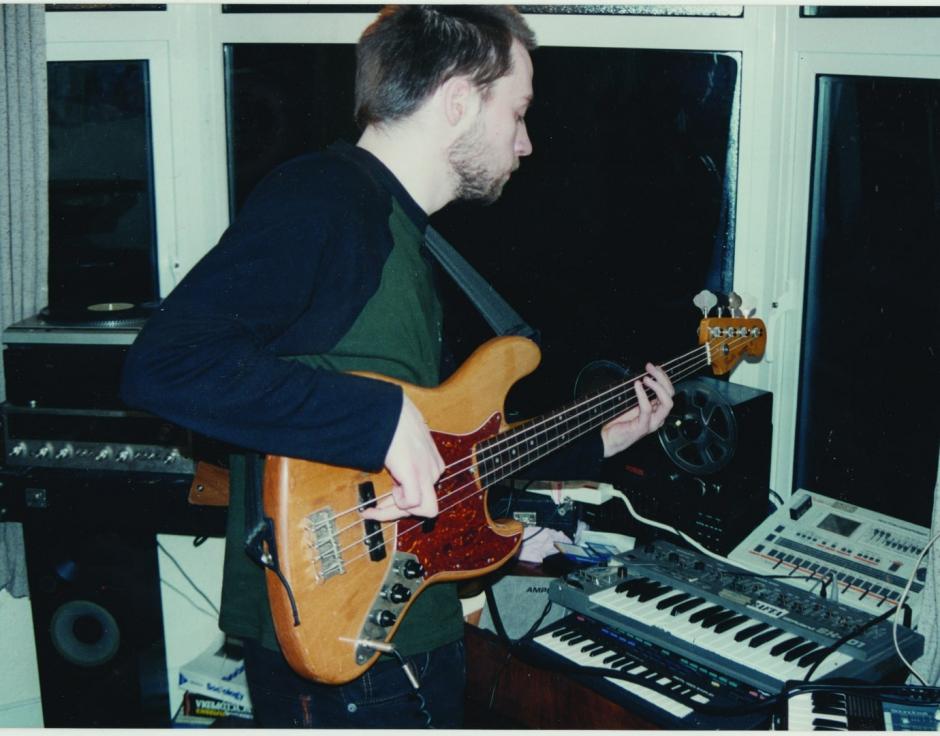
Tom Jenkinson aka Squarepusher circa 1996
As Feed Me Weird Things is released in a 25th anniversary edition, Tom Jenkinson recalls the gadgets that made it tick
Peavey Express 112 guitar amp
I used this on “The Swifty” for its built-in spring reverb, corresponding to the electromechanical ambience common on early dub records. The signal from the amp's headphone output had a fair bit of 50 hertz hum and was a bit too hot but I managed to keep it under control by setting the mixer's input gain at minimum and engaging a high-pass filter, which on a spring works OK as it enhances clarity. It's mostly audible on the percussion, including time-stretched extrapolations of the “Funky Drummer” break and rim shots from a Boss DR-660 drum machine.
Tokai fretless Jazz Bass
Regarding the bass playing on “The Swifty”, I was trying to escape a little from assertive transients and lack of timbral variety, influenced by the textures jazz saxophonists and other wind players got from their instruments. To assist that, I accentuated the mid-range and rolled off some of the low frequencies on the Tokai bass, audible here with a worn fingerboard. It was recorded direct to DAT as I didn't have a multitrack recorder at this time, which meant I had to play the bass part from start to finish in a single take along to the live MIDI playback.
The sound at the beginning of “Windscale 2” is an effect I achieved by rapidly tapping the strings with a plectrum and then processing the result with varying amounts of reverb. Related to this is the cello-like sound, audible initially at 2:29 and heard more or less in isolation at 6:26. This was made by rubbing one of the strings with a 50 pence coin in an attempt to approximate bowing characteristics but with a more abrasive and metallic timbre.
Alesis SR-16 drum machine
One evening in 1994 a pal brought over a newly purchased Alesis SR-16 drum machine. I combined a bar of SR-16 percussion with a Roland SH-101 synth’s bass drum-ish sound and processed the result through an Ibanez CP-9 guitar compressor pedal to make the main breakbeat on “Dimotane CO”. I sampled it on my recently acquired Akai S950 (this was the first piece I made using it) and MIDI-sequenced the break using the SR-16. The drums give way throughout to a Roland TB-303 set against a wall of noise which is actually the SR-16 drum break running through a Frontline guitar distortion pedal. “UFO’s over Leytonstone” uses the same break but pitched down to less than half the tempo.
Roland SH-101 synthesiser
Named after some memorably unpleasant cough medicine, “Dimotane CO” is an early iteration of my obsession with combining noise and breaks. The sound at the beginning is an SH-101, using a fair amount of noise modulation on the VCO pitch. It was about as brutal a sound as I could muster from it at the time, bearing in mind that this track was mixed down with just a Realistic four-channel battery mixer without gain control, EQ or auxiliary sends, thus without the benefit of being able to accentuate given frequency ranges. The SH-101 is also the source of the main melody in “Theme from Ernest Borgnine”.
Roland TB-303 Bass Line
The melody that becomes audible at 0:26 in “UFO’s over Leytonstone” is from a Roland TB-303. Carl Craig probably had it right on the Elements 1989–1990 album sleevenotes when he refers to the Roland “gear that everyone overuses” and that was in 1996. Despite being utterly guilty of that charge, at times I've tried to make the TB-303 produce unexpected sounds. Here portamento slides and the Lydian #2 mode are used in combination with long reverb from a borrowed Zoom 9000 effects unit to generate what I thought of at the time as a ‘doom riff’.
Yamaha VSS-30 sampling keyboard
I found this in a Winchmore Hill branch of Cash Converters. It was obviously a cheap gimmick, but the ADSR envelope and presence of pitch and amplitude modulation intrigued me enough to part with five pounts for it. Various melodic clusters on “Windscale 2”, such as the one audible between 0:47 and 1:09, are time-stretched samples (made on an Akai S950 sampler, using a large time granulation or D-time value) of a melody originally played manually on the VSS-30, using a sample of the Roland SH-101 sawtooth wave as the source.
The Akai S950 was remarkable for how well the anti-aliasing filter worked, which was handy when having to use lower sample rates to cram in more sounds to the tiny amount of memory. But I had an affinity for the crunch of low-grade samples one might hear, for instance, on 80s arcade games. The VSS-30 was useful for reprocessing samples to introduce unpolished quantisation distortion and sample-rate aliasing that is the hallmark of these sounds. Accordingly, I made the “Kodack” break that's initially audible from 2:53 to 3:30 by sampling a Boss DR-660 drum pattern on the VSS-30 to degrade the sound and then resampling on the S950 to allow for MIDI sequencing. The VSS-30 was also the basis of the melodic cluster that is first audible at 0:49, using the technique described above on “Windscale 2”.
Squarepusher's Feed Me Weird Things is reissued in June by Warp. His Inner Sleeve article appears in The Wire 448. Subscribers can read Rob Young's 1996 article “Breakbeat Decedents” via our online archive.
Comments
Wow, how does he remember all these details? I can't remember how i made tracks from 2 years ago, never mind 25 years ago.
Blunderspublik
Leave a comment