“Floats in a distant dreamworld of its own”: vari/ations: Ode To Oram reviewed
November 2025
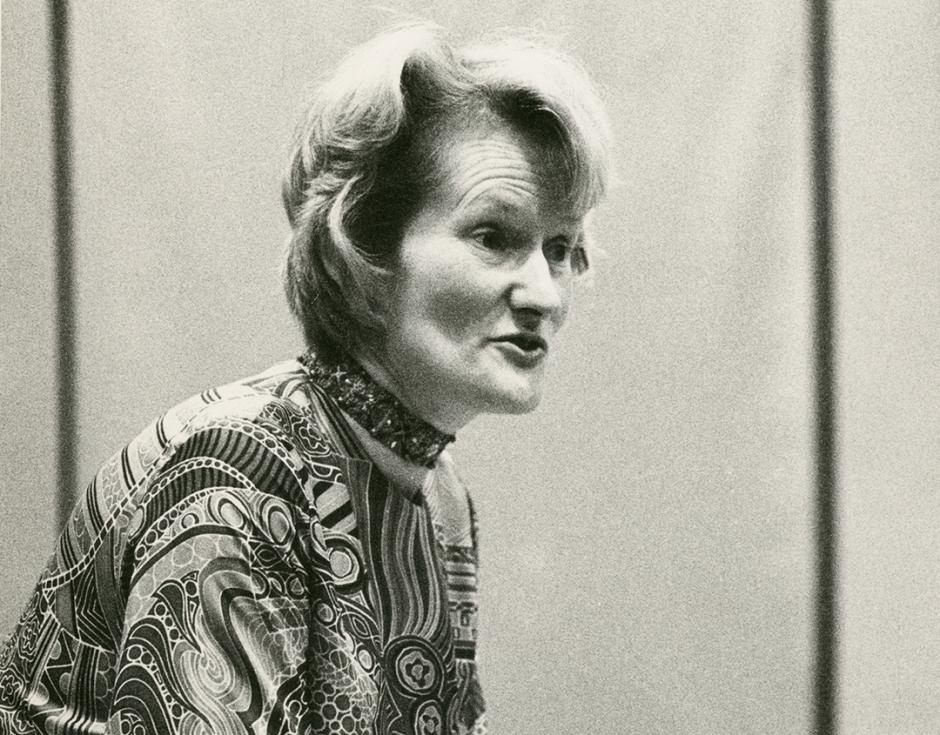
Daphne Oram presenting at East Surrey College, Redhill, 1980. Photo by Keith Harding
Abi Bliss reviews a new project that draws on the sound archive of BBC Radiophonic Workshop co-founder and electronic music pioneer Daphne Oram in The Wire 502
vari/ations: Ode To Oram
Various
(Nonclassical DL/LP)
“The home computer is today a very sophisticated machine, getting better every year,” wrote Daphne Oram in an article published in 1994 in the journal Contemporary Music Review, shortly before suffering the stroke that would bring her remarkable career to an end. “How exciting for women to be present at its birth pangs, ready to help it evolve to maturity in the world of the arts. To evolve as a true and practical instrument for conveying women's inner thoughts, just as the novel did nearly two centuries ago...” Oram had seen the potential of computers to liberate music technology since the 1980s, when she taught herself to code and hoped to adapt Oramics, her groundbreaking optical synthesizer system, for the Acorn Archimedes. Sadly, she didn’t live to see the era when her vision would come true for an ever-increasing number of female producers.
When Oram died aged 77 in 2003, she was remembered chiefly for co-founding and directing the BBC Radiophonic Workshop in 1958, then leaving it the following year, frustrated with shoestring budgets and its low status within the organisation compared with such crucibles of musique concrète as the RTF studios in Paris or Warsaw’s Polish Radio Experimental Studio. Even if no single recording of hers has the level of fame enjoyed today belatedly by Delia Derbyshire's rendering of the Doctor Who theme, every year brings greater appreciation of her work and influence.
The 2007 compilation Oramics and 2011’s The Oram Tapes put her music back into circulation, from compositions such as 1965's Pulse Persephone, to sound design that enhanced films (The Innocents, Dr No) and advertised everything from Lego toy bricks to washing machines. Her unperformed work Still Point, which combined an orchestra, turntables and electronic manipulation back in 1949, was finally (fully) realised at the 2018 Proms in London. Documentaries and theatre told her story; buildings have been named in her honour, while her post-BBC base at Tower Folly in Kent is recognised as the first electronic music studio founded by a woman.
Notably, Oram's archives were saved from disposal by her friend Hugh Davies and are now preserved by the Daphne Oram Trust at Goldsmiths, University of London. To mark the 2025 centenary of her birth, the Trust, together with the Oram Awards set up to celebrate and develop those same female and gender-diverse artists whose use of technology vindicates her prediction, commissioned this album, whose ten pieces use a sample pack drawn from tapes spanning 1956-1974.
This isn’t the first time that Oram’s sound collection has inspired collaborations beyond the grave. Taking its title from one of Oram's earliest radiophonic pieces, Andrea Parker and Daz Quayle's excellent 2011 album Private Dreams And Public Nightmares braved the eerier corners of her sonic archive, while 2014’s Sound Houses by Walls was an agreeable, if less successful attempt to merge the Anglo-Italian duo’s sensibilities with Oram's own. Where vari/ations: Ode To Oram distinguishes itself is in engaging with how the wider picture of her life interwove with her sonic achievements. Of course, much of the inner world of this famously independent composer is now lost to time. While also referencing the formative moment when a medium told the teenage Oram that she would excel in music, “Séance”, by xname aka London based Milanese producer Eleonora Oreggia, acknowledges this: veiled fragments of Oram's speech emerge between bursts of Oramic engine: Daphne Oram presenting at East Surrey College, Redhill, 1980 static, wispy sine tones and bubbling pops of melody then slip tantalisingly away.
For all the variety among the contributing artists, the shared sample pack means that sounds and motifs bind the album together with a pleasingly psychedelic quality, heightened by a recurring quote from Oram about music that “floats in a distant dreamworld of its own". As well as both featuring a contentedly purring cat, Cosey Fanni Tutti’s “Tributum” and Nwando Ebizie’s “The Art Of Living” both evoke a flowering creative consciousness, the former as loops and rhythms emerge from a cavern of filtered bells and slithering textures; the latter as the cat’s rumbles agitate flurries and specks of sound into a luminescent haze. By contrast, producer/DJs TAAHLIAH and Deena Abdelwahed make their respective “Gosamour” and “Eidolon” tough for the dancefloor yet still alive with intricate sonic details.
Elsewhere Tower Folly looms large, both as home to the composer’s Oramics explorations and symbol of how her commercial work co-existed with more esoteric ideas, folly to some, but visionary to others. Setting an emotive, multilayered cello solo and wordless vocals against jittery, sped-up samples, afromerm and abi asisa’s “1966 Interrupted" references the year when Oram’s apparent mental breakdown severed her working relationship with Graham Wrench, a valuable engineer for the mercurial machine. Meanwhile Lola de la Mata’s arresting “Folly Folly Folly” starts as prosaic waveform lesson Oram enunciating “sine wave”, “sawtooth”, “square wave”, and so on then takes flight as a soprano choir chants the title into a space both intimidating and unfettered.
Ultimately, Oramics became not just a means of sculpting sound, but a philosophy. As Oram's 1972 manifesto An Individual Note Of Music, Sound And Electronics outlined, to her, music could become (as Albert Ayler put it) the healing force of the universe. Whether her beliefs would endure in today’s age of 432 hertz obsessed YouTubers is a question for another time, but as layered frequencies sing an ambient elegy through the ether on Marta Salogni’s closing track “An Individual Note”, this rewarding compilation suggests that there is still plenty more to learn.
This review appears in The Wire 502 along with many other reviews of new and recent records, books, films, festivals and more. To read them all, pick up a copy of the magazine in our online shop. Wire subscribers can also read the issue in our online magazine library.
Leave a comment