Chasing Rainbows: David Toop on the early films of Jeremy Marre
April 2020
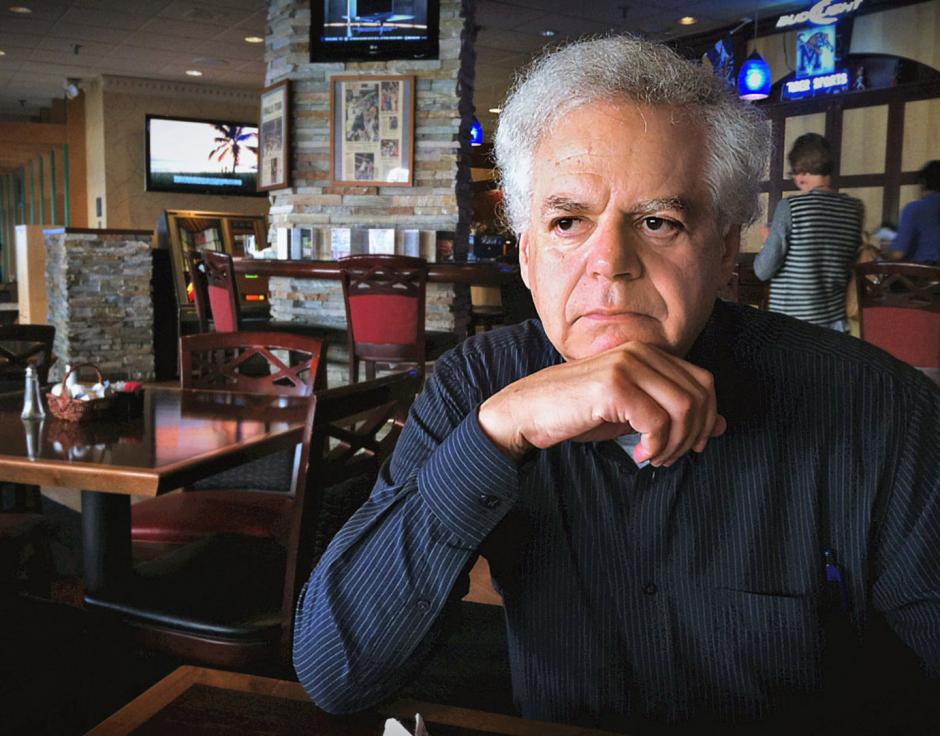
Jeremy Marre. Photo by Andrew Dunn
“Really it begins with instinct.” David Toop traces how the documentary film maker got unheard musics from around the world onto mainstream TV
The majority of 21st century music documentaries can be separated into three distinct categories: bloated Netflix hagiographies, weak doses of demographically targeted nostalgia, and in the shadows, overdue celebrations of obscure or semi-forgotten musicians, composers and scenes, the latter category destined for film festival audiences (if they are lucky), and if they are unlucky, hidden behind a Vimeo password until the end of time.
It would be educational to hear the robust opinions of film maker Jeremy Marre on this state of affairs. Sadly he died on 15 March, aged 76, after a long and illustrious career in which he redefined the idea of what kind of music was worthy of documentary treatment. Central to his method was listening: what did the music sound like and what was its atmosphere and place, what did musicians have to say about their own work and what did a style of music have to say about its own situation within a community, a society, a political reality? His own manifesto was laid out in Beats Of The Heart, the book he wrote in collaboration with Hannah Charlton in 1985: “I wanted to escape from the awful television categories which treat music as high art, folklore or consumer pop. I wished, instead, to show the street musics – the beats of the heart – that truly mirror the mixes and changes inherent in every society. There is no such thing as a nationally ‘pure’ music. As we attempted to show, the music of one culture has always been subject to influences from many others, as well as to developments within its own. Like the rest of life, music is in a perpetual process of change.”
If that sounds somewhat dry and earnest, the films were anything but. “Really it begins with instinct,” he told Sean O’ Hagen at NME in 1985, “hearing a great salsa record and thinking: Yea! That would make a great film – instinct is really important.” This love of music comes across either in a rush of excitement or as a fascination with the convolutions through which music finds its way to an audience. For the former, watch the opening moments of Roots Rock Reggae, in which that manifesto comes alive without any need for words – Bob Marley on stage intercut with scenes of poverty and urban decay on the streets of Kingston. Maybe that strikes us as cliched now but the film was made in 1977, when such thinking was relatively new to mainstream television. As for the process of music, watch Jack Ruby in the same film, silently sitting in judgement on the youths who audition for him in the open air, their desperation masked by the desire to ingratiate. Or in Konkombé: The Nigerian Pop Music Scene, feel yourself plunged into an overheated Ibadan studio as The Lijadu Sisters struggle to cope with too little time, a broken air conditioner and the bigger problems of being women in a predominantly male industry.
Although grouped now under the general heading of Beats Of The Heart, these two films were originally shown as self-contained documentaries on various channels. Every so often one would show up in the schedules – an exhilarating film on salsa featuring Celia Cruz or in Brazil, Gilberto Gil and Umbanda spirit ceremonies. I was captivated by all of them and in 1982 interviewed Marre for Collusion magazine. He turned out to be amusingly indiscreet, pragmatic as all film makers must be and totally committed to his vision of music as a profoundly social art. As an example, I challenged him on the absence of Cuban music in the salsa film. He explained that he had been to Prague to speak with the head of the Cuban Film Institute who told him that Cuba was out of the question and even if permission were granted, the final film couldn’t include New York salsa. “That ruled them out really,” was Marre’s response, “because you just can’t be dictated to.”
As a footnote to the Collusion interview I wrote that the Fourth Channel (launched later that year as Channel 4) would be showing all the existing documentaries, along with seven newly commissioned films. In the end there were 14 of these Beats Of The Heart: China, South Africa, the Appalachian Mountains, the Texas-Mexican Borderlands, the marijuana regions of Colombia, Thailand, Japan, Nigeria, Jamaica, Brazil, salsa from New York and Puerto Rico, Indian film music and a two-part film tracing the Romany trail of gypsy music through Egypt, Spain, Rajasthan, Yugoslavia, Hungary and Germany.
Not long after the interview was published, Marre approached me to discuss a collaboration, a new series that would attempt to understand global music through broad categories such as animals, work, love, crime, learning, sport, war and ritual. After working up a treatment for each film we presented this to Andy Park, newly appointed commissioning editor for music at Channel 4. Fine, he said, but no more of this global music. What he wanted to see was English music subjected to the same anthropological scrutiny. So it was we found ourselves working on Chasing Rainbows, a seven-part series shot in working men’s clubs in Newcastle and Barnsley, northern soul all-nighters, Bhangra all-dayers, a Wild West week at Pontins and in the homes of Bert Weedon, Tommy Trinder and The Nolan Sisters.
During the course of the production I introduced Marre to Derek Bailey, thinking that Bailey could give us an unusual way in to the subject of postwar entertainment, particularly the shadowy milieu of dance halls. Marre took to Bailey and went on to direct On The Edge, a four-part series on improvisation for Channel 4, narrated by Bailey. Nobody, before or since, has had the courage or tenacity to take on such difficult, amorphous subjects and successfully sell them to major television networks. Survival for an independent documentary film maker is not just about ideas, research and exotic travel. Money has to be raised, over and over again.
Marre’s Harcourt Films succeeded in doing so for more than four decades. Immediately after Chasing Rainbows he made Ourselves And Other Animals with Gerald Durrell, followed by films on the nature of music, ancestor spirit ceremonies in Madagascar, the Aryan Brotherhood, Latin Music USA, and profiles of Count Basie, Big Bill Broonzy, Roy Orbison, Youssou N’Dour, Otis Redding, Jay Z, Marvin Gaye, Carlos Santana, Otis Redding and James Brown. Once he told me a story about staying in a cheap motel somewhere in America, inadvertently hearing through the thin wall two men talking about a murder and thinking about ways to turn this scene into a film. For him, dramatic fiction was always present within the factual premise of the documentary. This tension between what is real in the world and what illuminates that reality from the fictive, imaginative power of music gave intensity and vibrancy to his storytelling. His later films may appear to be more conventional exercises but perhaps that’s because in his early work he had so thoroughly challenged our notions of what a music documentary should be.
Jeremy Marre (7 October 1943–15 March 2020)
Comments
Thank you for this wonderful tribute. Seeing Beats Of The Heart on C4 in the 80s changed my life. On The Edge is wonderful and revelatory too. Modern TV just got even worse.
I like this David sorry he's left us
Katie O'Looney
A valuable part of history that could be too easily lost – thank you for writing this. I'll search out these films.
Leave a comment