Process of Time
January 2026
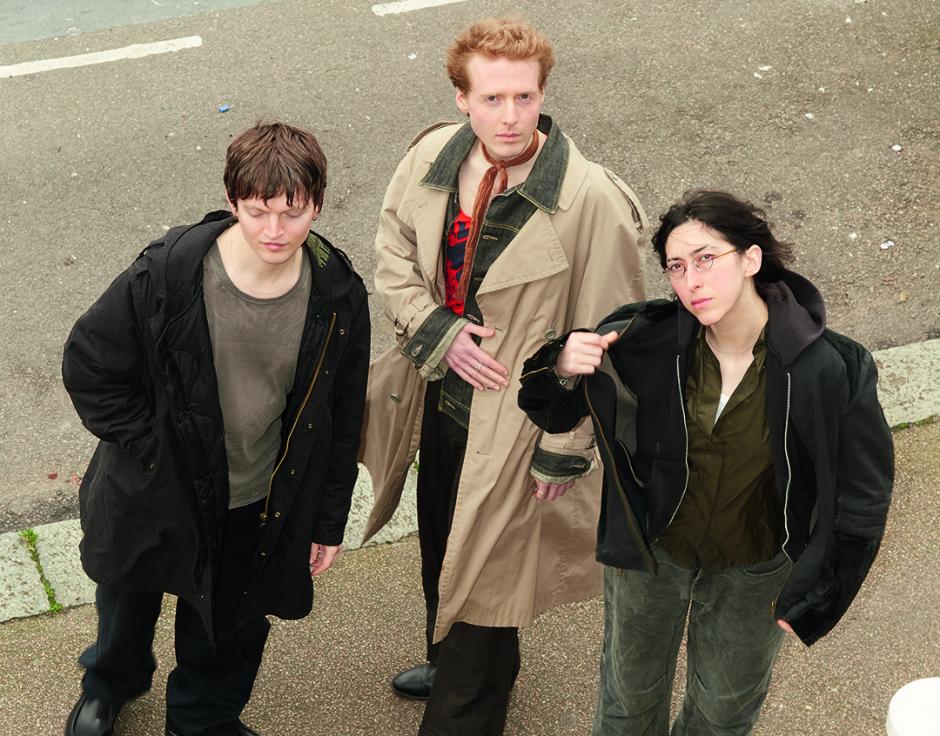
Still House Plants. Photo by Amy Gwatkin
To make sense of ongoing tech revolutions, a new generation of musicians is making music that metabolises electronic processes through analogue forms, argues Ryan Meehan
The progressive music scene turns to the future in a foul mood. It was detectable in the air last October, as the audience gathered for the first of the evening’s two sold out Autechre shows at Brooklyn Steel in north Williamsburg. Here, in the omphalos of the newly-minted Commie Corridor was a display of cultural force every bit as robust as the political one which had recently vaulted socialist Zohran Mamdani to the Democratic nomination (and, in short order, the mayoralty). So why, then, as the Rochdale duo took the stage in their preferred semi-darkness, was the atmosphere cut with an unmistakable current of dread? Perhaps it was the uneasy stagecraft of the Gaza truce, still fresh, or the unreconstructed decorum of post-pandemic concertgoers unable to handle their doses (and sometimes their bodily functions). Perhaps it was a suggestion hardwired into the music itself that, outside these walls, there was a vision of the future taking hold (remember the Artificial Intelligence series?) for which we weren’t entirely prepared.
Futurists though they remain, the future Autechre first portended is now largely history. Cloned sheep, Clippy the Microsoft assistant, and the like. Their vanguardist rhythms, swinging like sonic battering rams in 4-D, recede into the foundations of the world to come. Instead, as we attain the quarter century, artists are staking out a vital new position within the looming crisis of the digital as it develops in the here and now.
This tendency takes for granted the dynamic and space-bending possibilities of electronic composition, and accepts them not as grounds for abandoning the field, but as a sporting challenge to their own analogue rhythms. At a time when complex computers and their pitchmen lay claim to as much of communicative life as they can, this metabolic tendency in music emerges as one possible response – not theoretical, but organic; not doctrinaire, but instinctively oppositional. If the metabolic coheres as a specific answer, perhaps it’s to the question as to why the world has got so weird lately, and what of that weirdness plays back to us in our music.
Weirdness, of course, can be a source of delight. In 2025, few bands were as weirdly delightful onstage as Fievel Is Glauque, the jazz-pop ensemble shifting around the duo of American keyboardist Zach Philips and Belgian vocalist Ma Clément.
The rare progressive band whose precision feels spontaneous and vice versa, FIG’s baroque, fleetfooted compositions hit like bursts of sunshine in a funhouse mirror. Core to their sound is a downright algebraic approach to rhythm, massaged across the instrumentation generally, though special plaudits go to recurring bassist Logan Kane and many-handed drummer Gaspard Sicx.
Another provisional quality of metabolism: though its freneticism can seem to dialogue with digitality, the music itself is produced primarily by hand. This isn’t mainly a declaration of Luddism (though maybe it is also that) so much as a reclamation of terrain by enfleshed bodies in the production of what makes those bodies move. Nor is it an aesthetic of purity. Fievel’s last album, Rong Weicknes (2024), was recorded “live in triplicate”, its final tracks spliced together from overlapping takes à la Teo Macero. That the band commits to re-confecting this sound live (and live previews of new material place their upcoming album high among the most anticipated of 2026) emphasises a concern with human, rather than machine potential. With the serene bounce of a surrealist tour guide, Clément sings faster than you can think, her poetry the kind a computer could only spit out by mistake.
In metabolic songcraft, the glitch, long a point of fascination in digital aesthetics, migrates to a motif of human breakdown under the pressures of the mediated grid.
On the left, attention has turned increasingly to passages in Marx regarding capital’s potential to develop beyond the resource capacities of earth – what proponents of degrowth call the metabolic rift. In the last decade, art’s attempts to encompass climate change as a subject have found themselves stranded – often frustratingly so – in the passive, the local, and the melancholically topical. A crop of new artists on London’s AD 93 label has obvious recent antecedents – the fetid Zappa splatter of Geordie Greep’s projects, the high watermarks of Tom Skinner’s influence within The Smile – but at its most caustic, this pod-born sound suggests an aesthetic rift to measure up to the deep-tissue wrenching of the planetary one underway.
Brooklyn band YHWH Nailgun is the label’s latest rising star, porting their youthful current into sludgy contortions that bring to mind images of ceremonial emetics. And while their mixture of propulsive rhythms (courtesy of the reabsorbed kitsch of Sam Pickard’s rototoms) and effects-bent melodies recall Braxton-era Battles to this elder millennial ear, that band’s use of digital instruments had the flavour of liberation. The Nailgun, by contrast, sound penned in – all but strangled by the imminent cyborg dawn.
For my money, though, the most promising of this corridor of metabolists are Still House Plants, whose incantatory vocal lines and decaying guitar riffs tilt just off-axis over beats whose cracked precision would sound looped if you couldn’t see David Kennedy playing them up close and personal.
Irregular tempos and faltering structures seemed designed in advance to resist algorithmic training. As climate politics endures historic setbacks in the West, nascent popular outrage at the AI data centre boom’s resource intensity (alongside outcries against music’s unique role within the data regime) may provide a previously listless creative counterforce with a potent new metaphor for attack.
Some warriors in this emergent battle are happier than others. A founder of Darkside, one of metabolism’s most direct precursors, guitarist Dave Harrington applies the intricate compositional style he first refined beside Nicolas Jaar’s minimal post-dub atmospherics to his second band’s cheekily analogue arrangement.
Taper’s Choice styles itself as a supergroup (just about all of its elements of style are overtly over-styled) looking to supercharge the high-participation jam scene from its progressive fringe. Last year, the ensemble – which includes Real Estate bassist Alex Bleeker, Arc Iris keyboardist Zach Tenorio Miller, and Vampire Weekend drummer Chris Tomson – released their first proper studio album, after a compilation of songs (‘concrèted’, one imagines, in a method not dissimilar to Fievel’s) and a string of – what else? – live tapes. A mixture of balloon bounce and rapid-eye flutter, Prog Hat holds an affinity for the gentle dislocation of 70s jazz fusion. Is it a stretch to compare its supple geometry and bold colour to that other, utopian metabolism, of Tange and Kurokawa? Harrington conducts the marathon-like “Dave Test” with an eye for microstructure, all thrashed into shape by Tomson’s relentless stamina. If Taper’s swings, it’s at a rate your feet must first calculate to catch up to.
Which returns us to Autechre, and the ambiguous future of the human-technology interface, in which music is both figure and ground. A surging appetite for vanguardist rhythms perhaps only awaits the breaking of a figurative dam, the blowing of a metaphorical pipeline, that the metabolic turn can provide. For this generation, it may be that the pessimism of the intellect is a precondition for a renewal of the optimism of the will. Time and again, where democracy elevates a new political regime, its success can depend on the rise of a cultural one in tandem. Will metabolism play such a role? Predictions are a parlour game, but those that clamour for shibboleths of a “left with no future” will at the very least have to dance to the reality shifting beneath our feet, and contend with the eternal truth of Michael Crichton’s Jurassic Park – that life finds a way.
You can read more critical reflections on underground music going into 2026 in The Wire 503/504. Wire subscribers can also read the issue in our online magazine library.
Leave a comment