Style Counsel
December 2025
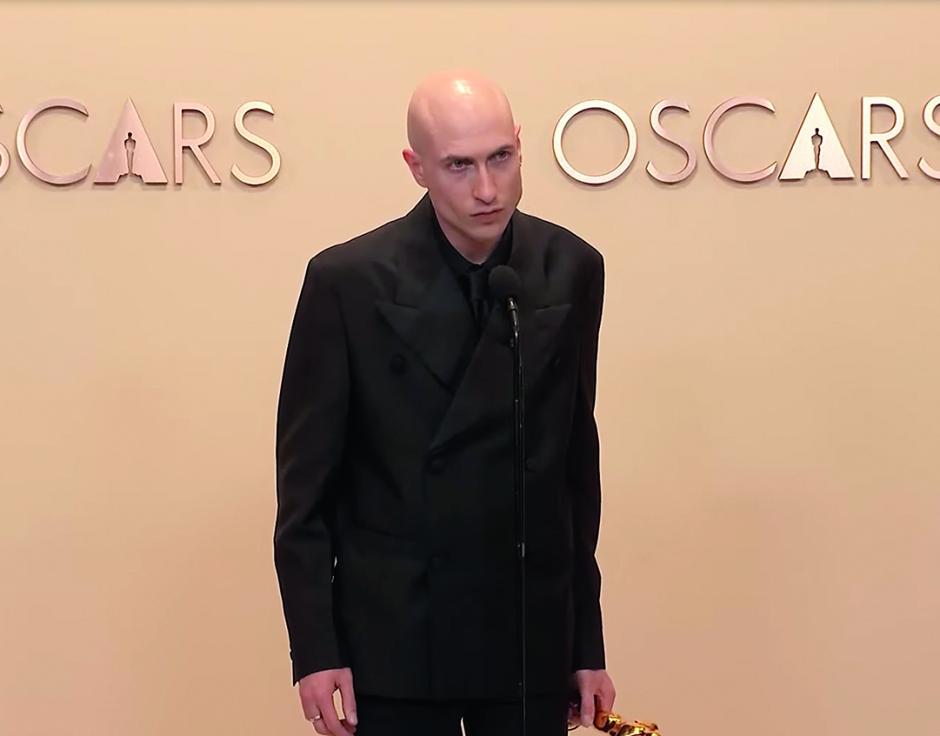
Daniel Blumberg at the Oscars, March 2025
In The Wire 503/504, Lucy Thraves argues that luxury labels and conglomerates are keen to purchase some avant garde glory, but at a cost to experimental music and the ecosystem that supports it
In March 2025, the UK experimental music scene was pleasantly surprised when London venue Cafe Oto got a mention at the Oscars. Daniel Blumberg, who won an Oscar for the score for The Brutalist, used his acceptance speech to pay tribute to the East London venue and its community of “hard working, radical musicians, who’ve been making uncompromising music for many years” (the soundtrack features the likes of Seymour Wright, Evan Parker and Steve Noble). Six months later, the composer walked the runway for designer label Miu Miu, prompting fashion magazine A2Z to praise him for “[infusing] the runway with introspection and avant garde energy”.
Whatever avant garde energy is, high fashion wants it. The last few years have seen a growing number of designer brands working with experimental music or musicians. In 2022, radio platform NTS partnered with designer denim brand Diesel to launch TRACKS, a series of parties, events and discussions that would allow Diesel to harness NTS’s community-making infrastructure and leftfield musical nous. In April this year, Berlin label Pan, who have released the likes of Beatrice Dillon, Iggor Cavalera and Slikback, teamed up with Nike – a company recently valued at $31 billion – to launch a new trainer. Cellist Oliver Coates and former Wire cover star Arca scored a Dior show in 2022. Another former Wire cover star, Dean Blunt, soundtracked Burberry’s 2024 show.
Obviously fashion and pop music go hand in hand, enjoying a nearly symbiotic relationship as cultural expressions. But a burgeoning relationship between high fashion and experimental music is troubling, most obviously because the economic and social forces underpinning the two are so drastically imbalanced. What could multibillion dollar companies possibly want with precarious, awkward, typically anti-capitalist music cultures? Unless it’s… precisely those qualities.
High fashion understands that ‘avant garde energy’, which we presumably should understand to mean a combination of cool, authentic and novel, is born from an ethics of anti-commercialism and political integrity. In creative scenes more broadly, artists’ ability to protest, propose counter ideologies and offer ways of thinking and being outside of the dominant culture is always in tension with the economic demands of their self-reproduction, meaning that pockets of radical culture are increasingly hard won, and appear increasingly rare in their commitment to independence and integrity.
Naturally, a company that exists to sell wildly expensive shoes, coats or bags cannot truly claim such integrity for itself, but that doesn’t stop it from trying. As part of capitalism’s ever intensifying search for new ways to sell and people to sell to, the marketeers of luxury are attempting to metabolise dwindling scenes of real creativity in their pursuit of the niche and cutting edge – without contributing anything meaningful to the landscapes that give rise to these cultures in the first place.
Some might argue that commercial partnerships of any kind work by bestowing exposure on the scenes they exploit. But is this true? Shortly after the Oscars mention, a Cafe Oto staff member mentioned to a Wire colleague that the rush of exposure had done nothing for ticket sales: it’s not obvious that interest translates into material gains. Nor is it obvious that any resulting engagement would be useful. If the people buying the Pan x Nike trainer are turned on to the label’s output, will they come to that culture with an attitude that goes beyond acquiring a certain musical taste in the same way that you might acquire a new coat? This is not to denigrate the buyers themselves, but to criticise the ways that capitalism forces us to behave, turning us not into listeners, but into consumers.
By accepting these parasitic partnerships, radical cultures risk letting themselves get caught up in a logic of elitism: luxury taste for luxury clothes. And as the desire for luxury creeps further into the domain of ordinary life via social media campaigns and endorsements by supposedly relatable celebrities and influencers, it’s not hard to see how the avant garde could be co-opted to support the toxic ideology at the heart of high fashion: that an individual’s expensive taste and purchasing power makes them better than everyone else.
However it chooses to present itself, high fashion peddles commodity fetishism, while experimentalism peddles the opposite, producing nothing easily captured, understood, replicated or marketed. It relies on engaged and passionate people working together in spite of economic and social conditions that are often hostile to their own reproduction. So it may look and feel good when it gets to strut down the catwalk – but it should keep in mind what it stands to lose.
This essay appears in The Wire 503/504 along with many more critical reflections on 2025. To read them, pick up a copy of the magazine in our online shop. Wire subscribers can also read the issue in our online magazine library.
Leave a comment