Time out of Joint
December 2025
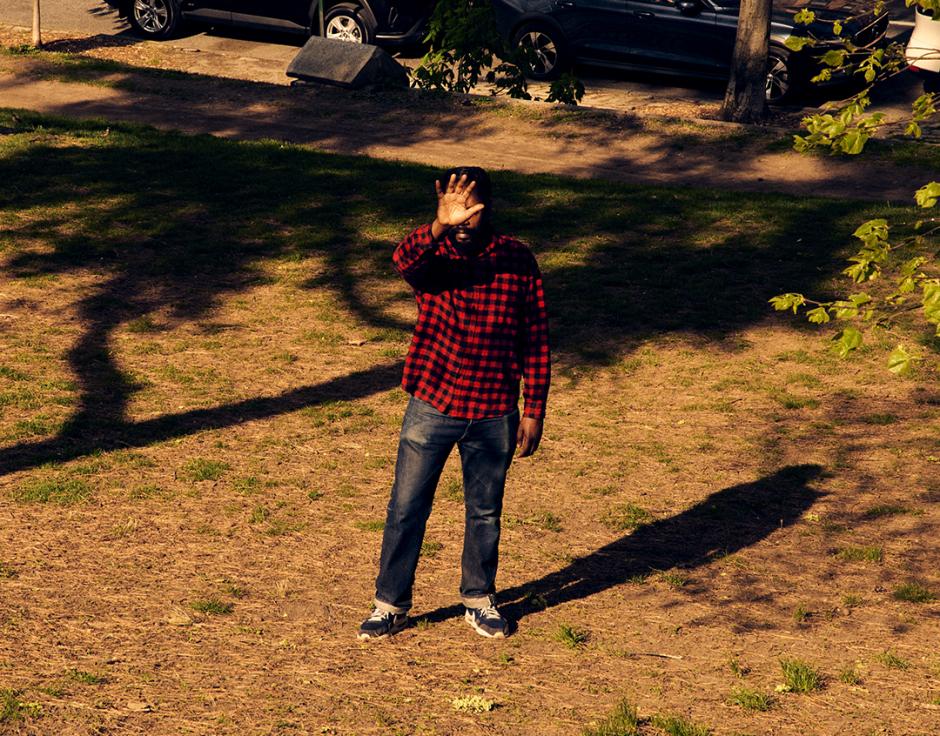
billy woods. Photo by Matt Genovese
Traditional instruments, folk cultures and mythic ideas of futurity offer slip roads exiting AI’s highway to a hollow future, argues Daryl Worthington in The Wire 503/504
“This system will take your ancestral traditions and twist ’em indigenous”, raps billy woods on “Make No Mistake” from Golliwog. Raising questions about where the boundaries of tradition are drawn, that line seems to get longer through repeat listens.
Time doesn’t move sequentially on Golliwog. The record opens with a back-spinning sample, swiftly followed by an incessant tick-tock. The tracks feel time-dilated, with warm soul, jazz and R&B instrumentation hitting disturbed beats as woods seemingly folds eras into each other. Across the album, deep histories of colonialism are meshed with their contemporary ramifications. Meanwhile, gruesome and supernatural imagery shares ground with 1990s horrorcore groups such as Geto Boys or Gravediggaz, but with woods the gap between allegory and reality is less clearly demarcated, reinforcing the sense that he is threading linkages forwards and back through history.
The nonlinear temporalities Golliwog inhabits resonate with other corners of underground music in 2025. Refugees Of The Symbolic Network by Egypt born, London based artist Cerpintxt takes works by Arabic poets – Palestinian Izz al-Din Manasirah and Assyrian Iraqi Sargon Boulus – and deconstructs them through effects and cut-up techniques. A small ensemble improvise through the distorted texts, all broadcast through a simulation of the reverb in the King’s Chamber of the Giza pyramid. Cerpintxt’s music evokes a garbled lament linking past to present against systems that exclude.
Where Cerpintxt and woods make era-spanning palimpsests mapping oppressive systems, others have found euphoric possibilities when the past leaks into the present. Many of the songs on Beirut based sextet SANAM’s Sametou Sawtan see vocalist Sandy Chamoun borrow texts, including two from 12th century Iranian poet and mathematician Omar Khayyam. They are sung over radiant music propelled by guitars, synths, buzuq and drums. Like woods and Cerpintxt, SANAM’s music sits far outside the recycled aesthetics of folk revivalism.
On the Chinabot album 〽 Japanese producer KASAI builds from the tradition of minyo. He writes songs that celebrate his day jobs – care worker and garbage collector – and criticise financial capitalism’s failings. Influenced by singeli and awa odori dance troupe Kokesaku, the album’s jubilantly off-kilter production reinforces KASAI’s handling of minyo as ongoing rather than timestamped.
All these artists’ works are more nuanced than simply updating old idioms or adding a folky veneer to new ones. They don’t separate traditional and contemporary, instead stressing that tradition doesn’t mean relics, but continuities where the present co-exists with the past.
Rasheedah Phillips’s 2025 book Dismantling The Master’s Clock dissects “western temporal norms which privilege progress and futurity”, arguing these were a tool of European colonialism. For Phillips, founder of the interdisciplinary practice Black Quantum Futurism with Camae Ayewa/Moor Mother, the arrow of time that can’t reverse course “locks us into the present”.
By exploring conceptions of space-time in African societies and quantum physics, Phillips shows that less rigid, nonlinear understandings of time exist, and can be emancipatory. Her focus is on Black communities and the specific oppression they face under current regimes. But Phillips offers a guide to think more broadly beyond linear history.
Binarising traditional and contemporary perpetuates a linear idea of time marching along a single line of progress. Contemporary music utilising older instruments or idioms isn’t new or unusual, and when it’s anachronistic it only reinforces the idea of a linear history. Cerpintxt, KASAI, SANAM and woods don’t deal in anachronisms but continuums – they signal the ongoing evolution of traditions as opposed to ruptures, a present evolving from the past rather than then and now as discreet entities.
Nonlinear timelines are reflected in Brìghde Chaimbeul’s Sunwise. Her music’s focus is the Highland small pipes. Close your eyes, and the blankets of luminous drones and repeating melodic phrases almost evoke pads and arpeggiators in synth music. Chaimbeul brings the lineage she’s working with into a wider dialogue, showing it’s more than a local anomaly. It’s both a precursor and contemporary to the stories of minimalism and drone.
Elsewhere, Sheffield based Emergence Collective deploy an array of early music instruments. Their minimalist, pattern based music is built from an improvisation practice that strives to be accessible by bypassing virtuosity and learnt repertoires. Their music exists within multiple traditions, but there’s a sense they’re striving to democratise the means of production. The result on Swimming In The Early Hours is a constantly evolving music that breaks the notion that traditional means unchanging.
Similarly forward-facing temporal distortions occur in Weston Olencki’s Broadsides. One of the most startling sees banjo fed through machine learning algorithms, extending bluegrass standards out into mesmerizing permutating patterns. As Olencki explained in The Wire 500, they’re trying to break the banjo free from the colonialist histories embedded in it “to see if there’s a futurism to this thing”.
At a moment when we’re facing the AI revolution, music that destabilises ideas of linear progress provides a useful counter. These artists are far from retreating from the present, but their work makes the future look a lot less straightforward. Instead of single lanes hurtling towards a fixed horizon they present roundabouts with multiple exits. At a time when progress points to AI slop, music that complicates forward motion is vital.
This essay appears in The Wire 503/504 along with many more critical reflections on 2025. To read them, pick up a copy of the magazine in our online shop. Wire subscribers can also read the issue in our online magazine library.
Leave a comment