Can we float in the air? An interview with EAT’s Julie Martin
December 2021
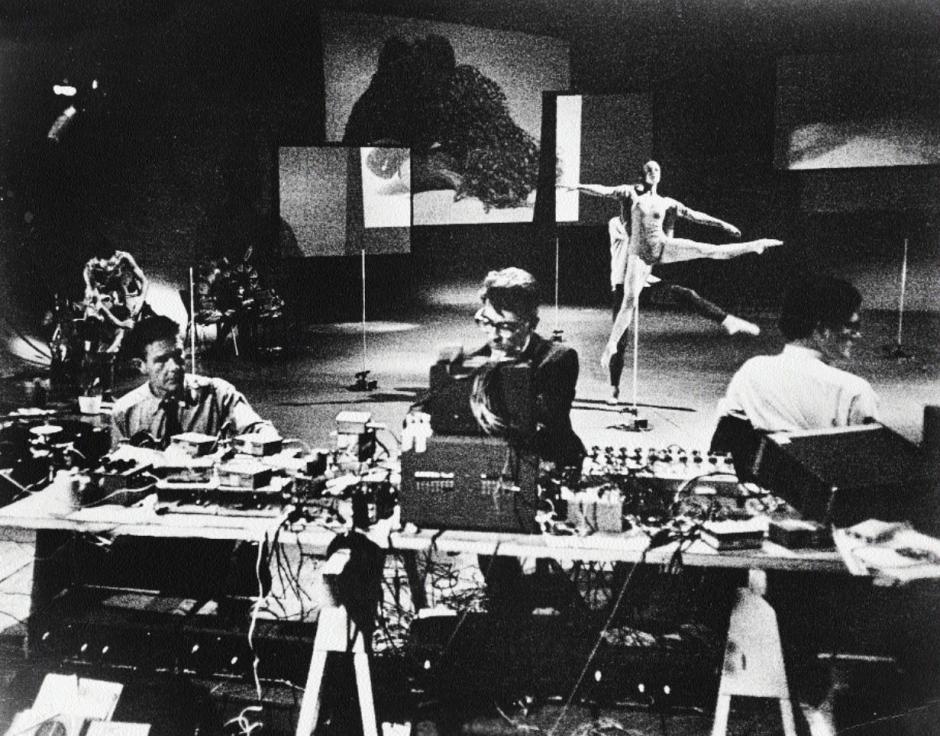
John Cage (bottom left), David Tudor (bottom middle) and Gordon Mumma (bottom right) performing Cage’s Variations V with the Merce Cunningham Dance Company
Robert Barry looks back at the work of Experiments in Art and Technology from art pavilions to discos with its veteran director
From 13–23 October 1966, the 69th Regiment Armory building in Manhattan was host to one of the most ambitious events in the history of modern art. 9 Evenings: Theatre And Engineering brought together artists and composers including John Cage, David Tudor, Yvonne Rainer, Robert Rauschenberg and Lucinda Childs, with engineers from Bell Labs such as Billy Klüver, Max Mathews and Fred Waldhauer. Over the course of its run, over 13,000 people attended and several now familiar technologies were employed for the first time in the course of the performances, including closed circuit television, fibre optic cameras, and portable wireless FM transmitters.
The collaboration of several key players continued under the banner of a new organisation called Experiments in Art and Technology, dedicated to bringing artists and engineers together. Julie Martin worked behind the scenes at 9 Evenings and later became one of EAT’s first employees, initially as the editor of the newsletter.
Now, as director of the organisation, she’s working with sound artist Jacob Kirkegaard to document some of the history of the organisation, including the release of new vinyl editions of Cage’s Variations VII (from 9 Evenings) and Monobirds by David Tudor. I spoke to Martin via a Zoom call to her home in New Jersey about the origins of EAT, its utopian promise, and the time David Tudor performed in the hottest disco in New York.
Your first involvement with 9 Evenings was through your work with Robert Whitman, is that right?
Yes, exactly. I was in New York very busy not getting a Masters in Russian Studies at Columbia. I met Bob Whitman through a friend and was kind of free that summer. So I began to help him on pieces that he was doing, [the film] Prune Flat and then a piece out on a swamp in Long Island. So then when the 9 Evenings came about, I continued to help him out. I was finding films for him and things like that.
As you became more involved in the event as a whole, what kind of things were you doing?
One of the things I was doing was wiring tiny plugs. Although the engineers had developed what they called the TEEM – Theater Electronic Environmental Modular system, a wireless system for both transmission of sound and also sound as control that each of the artists could use in his or her performances – they realised they needed a lot of cable for audio. So we spent last-minute time wiring tiny plugs. And also I helped on the catalogue, which is what led to Billy Klüver and Fred Waldhauer asking me to join EAT a little bit later, as editor of the newsletter.
And of course now you’ve done lots of archival work around 9 Evenings. What do you think of as its key legacy?
It was really the first largescale collaboration between artists and engineers. Billy, as an engineer at Bell Labs, had been working with individual artists on projects – Oracle for Bob Rauschenberg, a wireless neon ‘R’ for Jasper Johns [part of Field Painting], and with John Cage, he’d done electric eyes that would trigger sound [in Variations V]. But I think the 9 Evenings really was about the artist having an idea, then the engineer coming up with a solution that could change the idea or push it further.
The collaboration with Andy Warhol is one of the classics, I think. Andy asked Billy for a floating lightbulb. When Billy went back to the Labs and talked to his people, they would need a battery as big as a house. The battery technology wasn’t there. But he found this heat-sealable mylar material and he showed it to Andy. And he [Warhol] said, ‘Oh, let’s make clouds!’ And the engineers went, ‘OK, well, how do you heat-seal clouds, how do you make them stand up?’ etc. Andy just simply took the material, folded it over and said, ‘These are clouds.’ And looking back, this was the first weightless sculpture.
Tell me about John Cage’s contribution to the 9 Evenings, his work Variations VII.
It actually used one of the technologies that Billy had worked on for Cage for Variations V, which was sound for a Merce Cunningham piece. That had two components. Onstage were these antennae made by Robert Moog, which as the dancers came closer it would affect the sound in some way. And Billy and his colleagues came up with an electric eye system, at the base of these antennae, and as the dancers broke that, it would affect the piece.
The difference with the 9 Evenings piece was that Cage wanted no recorded music. He wanted it so that all of the sound that fed into the system would be live at the time. So he had telephone lines that came into the Armory [building] and he called different places around the city, like a restaurant and a dog pound and Terry Riley’s turtle tank, and he left the receiver off the hook and these sounds fed in. And again he used the electrical eye system. They were installed on the edge of the table with lights on the floor and as the performers, David Tudor and Cage and David Behrman, walked around and activated different components, it would break the beam and affect the music. The other inputs were things like radios and telegraphs and also contact mics on kitchen equipment. He had a blender and a fan, so he put contact mics on them and they would be turned on and this would feed into the whole system and that would go out to speakers around the Armory.
This strikes in a way as an almost archetypal 60s idea of everything right here, right now.
Well, 60s, I don’t know exactly. But David Tudor, also, was very interested in this. His piece was called Bandoneon! in which he put contact mics on a bandoneon, which is kind of a double-sided accordion, and he could play each side against the other. He put contact mics on the bandoneon and some of them went to create sound and others were control signals that would turn lights off and on around the platform where he was and send sound to different speakers around the Armory.
He worked very much with the six-second delay in this huge space. So he would be playing sound and then he would stop the sound and let the sound reverberate around there and then start up again. So he was playing the whole Armory, in effect. In a sense this piece used everything. He had built objects on which he put transducers, so he put sound into these transducers that were on carts that were moving around the Armory, he had these moving loudspeakers as part of the piece as well. He was using all these different technologies. A lot of troubleshooting went on.
Tell me about your relationship with Tudor and Cage on a personal level. How well did you know them?
I didn’t know Cage that well. But we did projects with David Tudor much later. One of the projects which I call the greatest concert never heard. In the early 70s, David wanted to do a concert on an island. He wanted to record sound on an island and then, using different parabolic speakers, make sound beams and sound reflectors so that individuals could walk around the island and hear the sound in different ways. And he invited Fujiko Nakaya to make cloud sculptures, Jackie Matisse, who he was friends with, to make her long-tailed kites that would react to the wind, and then a Swedish dancer, Margaretha Asberg to interact with the environment.
We actually did go to an island in the summer of 1974 where David was able to test some of these ideas and Fujiko made some test fog, etc. So this idea would be an environmental concert. It would enhance nature, using technology to enhance your appreciation and knowledge of nature. This was really wonderful, to be on an island with David. He could take one carrot and make a whole meal out of it – among other things! It never happened. We tried again in 1978 in upstate New York on some islands there, did tests and visits, but somehow it never quite happened. So I call it the greatest concert never heard.
So how do we get from 9 Evenings to the founding of EAT itself?
Actually it happened before. It started in Sweden. The Swedish music society wanted to do a festival of art and technology and they asked Billy to invite some Americans to participate. So Billy went to Robert Rauschenberg and he said yes and they got together their friends and began to work, but somehow the relations with Sweden broke down. So they said, let’s do it here. Simone Forti found the Armory and it was quite grandiose but still a great idea. Then the people who were most active – Billy, Bob Rauschenberg, Bob Whitman and Fred Waldhauer – started talking and really wanted to continue this collaboration. Partly so all this equipment that had been built could be used by artists but also so that more artists could have access to technology.
I think it was in the air already, with the moonshot and the development of technology like the transistor. So they formed an organisation, a non-profit, that actually formed just before the 9 Evenings. Then about a month or two after that they held a meeting and invited artists from New York to come. 300 people showed up. There were about 50 requests already – including from Pete Seeger.
It seems to emerge as a sort of dating agency for introducing artists to engineers.
Exactly. That was the idea. What we started doing was matching artists and engineers, so if an artist had a problem, wewould find an engineer who could work with him or her, and not necessarily do the project ourselves. We encouraged the formation of Local Groups outside New York. For local artists and engineers in different parts of the US and Europe, who wanted to get together, we would encourage them to form their own organisation.
So when you talk about these different local chapters, at the height of EAT, how widespread was this?
I think we had a list of about 2000 engineers who signed up. There were about 30 chapters – even in England. We worked with the Artist Placement Group. They were essentially doing the same thing but differently. There were some others in Europe. LA in particular and just around the country. I don’t know how long they actually lasted, but the enthusiasm was certainly there.
Can you think of any of the early requests that came through when EAT first started?
I can’t. I wasn’t part of that [side of things]. But at the beginning of 9 Evenings, when Billy asked the artists to say what they would like, many of them wanted to float. Can we float in the air? That never happened.
As I understand it, the Pepsi Pavilion at Expo 70 [world’s fair in Osaka, Japan in 1970] came about just because the artist Robert Breer happened to live next door from an executive from Pepsi.
Exactly. It was David Thomas who talked with Breer. Then Breer introduced him to EAT and Pepsi said, “Why don’t you make a proposal?” The idea was to have these four core artists that began to come up with an idea for programming a pavilion: Breer, Bob Whitman who did performances and worked with films, Frosty Myers who had done these outdoor light sculptures, and then David Tudor, of course, with sound. Then we reached out to other artists. Tony Martin did lights and David worked with Lowell Cross to do a laser reflection system, and then of course we found a great architect who pulled it all together, John Pearce.
I’ve heard John Pearce described it as a kind of anti-pavilion, an anti-Expo. What do you think he meant by that?
If you think of Disney, you got in a little car and you were driven around or you walked in and there was a film and you watched a film and everybody saw the same thing. You were herded in and herded out. But [at the Pepsi Pavilion], the outdoors was always changing. The fog sculpture was changing. Breer’s sculptures were moving around the plaza with sound. It was quite wonderful. There would be a line to get into the pavilion and these big sculptures would nudge people and they would move so the line would change.
It was always – before the word was really there – interactive. You interacted with the environment’s light frame at night illuminated the fog. Then inside, you got a handset which you could listen to. The floor was divided into sections made up of different material – asphalt, stone, grass – and under each one of these sections was a sound loop with a sound associated with the material. So as the person walked around they could compose their own soundscape, so to speak.
If we imagine we’re inside the pavilion right now, what might we be able to see and hear?
It was a dome, over 20 metres in diameter, with a spherical mirror [on the inside]. In the back of the mirror there were 37 speakers arranged on this shell so that the sound could be moved around as you wanted. One of the first programmers was Harry Harper. He had some of the first recordings of whales singing. We were able to play that in the space and have that sound move around the space. That was one of the performances.
Lowell Cross, who was there working with David Tudor, said that he could stop people at the door just as they were about to leave – he could make the sound do something that they would then notice. So it was incredibly flexible. As you looked up, you would see what was on the floor, hanging above your head, so you could look up and see people looking down at you upside down, and then there were all these other optical effects – extra rings, extra space, you could see things underneath the floor because there was glass on the floor. These very gentle optical effects – not jarring or funhouse – that would allow you to explore the space and this visual phenomenon.
All this stuff with EAT was also happening in the era of Marshall McLuhan’s notion of the global village and Buckminster Fuller’s Spaceship Earth. There’s a real sense of utopianism about this combination of art and engineering at that time.
It’s interesting that you use that word. Looking back on it, I realised that in a sense EAT and the whole concept was very much part of this whole ferment of the 60s. It had its own development and it did its own thing, but it was a very utopian idea: the idea that artists and engineers working together could expand both of them for the benefit of society. I don’t think we saw it that way then, because you’re so busy doing what you do. But looking back on it, that very much was the spirit.
But it was also an era of public anxiety about the atomic bomb and the military-industrial complex. Did you ever get any pushback against this idea of hooking artists up with these big corporations with defence contracts, like the Teledyne Corporation or Raven Industries?
I think there was a little bit of that. But I think Ban The Bomb was earlier. The promise of the technology, which was becoming much more available to people’s lives, with the transistor and so forth, that’s what EAT picked up on, that promise.
So to turn to the David Tudor Monobirds record that you’ve been working on releasing recently, did this have its origins in the EAT American Artists In India project [with a grant from the JDR 3rd Fund, where artists including Yvonne Rainer, Trisha Brown Lowell Cross, Terry Riley, La Monte Young and Marian Zazeela travelled in India to work on projects] that EAT was involved in around the turn of the 1970s?
Actually, David Tudor was invited to India individually. The Sarabhai family, they had textile mills as well as electronics in Ahmedabad in Gujarat. And one of the daughters, Gita, had come to the United States and studied with John Cage. Then when Merce Cunningham was doing his around the world tour in 1964, one of the stops was in India and the Sarabhai family organised performances for Merce, and of course John and David were there.
In the early 70s, Manorama Sarabhai, who was married to Suhrid Sarabhai and lived in a Corbusier house, invited David to come and set up an electronic studio at the National Institute of Design, which [architect and designer] Gira Sarabhai and her brother Gautam had founded. Ray and Charles Eames were there, other people were there. They wanted an electronic music studio. Unfortunately for David, they decided to buy a Moog synthesizer, so David arrived with a Moog synthesizer which he really didn’t like because you pressed a button and you knew what was coming out. David really didn’t want that. But, of course, he accepted the invitation and he came and worked with the students.
Gita made a piece and she was going to perform but then she was too shy so she asked David to perform. What he did was simply take the output of the Moog and put it back into the input which made the machine go crazy; but he made it do what he wanted it to do and he recorded some tapes there. He called it Monobirds so maybe he used the input of some environmental recordings he did there. This was just before he came to the pavilion, so it was about 1970. For the next few years, he used these tapes as inputs for performances that he did after the pavilion.
In 1979, we got the idea of doing a benefit for PS1, which was a new arts organisation. Discos were big in those days. Ted Kheel, our lawyer, knew the people who started Xenon [nightclub], so we said we’ll do a performance at Xenon. Jim Rosenquist did a poster. We invited everybody we could think of and we were going to do a performance of Tudor and Lowell Cross’s collaboration, Laser, a sound-activated laser. But the night of the performance, the one thing we didn’t take into account was how dirty the New York City water was, so after about ten minutes, the filter on the laser clogged and the concert was aborted, so it never happened. But David left his equipment there, set up.
The next day, he came and, using this incredible sound system that the disco had, he did two performances for himself. Then David Tudor scholar You Nakai reminded us that we had tapes from Monobirds, some of the originals that David did which he used to do this 1979 recording. We put it out together as a double record, Monobirds.
It’s a tragedy that you never got to find out how the disco dancers of New York might have reacted to David Tudor’s music!
I know! But I think it was seen as a performance and then the disco started.
I’m trying to imagine if people would have tried to dance.
I’m sure they would have.
David Tudor’s Monobirds (From Ahmedabad To Xenon) is released by Topos. Subscribers to The Wire can read reviews of David Tudor’s recordings and You Nakai’s book on Tudor via our online archive
Comments
wonderful! I also enjoyed Martin's talk here:
https://www.youtube.com/watch?v=B0coC9CxER4
Floris Vanhoof
daaamn amazing.
OFF
Leave a comment