Cassetteboy take their cut-ups live
June 2016
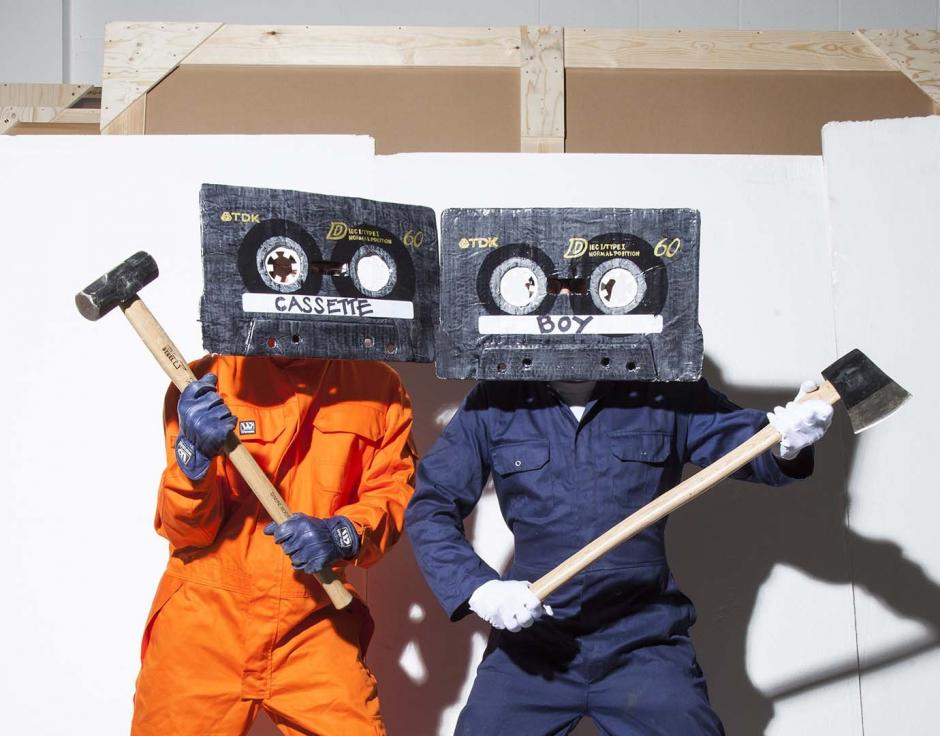
The Wire’s Deputy Editor Emily Bick speaks to Mike from Cassetteboy, in advance of their performance on Friday 3 June at London’s Splice festival of AV art.
For the last two decades, satirical pop collagists Cassetteboy have hacked apart the guts of news programming, reality TV and chart hits, and spliced them together into collaged, comedy songs. From lo-fi beginnings taping sound from the radio and then recording onto tape from one boombox to another, their cut-ups have evolved into ever more sophisticated video clips, including a monthly “Remix The News” series that ran in The Guardian last year.
What have you got planned for Splice festival?
Cassetteboy’s Mike: It’s essentially a comedy disco. It’s a show we’ve been doing for a few years now, we did it at the Edinburgh festival a few years ago. It’s a mix of pop songs and party favourites, mixed in with clips of people off the telly. So you’ve got Dot from Eastenders duetting with Justin Bieber and Alan Sugar popping up and commenting on the songs every now and again, and changing around the song lyrics and putting funny visuals.
So it’s more of the pop stuff rather than some of your more political work?
Some of our news mashups are there and we’ll be playing the David Cameron rap and the Jeremy Hunt rap, so there is some political stuff in there, but a lot of it is just silly. You know, it’s hopefully fitting for a fun night out.
When you were starting out, you were just working off boomboxes and cassette tapes. When did you make the move to video, and what made you decide to do that?
We used to just do audio, and we released a few albums between 2002–08, and then that felt like it had kind of run its course. So essentially, we started using video just to see if we could do it. We thought that maybe we’d be able to get jobs as video editors, we taught ourselves video editing mainly to be able to do that. And we put the first few results of that up on YouTube, just for fun and to share it with our friends, and it took off massively! Our YouTube videos were far more successful than our albums have ever been. So we stuck with it.
You started the Cassetteboy project in around 1996–97 – is that about right?
Yeah, we started working together in about 95, but that was just tapes that were circulated among friends, and friends of friends. I think we had a track on a compilation that came out in 99 maybe? And then our first album came out in 2002. But yes, when we first started, no one had even heard of the internet, or we hadn’t, anyway. And even in 2002, we were using the internet to get some of our source material, but we were also buying VHS tapes and taping things off the TV and selling physical CDs. By the time we’d finished doing albums, YouTube was available and suddenly we were able to reach a global audience as soon as we’d finished something, which wasn’t the case when we started, and obviously made a huge difference to us.
Your breakthrough moment, for a lot of people, was the 1997 release of “Di And Dodi Do Die”, your cut up single of news footage following the death of Princess Diana. How did you get the source material for something like that? And how much harder was it to find source material than it is now?
Everything we’d done up until then had been very abstract and very collagey, so we’d take a sample from one show and then from another show, and then a bit of music and then something else. This was when we were working on tapes, and not thinking of releasing anything. But then when Princess Diana died, we realised that every radio station, every TV station was going to be talking about exactly the same thing, for you know, the next week, if not more. So we immediately set up a video recording BBC 1, and then we took the audio out of that and started recording ITV; we had another video, another tape deck recording Radio 4 – so the news footage in “Di And Dodi Do Die” is taken from the first eight hours of coverage on the day that it happened.
It must have taken so much time to sift through all of that to find the precise things that you wanted to fit together.
Yes, yes it did. With everything we do, the vast amount – most of what we do is watching the raw material, so probably a minimum of 80 percent of our time is just spent watching David Cameron, or watching The Apprentice, or listening to coverage of Diana’s death, and the actual creative part, the fun part of putting it all together, is 20 percent of the time, I would say.
For something like your response to David Cameron’s Pig-gate scandal, “Getting Piggy With It”, how much footage would you have to sit through to produce one of those? Because they come out fairly quickly, they seem to be fairly responsive and topical. But it must be an amazing amount of work in a short time to be able to do that.
With David Cameron, we’ve got six years’ worth of his party conference speeches, which are each about an hour long. And we’ve watched those speeches many, many times. So the first David Cameron rap took a few weeks to make, I think – but we’ve done – we’ve amassed a huge bank of samples, and we’ve got transcripts of those speeches, that sort of thing. For “Getting Piggy With It”, we managed to get that turned around within a few hours of that story breaking, purely because we’d put in the hard work already, doing other David Cameron raps.
Are there other people that you’re anticipating saving up footage for – like maybe a Boris or a Trump or something like that, for future moments when you can pounce?
No, I can’t bear it, subjecting ourselves to watching ten hours of Boris Johnson on the off chance that he becomes prime minister! No, because we’d have to watch Osborne and everyone else as well. No, no, the thought of that is ghastly! So obviously, politically and morally and, you know, from a human decency standpoint, we were very disappointed when Cameron got re-elected, but professionally it was very good for us, because all our material is still relevant, and will be for another few years, if he lasts the course.
Professionally, the UK copyright laws changed in 2014, so you’ve finally been able to get paid for your work because it’s become easier to use material for satirical use legally. Has that changed your fortunes in any way?
Oh, it’s been a very good thing – if you go back to the tape years, almost 20 years, we did it without it ever being possible to be a career. We occasionally sold a few albums, we did a few gigs, we very occasionally got commissioned to make a few things, but it was never a feasible career. Whereas since the law changed, touch wood, we’ve done OK. We’ve had a fairly consistent stream of commissioned pieces. So we’ve managed to make more content in terms of more different videos since the law changed, than probably the ten years before that.
These days, with with 24 hour news cycles, twitter and so many things going viral – and politicians like Boris and Trump – do you ever think sometimes that we might be moving to a point where we’re beyond satire? And how far do you think that satire and comedy can have a positive political effect?
First of all, I don’t think we’re beyond satire. Satire has maybe changed slightly – as you say, there is maybe less information, less substance in what we see from our politicians, in what they say and in the news investigations that are more superficial because they repeat every 15 minutes on 24 hour media – so satire is maybe changed slightly.
You’ve got people like John Oliver, his HBO show has an incredible amount of factual information in it as well as brilliant jokes. Though some satire has gone more in depth, where before it was just kind of pointing and laughing and mocking politicians, these days, it’s more informative as well as doing that. So I think it’s evolved, to react against what politics has become. In terms of satire having any effect, I don’t think so – hopefully, it can raise some awareness of issues, but you know, satirists don’t have the answers. They can point out what’s going wrong, but if they had the answers, they’d be politicians, and hopefully trying to enact those answers rather than mucking about making jokes.
The Splice festival takes place between 3–5 June at various London locations.
Leave a comment