Alison Knowles (29 April 1933–29 October 2025)
November 2025
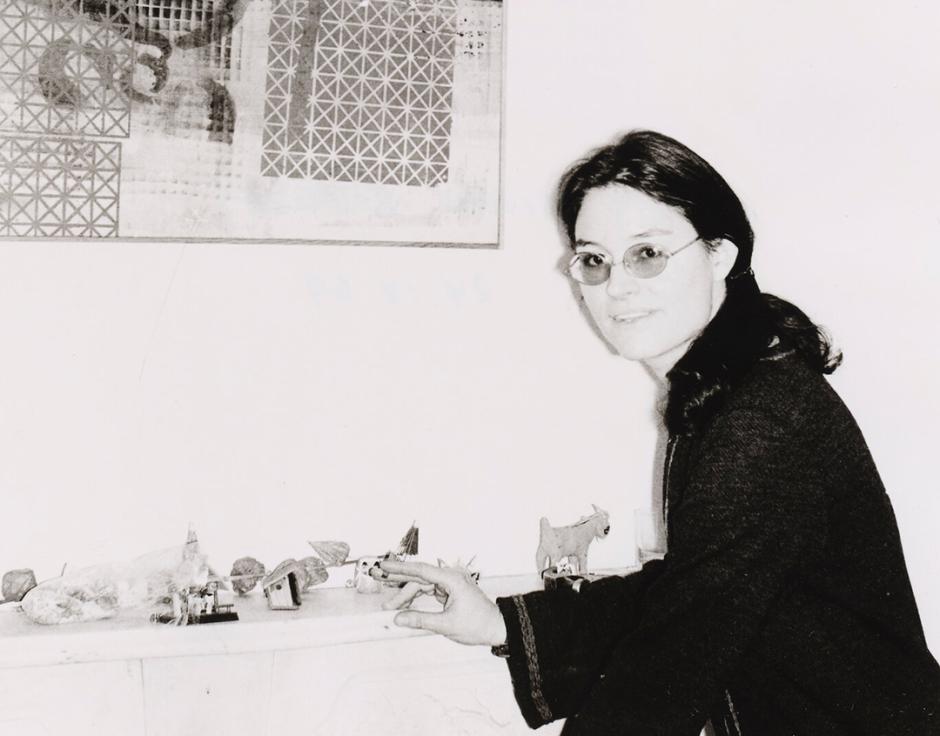
Alison Knowles, 1969
Irene Revell reflects on the life and work of Fluxus co-founder Alison Knowles, who died in October
There is a German television newsreel of the Fluxus Internationale Festspiele Neuester Musik at Museum Wiesbaden in autumn 1962 that captures what is often described as the genesis of the Fluxus movement. In the opening shot the line of protagonists take the stage: first is Alison Knowles who radiates a gnomic poise in her commanding stature; joint performances ensue with her colleagues Nam June Paik, George Maciunas, Benjamin Patterson, Philip Corner et al.
For Knowles, it is this moment of co-founding Fluxus that equally heralds the flourishing of her own highly multifaceted oeuvre that encompasses participatory installations, performance, sound, poetry, publications and tactile objects. Most immediately, on these early European Fluxus tours she would write many of her iconic event scores: Newspaper Music (1962), Nivea Cream Piece (1962), Shoes Of Your Choice (1963), and perhaps best known of all, the eponymous proposition Make A Salad (1962).
As she explained decades later to composer John Lely: “A lot of people followed us from city to city – we had to have fresh material... it had to be super simple, it had to have no theatre accoutrements, and it had to be for anybody in the group who was travelling with us. I composed them when we were touring and we did them the next day. It was very, very exciting.”
Scores that bring attention to, and ultimately revel in a shared wonder and joy in the simplest elements of everyday life. The rhythms of preparing a salad; the story of the shoes on your feet (or any other pair); applying hand cream as a communal and sounding event; works that produce an infectious social materiality yet are simultaneously so precise, incisive.
Born in 1933 in New York, from a childhood permeated by her father’s literary interests (a college professor and Don Quixote expert), as well as a love of disappearing into the woods behind her teenage suburban home, Knowles trained in painting at Pratt Institute in the mid 1950s. Without independent wealth, in parallel she took up professional layout and page design work to maintain financial autonomy, techniques that would also enter her own practice through silk-screening onto canvas – as well as in a multitude of artist book projects. In 1960 she married her second husband, and fellow Fluxus artist, Dick Higgins, and in 1964 they would have twins, now artist Jessica Higgins and art historian Hannah B Higgins (with three grandchildren, including Shimmy Disc musician Clara Joy). The aforementioned event scores would find their way into her first publication, By Alison Knowles (1965), one of the Great Bear Pamphlet series published by Dick Higgins’s Something Else Press, a press which she in fact named and contributed to copiously – perhaps most prominently co-editing the Notations (1969) score anthology with John Cage.
But the book is more than a medium for Knowles, something to be explored from all perspectives. In her Big Book (1967) gallery installation the giant pages become a physical habitat. Bean Rolls (1963), her first book object, also inaugurated two further long-standing interests – quite literally as it says on the tin, a fascination with beans (dried beans are in the tin alongside written scrolls that detail her research on the topic) – and more broadly with sounding objects (here, the beans’ percussive quality). These converge again in the Bean Garden (1971) installation, a giant amplified tray of 200lbs (90kg) of dried butter beans that was a stage for invited performances, as well as members of the public during Charlotte Moorman’s 12th Annual Avant Garde Festival, and then slowly consumed, a circular economy present in much of Knowles’s work that presciently anticipates contemporary interest in ‘art and ecology’. In all these examples, the inherent playfulness is also underpinned by a profound and long-standing material enquiry.
Many of these interests converge in her most ambitious undertaking The House Of Dust (1967) project, thought to be the first computer-generated poem, that uses FORTRAN-IV software coding (with the aid of composer James Tenney) to generate and print 100s of permutations of quatrains, meditating on different forms of housing, another highly prescient concern. One of which “a house of plastic, in a metropolis, using natural light, inhabited by people from all walks of life” became the basis for her Guggenheim fellowship large-scale sculptural installation (with electronic sound by Max Neuhaus) installed in the Lower East Side, and later shipped to the desert of CalArts while Knowles taught there in the early 1970s, operating as a site for gathering and performance with Knowles’s students.
If she cut a lone female figure at Wiesbaden, it was in the early 1970s that some of her creative friendships with women would blossom. First the deliciously sardonic Postcard Theatre (1974) series with Pauline Oliveros (Beethoven was a lesbian; Chopin had dishpan hands; etc). In turn, Oliveros would introduce Knowles to Annea Lockwood with whom she would co-edit and self-publish the score magazine project Womens Work (1975-8) – my personal point of intersection with Knowles’s work, researching that project’s history, and collaborating with Primary Information on re-publishing it in 2019. During this period Knowles would also inaugurate (with Lockwood, Ruth Anderson and Jean Rigg) the 48 hour marathon reading of Gertrude Stein’s 925 page novel The Making Of Americans Over New Years 1974/5, that would then become a tradition at Paula Cooper Gallery (with various more recent revivals). Composer Tom Johnson, writing in The Village Voice, described this as “the ultimate Knowles work … one of her most personal and characteristic”, exemplary in as much as she always works with existing materials, concerned with social implications and the bringing together of people, taking an “exceptionally modest stance”. And for Johnson, most characteristically of all, works that allow for her to remove herself altogether, as in many of her scores.
Alison Knowles’ works have only circulated more over time in both art and music contexts, and crucially the in-between, intermedia communities that she has been so foundational in nurturing. Yet it is clear that her centrality is still not understood fully enough. In the last decade several major museum retrospectives have begun this work including the still touring By Alison Knowles; and next year the first monograph study of Knowles's life and work, Performing Chance: The Art Of Alison Knowles In/Out Of Fluxus by Nicole L Woods will be published. More than anything, though, her work will live on through her many scores. While these have been taken into the classical repertoire – most recently in concerts by the LA Philharmonic – what is perhaps most notable is the sheer breadth of contexts in which her scores are performed: in London alone, in recent years, at Wigmore Hall, Whitechapel Gallery, the London Contemporary Music Festival, and, most repeatedly, Cafe Oto.
Make A Salad (1962), first performed at the ICA in London just weeks after Wiesbaden, would go on to be presented in the Turbine Hall at Tate Modern in 2008 for an audience of 3000, and of course in so many other instances here and elsewhere, with and without Knowles’s own presence. In a lockdown performance over Zoom with my own sound arts students, we each set to work with the ingredients we had assembled in advance. Chopping together and apart, inevitably at some point I find myself no longer performing a score, no longer in a class on a call but completely absorbed in the work at hand. A feeling of how alive we are, how connected to each other and the world around us; even in these bleaker moments, or perhaps even more so.
Wire subscribers can read Louise Gray's review of Womens Work in issue 426 in the digital library.
Leave a comment