Listen: tracks from Sublime Frequencies's Ethnic Minority Music Of Southern China
May 2013
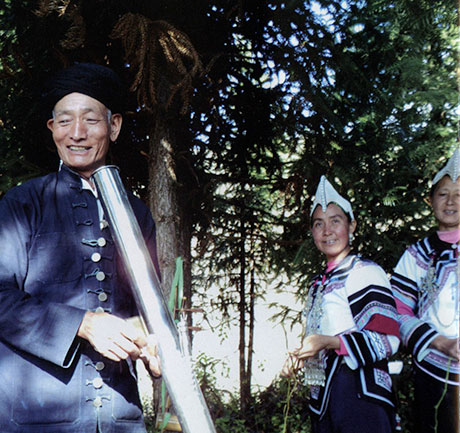
Photo: Laurent Jeanneau
Listen to two recordings from gonzo ethnomusicology label Sublime Frequencies's new release, Ethnic Minority Music Of Southern China.
| Amukadela | 0:03:45 |
| Wu Bulang Theravada Buddhist Drum | 0:03:47 |
"Wu Bulang Theravada Buddhist Drum Ensemble" was performed by a large percussion ensemble for the Theravada Buddhist New Year in mid-April. Recorded in Da Bang Xie, Shuangjiang, Lincang, Yunnan, China in October 2011 with Huang Peishan and Olivier Schneider.
According to the CD liner notes: "eight women are dancing in a circle, each holding and hitting a sa toua hum. In the center a man hits a sa toua a, a 1.2m high drum. Outside of the dancing circle a man or a monk hits the huge temple drum also called sa toua a, or sa toua noi so a. Two gongs of different sizes (ba uom) and two pairs of cymbals (ba chiang) are also being used in the ceremony.
The Bulang (100,000 people), first called Puman by the Chinese, belong to the Mon Khmer (Austro-Asiatic) linguistic family, spread from Cambodia to eastern India and are divided into subgroups with distinctive languages. There are 32,000 Bulang in Lincang. The Wu are one of their subgroups. Most Bulang villages have converted to Theravada Buddhism under the influence of Dai who ruled the area for centuries before the Chinese moved in. Both religious and secular music of the area still carry the Dai cultural influence.
The second track, "Amukadela", is the song of the love of a daughter for her mother, performed by Wang Liliiang, a 63 year old playing isong (a double-stringed plucked instrument with a large round body). Wu Bien Rien, 69, plays saxian (a 3-stringed plucked instrument with a small body.) The singing women are Tza Posi, 46, Pu Sansei, 49, and Li Apa, 49, and they also play muga (copper jew’s harp) and munga (bamboo jew’s harp).
The area of Azhahe south of Honghe is home to the southern group of Nisu and other ethnic groups like the Hani or Yao. Their traditional Nisu orchestra gathers 11 people between 35 and 69 years old. Recorded in Dishi, Azhahe, Honghe, Yunnan, China in February 2011 with Zhang Xinrong and Pierre Bois.
More details on the release here.