Read an extract from Living Space: John Coltrane, Miles Davis And Free Jazz, From Analog To Digital by Michael Veal
July 2024
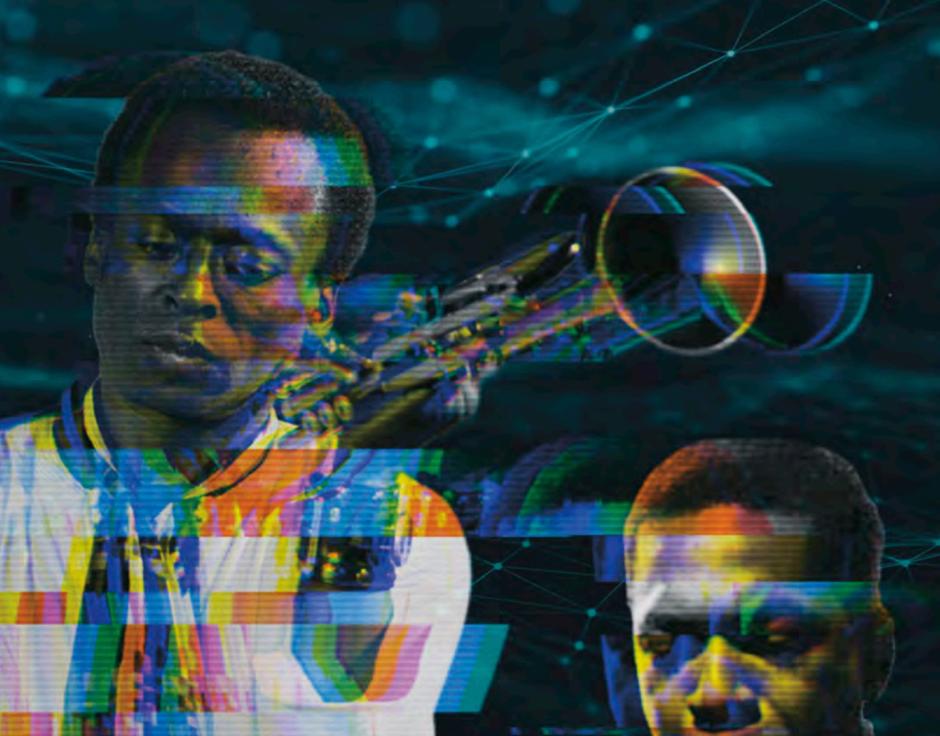
Living Space book cover (crop)
Michael Veal shares an extract from the second chapter of his new book, in which he considers “the Africanist Grid as a mode of jazz consciousness”
In the area of Queens, New York where I grew up, my introduction to music took place in a world shaped and defined by rhythm. My father was a part-time jazz drummer who was fascinated by so-called Latin (ie Afro-Caribbean) rhythms, so I was immersed in the sound of drums and percussion from the very beginning of my life. The 1970s were also an era of funky music in which musicians strove to make their music more self-consciously Black. To take three examples: the chicken scratch guitar style of James Brown’s guitarist Jimmy Nolen, the slapping style of Sly & The Family Stone bassist Larry Graham and Stevie Wonder’s syncopated phrasing on the electric Clavinet keyboard are all sonic transmutations of the wave of racial pride inspired by the political and cultural liberation spreading throughout the Black Atlantic world as a result of decolonisation, Civil Rights and Black Power. In the Spanish Caribbean areas of New York such as El Barrio (Spanish Harlem) and the Bronx, a similar cultural frequency could be felt; the acknowledgement and embrace of the African element of Latinx culture was a strong undertone of the rumba ensembles on street corners, the Latin jazz played in local nightclubs, and the salsa dura sound associated with musicians such as Hector Lavoe, Willie Colon, Ismael Rivera, Eddie Palmieri, and the Fania All-Stars. It was a reflection of the cultural sensibility of the time that even the free piano improvisations of Cecil Taylor – played in free metre and heavily informed by elements of 20th century classical composition – were metaphorised by the British jazz writer Valerie Wilmer as “88 tuned drums” and by the Nigerian journalist JB Figi as “African Code, Black Methodology”, dramatising the cultural and political imperative of providing an Africanist aura for even the most experimental spheres of Afro-diasporic art. The 1970s, then, were a decade in which assertions of race and culture were being forcefully articulated through the medium of rhythm. And as artists and architects from Le Corbusier to Piet Mondrian had observed in relation to earlier periods of Black music, those rhythms helped inflect post-industrialising New York City in a unique and powerful way. And it was the formative influence of Black dance musics that conditioned me to experience music as a complex of layered, interlocking and repeating parts. Without reverting to essentialist ideas about African-derived musics as fundamentally rhythmic, this is one of the main lenses through which I am approaching the free jazz repertoire discussed in this book – a view of the music as fundamentally oriented around the dance imperative and by a corresponding understanding of groove (ie the layered, repetitive structures of Black dance music) as its conceptual core.
* * * * *
My initial ability to hear and think through free jazz, on the other hand, began to consolidate in relation to the work of musicians who are considered to operate in a universe far removed from social dance music. These musicians such as John Coltrane, Cecil Taylor, Sun Ra, Anthony Braxton (particularly the work of his classic quartet of the late 1980s/early 1990s), the avant rock musician Captain Beefheart (Don Van Vliet), and postwar composers like Karlheinz Stockhausen, had worked their various ways from origins in jazz, blues, rock and art music composition to the experimental fringes of their respective traditions. If the repetitive structures of dance music were my main point of departure, what interested me most in the work of these artists was the various ways that repetitive rhythmic figures and cyclical metre had been unhinged from each other or done away with altogether.
One of the pieces of music that fascinated me during this period, for example, was “Light Reflected Off The Oceands [sic] Of The Moon”, an instrumental song released in 1982 by Captain Beefheart & The Magic Band that was based on the juxtaposition of riffs in multiple, disjunct metres. I spent a lot of time listening to this track from various angles, trying hard to understand how Beefheart came to use the luminous, aquatic imagery of light, reflections, oceans and moons to describe a music of such hard angles and lurching rhythms. In time, I would come to understand that the ‘hard angle’ strategies of collage, fragmentation and juxtaposition have often been used to cultivate states of flow and fluidity, a concept that would reveal itself to me much later as I explored not only the music of Coltrane, Cecil Taylor and other so-called free jazz musicians, but also several contemporary architects discussed in this text including Zaha Hadid and Peter Eisenman. In any case, these unconventional rhythmic constructions had already planted several seeds in my mind for what might be thought of as a spatial experience of music. As music theorist Eve Poudrier has noted, the deconstruction of metre actually encourages the listener to expand their spatial awareness of music, as a way of reconciling the tension inherent in simultaneous rhythmic perspectives. Inspired by these musicians, my growing sense of the spatial in music set the stage for an expansion of my musical experience of rhythm into the physical world.
Read Stewart Smith’s review of Living Space: John Coltrane, Miles Davis And Free Jazz, From Analog To Digital in The Wire 486. Subscribers can also read the review online via the digital library of back issues. Living Space is published by Wesleyan University Press.
Leave a comment