Read an extract from Sonic Faction: Audio Essay As Medium And Method
November 2024
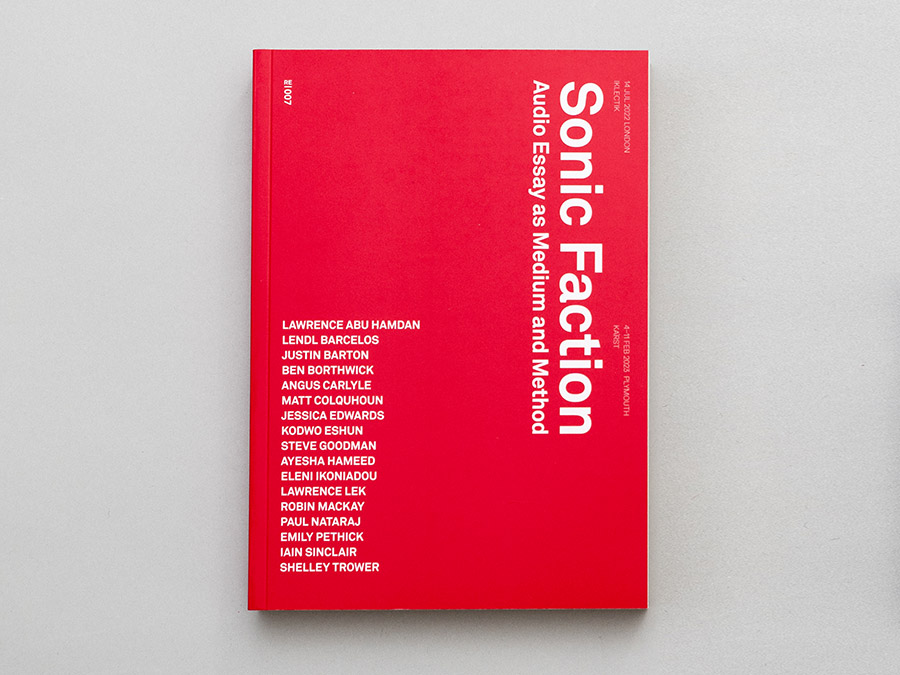
The cover of Sonic Faction: Audio Essay As Medium And Method (Urbanomic, 2024)
This extract from new book Sonic Faction considers the possibilities and limitations of the audio essay as a form of sonic psychedelic experiment, prompted by three releases on Hyperdub’s Flatlines sub-label
The audio essay could provisionally be defined as an extended recorded piece combining discursive and/or narrative speech with both musical and non-musical sound elements. Recent years have seen the production of a number of audio works which have in common a resistance to being accommodated in existing formats, even those with which they share certain qualities and characteristics – radio play, documentary, audiobook, essay film, concept album, mixtape, sound art, podcast, ambient music, soundwalk, field recording… The audio essay is all and none of the above – a hybrid form whose potential remains largely undiscovered.
Sonic Faction, a recent event at London’s ICA jointly organised by publisher Urbanomic and Hyperdub sublabel Flatlines, featured a collective listening session centred around playback of three Flatlines audio essay releases: Mark Fisher and Justin Barton’s On Vanishing Land (2006), Steve Goodman’s (Kode9) Astro-Darien (2021), and the most recent Flatlines release, Robin Mackay’s By The North Sea (2022). The ensuing artists’ discussions explored where the audio essay stands in terms of its formal definition and its cultural status, and what it offers in terms of creative possibilities, discursive scope, and auditory experience.
In the Flatlines releases, the audio essay tends to move fluidly between fiction and conceptual discourse, using narrative dramatisation to think through speculative ideas, employing sonic abstraction as the glue for conceptual collage, and ambiguously undercutting the veridical authority of the voice. It uses sound to make possible what Justin Barton calls outsights – whispers, at once perceptual and cognitive, of a realm beyond the normative space of discourse, whether the latter is construed in terms of distinctions between different disciplines, media, and registers of speech, the fixedness of chronological time and geographical space, or the delineation via attentional conventions of what is and is not possible to articulate, what may or may not be voiced.

The sleeve of Mark Fisher and Justin Barton's On Vanishing Land (Flatlines, 2006)
One of the most significant players in the development of the audio essay in this form was Barton’s collaborator for On Vanishing Land, the late Mark Fisher. In the 2000s–2010s, Fisher’s negotiations around how to present this in-between medium, which by its very nature – being neither pedagogy nor entertainment – generates disciplinary perturbation, took place in his Vocalities seminars at London Goldsmiths.
Fisher’s advocacy for the audio essay also involved feeling out a space – physical, cultural, and discursive – in which the audio essay could be heard. The Vocalities seminars emphasised the collective intensity of listening sessions, where the effort necessary to achieve a diagonal between immersion and attention, absorption and concentration, is heightened by a very particular sense of communal experience. In an age where background music and mediated chatter is everywhere, such concentrated auditory attention can be both an uncommon pleasure and an unaccustomed labour for listeners. It was the audio essay’s mesmerising, slowing down effect that inspired Fisher’s perseverance with the format, which he saw as harbouring a disruptive potential for thought precisely because in actively exploring these zones of affect, it ran counter to a visually dominated culture in thrall to the immediately recognisable and the visibly demonstrable.
These seminars in which students, musicians, and theorists shared their audio work echoed earlier experiments in which Fisher had been involved during the late 1990s with the Cybernetic Culture Research Unit (CCRU) group. The proto-audio essays created by CCRU during this period – Swarmachines being one of the few preserved examples – reflected their determination to plug theory into the circuits of cybernetic cultures rather than theorising about them. CCRU repudiated any division between the cognitive abstractions of discursive enquiry and the sensory intensities of popular culture – in particular what Steve Goodman would later designate the hyperdub continuum; experiments in delivering philosophy with a side order of breakbeats (or vice versa) were the inevitable result.
In the years following the group’s millennial disintegration, CCRU veteran Steve Goodman perpetuated this coupling of high theory and low-end vibration in his book Sonic Warfare (2010), in his work with the group AUDINT, and through the Hyperdub record label, which he founded in 2004. Notably, early Hyperdub releases included Kode9’s own productions in collaboration with The Spaceape, in which the vocalist’s ominous proclamations were twinned with jungle stripped down to skeletal infra-dub, not so much gesturing toward US hiphop as lending a newly dystopian slant to the British diaspora legacy of Linton Kwesi Johnson’s dub-poetry oral histories.
The relation between the audio essay and Goodman’s sub-bass materialism have emerged more recently via the relationship between Hyperdub and Flatlines, created specifically for audio essays and launched via the club night ø (2017–2020) at Corsica Studios in London, where various audio works were presented alongside DJ sets. Writing in Sonic Faction, Mattie Colquhoun aka Xenogothic argues that both prongs of this twofold sonic practice express and explore the cognitive pathologies of contemporary life.
In a 2013 review of DJ Rashad’s Double Cup, Mark Fisher diagnosed footwork as a form which, no longer using computer music to envision and evoke a futuristic or alien machine world, instead directly expressed a contemporary subjectivity rendered “frustrated, angular” by its continual reprocessing through electronic networks and by dividualising dopamine addictions. Rather than interpreting and resolving symptoms, though, footwork uses sound to unfold them into new mind- and bodyscapes via synthetic forms of physical and auditory jouissance.
Similarly, Colquhoun suggests, if audio essays are not clearly legible as either entertainment, theoretical proposition, narrative, documentary, or sound art, this is because they too tend toward a digital psychedelia that recombines and reprocesses “the remains of [a collective] unconscious experience not properly signified”. Like footwork, rather than resolving problems, the audio essay recruits the listener into productively intensifying the problematic.
Accordingly, the audio essay is not easy listening: it makes stringent attentional demands upon its listeners, who have to negotiate the tension between, on one hand, being absorbed by sound or physically activated by rhythm, and on the other, having to maintain cognitive focus on a spoken text that is often complex and shifting in its modalities. At Corsica Studios, the ø nights dramatised this battle on the scale of the club setting itself, playing on the tension between intellect and affect from both directions simultaneously.
This is an extract from the introduction to Sonic Faction: Audio Essay As Medium And Method edited by Justin Barton, Maya B Kronic and Steve Goodman, and published by Urbanomic. A playlist to accompany the book is available on YouTube. By The North Sea is available as a CD and digital download now.
Read Paul Rekret’s review of Sonic Faction in The Wire 490. Wire subscribers can also read the review online via the digital library.
Leave a comment