Against The Grain: UK rap is hijacked by London’s police force for clicks
March 2026
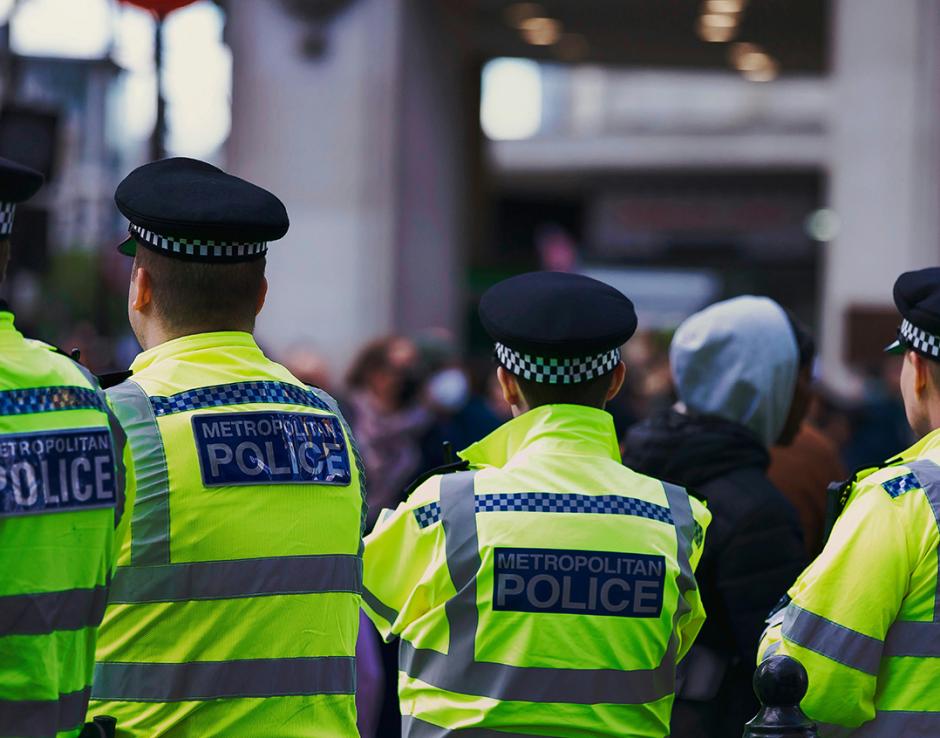
Photo by Bob Jenkin
London’s Metropolitan Police persecutes UK rap while using it for self-promotion, argues Hugh Morris in The Wire 506
2025 was the year that the world woke up to the UK’s underground rap scene, and at the centre of it all was EsDeeKid, a masked rapper from Liverpool. With fellow breakout stars Fakemink and Rico Ace, EsDeeKid released arguably last summer’s biggest hit, the swaggering “LV Sandals”. He now has around 20 million Spotify streams per month, and has reportedly signed a huge record deal with Capitol Records, following in the footsteps of fellow UK rapper Central Cee.
Unlike Central Cee, the success of EsDeeKid is yet to translate into a smoothing out of his sound. The “OK” tag heard throughout EsDeeKid’s debut record Rebel comes from producer Wraith9, whose clattering, blown-out beats tie the project to a more recognisable North West underground. The tag crops up on tracks by rapper and dancer Blackhaine, while Rainy Miller mixed and mastered Wraith9’s own album Designer, an undersung release from 2025 that adds weight and complexity to cloudrap delivery.
Past the foregrounded accent trickery – listen for the virtuosic “ex” verse on “Dirty” – and the specific Liverpudlian callbacks – Bourbon rhymes with Jürgen – EsDeeKid’s Rebel is a particularly debauched version of a thematically common rap album: fast cars, girls, drugs, evading the police in fast cars to sell drugs and get girls. Whatever! But it did make hearing EsDeeKid on a recent video posted to TikTok by London’s Metropolitan Police feel a little odd.
Throughout the winter of 2025, the UK public were subjected to yet another of Timothée Chalamet’s agonisingly sculpted press tours, ahead of the film Marty Supreme. After rumours that felt like a cunningly crafted industry set-up – is Chalamet actually EsDeeKid? I couldn’t care less, and yet here I am, discussing it – Chalamet made an embarrassing guest appearance on EsDeeKid’s “4 Raws” (sample lyrics from the Wonka star: “Got model bitches in Peckham/I’m Ryan Reynolds in Wrexham”. Or “I’m having fun, just sexting/My dick is young and restless”.)
And, because everyone – whether they’re a 16 year old content creator or an “institutionally racist, misogynistic and homophobic” police force, as the Casey report concluded – must jump on digital trends, the Metropolitan Police added EsDeeKid’s “Phantom” to accompanied flashily cut shots of coppers catching baddies. “Not the Met making edits to EsDeeKid,” the ultra-arch caption read, followed by the monkey covering eyes emoji and the side-eye emoji – an actual message posted by the actual police force of our actual capital city.
When I asked the Met Police about the use of EsDeeKid’s music, they said that the video “complements, rather than replaces, our traditional engagement methods, helping us to build trust and confidence in our work and inspire the police officers of the future”. It’s by far the Met’s most popular upload, with over three million views at time of writing, and seems part of a wider, meme-ier and crueller digital strategy. In another Instagram clip, footage of a police chase is supercut with graphics from Mario Kart; a countdown begins, the officer releases their ‘blue shell’ and the rider promptly crashes their scooter. This is justice in 2026: sub-You’ve Been Framed! ragebait, cheered on by gullible gremlins in the comments section.
Aside from the deep unseriousness of the Met’s new form of communication, and the reputational blow it’s no doubt done to EsDeeKid (who wants to work with a rapper co-signed by the Met?), the clip obscures the rather more antagonistic relationship with rap that the UK police force – and the criminal justice system more broadly – has established over the past decades.
As Erik Nielson and Andrea L Dennis outlined in Rap On Trial: Race, Lyrics, And Guilt In America, their exhaustive 2019 book on rap and the American criminal justice system, there’s a strong historical precedent of rap being wielded against Black and Latino men, stretching back to the style’s early days. Where rap being used on trial has high profile US critics such as Jay-Z and Kelly Rowland, the same can’t be said for the UK, despite numerous studies showing a similar pattern.
Prosecuting Rap, an online resource organised by the University of Manchester, looked at cases where rap videos and lyrics were used as prosecuting evidence. Between 2020–23, they found 68 such cases, with a total of 252 charging individuals. 84 per cent of defendants in these cases were of ethnic minority backgrounds, and 82 per cent of defendants were aged 24 or younger.
The report drew out the use of rap as a way of tying together Joint Enterprise prosecutions, a controversial doctrine which allows individuals to be convicted for crimes they did not personally commit, if they are deemed to have assisted or encouraged the principal offender. A 2025 report by the UK legal reform charity Appeal laid out the “excessive use of charging powers” regarding joint enterprise; they are currently campaigning for a narrowing of the law.
One such case, highlighted by Guardian journalist David Conn, was the conviction under joint enterprise of three young Black men – Durrell Goodall, Reano Walters and Trey Wilson – for murder in 2017. During the trial, Greater Manchester police and the Crown Prosecution Service showed a rap video as evidence that they were members of a gang called Active Only. The judge, Sir Peter Openshaw, directed the jury that they could infer gang “membership or allegiance” if a defendant had the rap video on their mobile phone (in November, the Criminal Cases Review Commission referred this particular case to the Court of Appeal).
56 per cent of cases Prosecuting Rap examined were in London, a city where the stigmatisation of rap by law enforcement is well documented. In 2019, the Met launched Project Alpha, a Home Office backed project examining serious gang violence. But a key part of this strategy has been the monitoring and removal of drill videos from YouTube. Along with its use in trials, there has also been a wider penalisation of these forms of creative expression by authorities – who now seek to reap the reputational benefits associated with them.
Campaigners like Art Not Evidence continue to make the case that rap should be nowhere near criminal trials, and their proposed bill – Criminal Evidence (Creative and Artistic Expression) – has some support in Parliament. But progress is slow. While the CPS continues to use rap as evidence, there’s no way the Met can clout-chase itself back to respectability.
This essay appears in The Wire 506. Pick up a copy of the magazine in our online shop. Wire subscribers can also read the essay in our online magazine library.
Leave a comment