Daniel Lopatin: Bling Tones and Digital Iridescence
March 2026
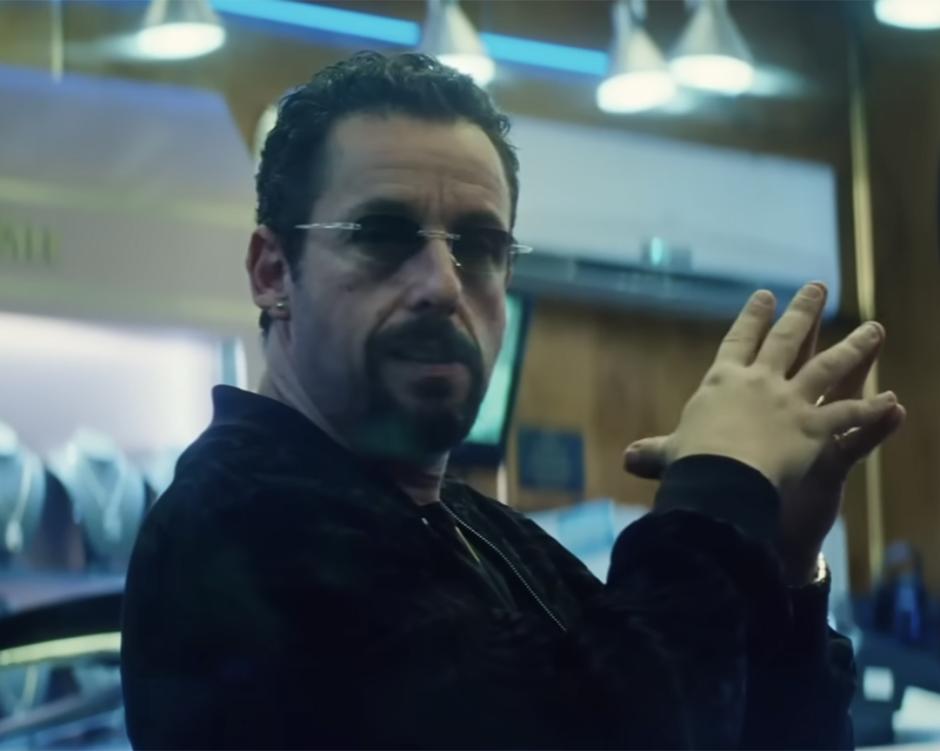
Adam Sandler as Howie Bling in Uncut Gems (2019)
In his latest Secret History of Film Music column, Philip Brophy considers Daniel Lopatin's score for Uncut Gems (2019) and its context within an aesthetic of ‘bling’
The Safdie brothers’ Uncut Gems (2019) opens in 2010 in Ethiopia, where low paid diamond miners toil, harvesting what will be the bling tokens for an affluent culture many miles away. The soundtrack quakes with deep drones like synthetic shōmyō baritone chanting by Buddhist monks foretelling the fatal consequences of unchecked greed and ignorant hubris. The scene recalls a similarly ominous moment at the opening of The Exorcist (1973) when a stone talismanic statue is uncovered by archaeologists in northern Iraq. The devil in Uncut Gems will be revealed to be Man himself. I’m employing pompous terms here, because the thrust of Uncut Gems – indeed, of the Safdies’ films in general – is to build grand statements from little people. It’s a knowing tactic skilfully deployed. It also contextualises how composer Daniel Lopatin creates his scores for their films. (Only Uncut Gems is discussed here; Marty Supreme is reviewed in The Wire.)
When a miner finds the lodestone gem which will be the mystical harbinger of the film’s events, the camera zooms in and seamlessly enters a digitally constructed interiority of microcosmic splendour, revealing a glinting rainbow unlocked by the rock’s Obsidian iridescence. The viewer becomes lost in this cosmos of beauty, oblivious to its dangerous undertow. The image morphs into a colonoscopy endoscope monitor, gleaming with the viscosity of moist canals to note a small polyp – a discovery of a different type of ‘uncut gem’. From the caves of Ethiopia to the colon of Howard Ratner (Adam Sander), Uncut Gems frames its cosmological energies around a figurative everyman whose journey will now be undertaken.
As Howie charges down a street in Manhattan’s Diamond District, barking on his cell phone, the deep droning of the ‘gemoscope’ opening forms itself musically into the main theme of the film, “The Ballad Of Howie Bling”. This track runs for eight and a half minutes, entirely unchanged and unedited over Howie’s daily business, carrying through to the end of the title credits. The music is a fantastical ceremony of engorged synth pads, trumpeting brassy lines and choral praises-on-high. It feels ironically forced due to the predominance of digital and physically-modelled synthesis, but it simultaneously elicits a strange empathy in its mix of gloss and gloom. Real voices, choirs, saxes and drums dance with the synthesizers to further create a mirage of musicality.
This speedy montage follows Howie into a security heavy upstairs jewellery store where he deals with customers, clerks and stand-over thugs; returns onto the street with more phone haranguing; into a restaurant to place a bet with his bookmaker; and segues into his apartment where he has secretly installed his mistress. The momentum is non-stop (as it will be for the duration of the film) as we encounter around 20 characters and streams of multi-levelled dialogue. Its loquacious orchestration is clearly indebted to Scorsese’s compressed verbiage in films like Goodfellas (1990), which was one of the first films to use multitracked digital editing of dialogue, narration and songs to structurally erase gaps and silences to compress its drama.
The difference in Uncut Gems is how Lopatin’s single track plays across this manic network of interactions. Normatively, film music somehow strikes up a relationship with its concurring images, through reinforcement or counterpart. “The Ballad Of Howie Bling” is a rarity in existing emotionally outside the charged drama of its characters, implying a meta level at which the music’s commentary resides. Upon encountering this on first viewing, the music almost feels intrusive. Lopatin’s piece is shaped by dynamic peaks and troughs – far from any pastoral evenness typical of subservient cues – and the Safdies have even chosen to ride the track’s volume, sometimes competing with the yelling of characters. Psychoacoustically, the music almost repels the viewer, driving a wedge between the story and the audience. This well describes the character of Howie.
Lopatin is not engaged in mere vintage aesthetics here. Uncut Gems’ tonalities, waveforms and harmonics recall an LP probably not in many Wire readers’ collections: The Official Music Of The XXIIIrd Olympiad Los Angeles 1984 (1984), which features instrumental tracks by Toto, Quincy Jones, Bill Conti, Herbie Hancock and Philip Glass. I could be wrong, but I don’t think there’s any ‘real’ instruments on any of their tracks – which is perverse, allowing a type of ‘digital steroids’ in composing music meant to reflect the glory attained by human bodies pushing beyond their natural thresholds.
Howie’s main customers are African-American star athletes of Olympian stature, who – like the rap and hiphop stars of the film’s era – are attracted to the bling-bling aesthetics and currency which typified ostentatious displays of attainment, be they physical, financial or musical. At one point, Howie’s recruiter of Black celebrities, Demany (LaKeith Stanfield), points out to real life basketball legend Kevin Garnett that Howie is the one who started bling-bling by furnishing music video producers with his outrageous jewellery.
Hype Williams’s Belly (1998) is, I believe, the first film to critique the deadly allure of bling. Well known for directing the amazing ‘meta-bling’ music videos for pretty much every hiphop and R&B star from the 1990s, Williams's excursion into narrative filmmaking makes an ‘anti-bling’ statement against the ‘affluenza’ trappings which seduce hustlers into upscaling their criminal enterprises. The film is largely bereft of hiphop beats and swagger, and instead concentrates on the existential moments of inactivity which contour the lives of those desperate to get rich quick or die doing so.
Uncut Gems looks at bling through a Jewish prism, with Sandler performing a disturbing impersonation of a man who comes in his pants at the prospect of making big bucks in a single high stakes gamble. In this light, Lopatin’s digitally glinting music parodies and extends the type of tacky library music playing non-stop during late night jewellery shows on home shopping channels. The effect and purpose is not for laughs: rather, it points to the semiotics of inflated grandeur with which digital synthesizers were initially marketed: as wondrous machines for bringing heightened realism, advanced sensorialism, and quality production, all via a single keyboard. Lopatin’s music unfolds from a position of heightened awareness of this situation and its legacies in the history of music technologies.
As Oneohtrix Point Never, Lopatin has been signed to Warp since 2013. The Warp aesthetic has for decades been built into an ever expanding pyramidal pleasure of the grid. Many original and successive waves of IDM performers have hammered their compositions by proffering a post-techno sensibility which rejects the ruthless simplicity of limited cycling patterns. In place, they tender a garden of synthetic delights where sounds are choreographed by every imaginable rupture and displacement, creating rhythms and harmonies that seemingly eschew hyper-quantisation and extoll beat fracturing and melodic tessellation (though all remain tethered to DAW time-line and track-lay grids). I often imagine this as the dimensional inverse of brutish sub genres like ghetto house, which fixate on the impossibility of transcendence while amazingly achieving it through sonic hallucinations of development. ‘Intelligent’ dance music progresses by implying it is always moving ahead in challenging ways. I’m a big fan of the Warp aesthetic and all its key artists, but I remain sceptical of how progressive and ‘intelligent’ its practices claim or suggest.
Daniel Lopatin’s scores to my ear feel more connected to the ugly step sister of IDM: progressive rock, and its royalty of keyboardists. Specifically, the morphological continuation of the form beyond those originators – from the tackiness of home shopping channels and the 1984 Olympics, to exhilaratingly pompous records like Geinoh Yamashirogumi’s Ecophony Rinne (1986), the precursor to the score for Otomo Katsuhiro’s Akira (1988). These florid connections might sound off topic, but they surface from the churning musicological whirlpool of readings which arise from Lopatin’s expansive score. Rather than enhance or describe emotional, psychological states, his tracks for Uncut Gems agglomerate a stubborn atmosphere which hangs over Howie no matter where he goes and what he does. From the infinite wealth forged from centuries of archaeological pressures and random geological interactions (of his treasured black opal, Howie says, “You can see the whole universe in there”), to the equally aleatory disposition of a human body whose death has been designed at its genetic birth, Lopatin’s music spins glistening threads of a tragic desire to be rich and successful.
Wire subscribers can read Philip Brophy’s original Secret History of Film Music columns from the 1990s online in the digital archive. Previous instalments of this column published on The Wire website can be found here.
Leave a comment