Read an extract from Everybody’s Head Is Open To Sound: Writings On Tom Wilson
February 2026
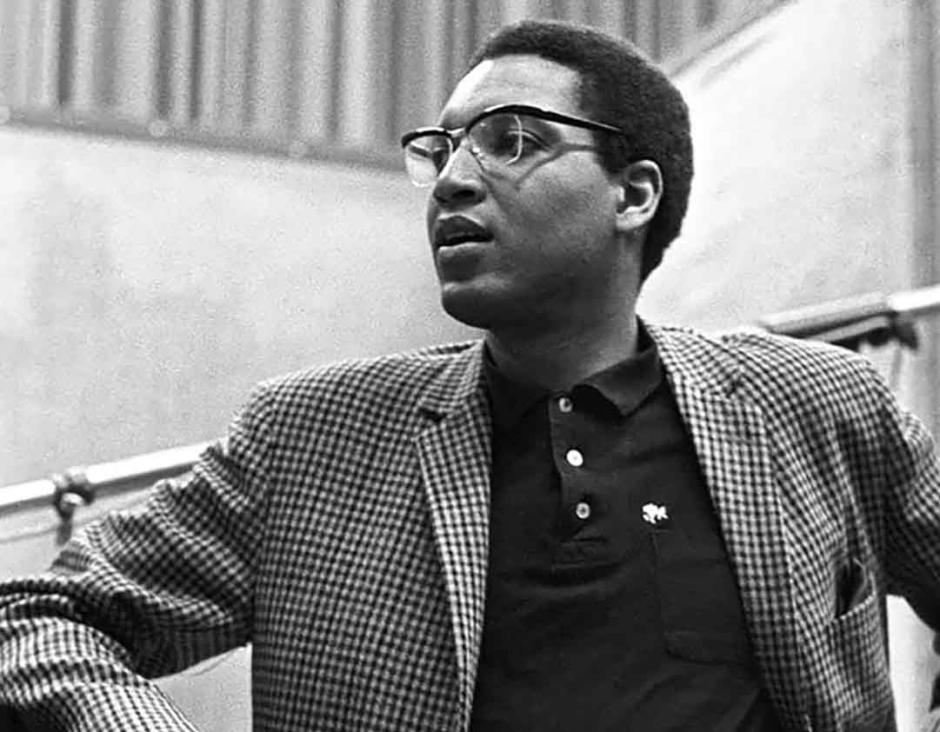
Tom Wilson in a detail from the cover of Everybody’s Head Is Open To Sound
In the introduction to her collection of writings on Tom Wilson, Anaïs Ngbanzo gives an overview of the influential producer's life
It was December 2004 and I was watching Bob Dylan get into heated conversations with journalists during his 1965 British tour in Dont Look Back. Halfway through DA Pennebaker’s film, when Dylan sits at the piano and starts playing an early version of “I’ll Keep It With Mine”, the camera lingers on a man seated next to him, eyes closed, deeply listening. This was the first time I saw Tom Wilson. Over the following years it occurred to me that the photographs of Dylan’s 1965 recording sessions, and those of Nico promoting Chelsea Girl at ABC studios, and the one of Frank Zappa standing in a bright studio during the recording of We’re Only In It For The Money have one thing in common: Wilson is there. I started researching Wilson.
Thomas Blanchard Wilson, Jr was born in 1931. He grew up in Waco, Texas with a librarian mother and a father in the insurance business. He attended Moore High School, where he played saxophone in the school band. He later played trombone and took cello classes for a couple of years – the only formal musical training he ever had. His music-related childhood memories would involve his father conducting a choir at the Texas state centennial celebrations of 1936 and the jam sessions held on Saturday afternoons at his grandfather’s carpet cleaning business. A year after enrolling at Fisk University in Nashville he had to take two years out getting tuberculosis treatment, but then, in 1951, he went further north to study economics at Harvard.
In Cambridge, Wilson became committed to university radio station WHRB – broadcasting classical and popular recordings. He later said: “I owe everything accomplished in the recording field to highly informal but inspirational training as a member of WHRB.” The Harvard archives also show his membership in its most active political club: the Young Republicans. “For some, being a Young Republican was a full-time job, an exercise in wardheeling,” explained an alumni report. “For others, the club was an easy-going, semi-social organisation, which provided interesting speakers and dances.”
In early 1953, Wilson founded the Harvard New Jazz Society. The club was to create “an atmosphere here at Harvard that will foster an appreciation of the idiom,” as he told the Harvard Crimson, extending an invitation to “all interested in jazz and its recognition as an indigenous art form.” With its informal performance and lectures, the New Jazz Society received national publicity and established jazz among the more entrenched musical forms at Harvard. Wilson graduated in May 1954.
That summer he took a job at the Stop & Shop supermarket chain as assistant buyer, languishing at its South Boston headquarters for a few months. Although only 24 years old, he already had strong connections with gifted musicians of the Boston area jazz scenes and a plan to record them. In a 1956 interview for Metronome, Wilson recalled sitting in a friend’s living room talking about trends in music when he said, “If I had a thousand dollars I’d prove something.” The girlfriend (as yet unidentified) of fellow Harvard graduate Charles Henri La Munière, having command of an annuity, offered Wilson $940 that day to start cutting records. As a result he started his label Transition Records in Cambridge in March 1955. That same year he married Beverly J King; they would welcome their first child, Thomas Blanchard III, in 1956.
Herb Pomeroy’s Jazz In A Stable is the first Transition record, and Donald Byrd was the first artist to be signed. Recordings were made in various locations – and through his lasting relationship with the university, Wilson was able to use WHRB’s engineering staff and a completely renovated studio there known as “studio B.” With the assistance of Harvard students and alumni A Ledyard Smith, Stephen A Greyser, Edward H Rathbun and Dean Gitter, Transition swiftly came to prominence in jazz recordings – collaborating with John Coltrane, Sun Ra, Art Blakey, Horace Silver, and Cecil Taylor. Yet it continued to operate from Wilson’s living room and it was losing money: Wilson had to moonlight as membership secretary in the Waltham Boys’ Club during 1957–58 to make ends meet. Transition Records folded in the summer of 1958. The Wilson family moved to New York shortly after the birth of their second child, Darien Wilson, that September.
Upon arrival in the city, Wilson started a career in A&R (artists and repertoire) for indie and major labels, taking a job at United Artists until February 1960. Later that year he founded Communicating Arts Corporation, which produced jazz radio programmes on the New York metropolitan area classical station WNCN-FM, while doubling as jazz A&R director at Savoy Records and as executive assistant to Malcolm E Peabody, Jr, director of the New York State Commission for Human Rights. In 1962 he joined Audio Fidelity Records as associate recording director.
A pivotal encounter occurred in mid 1962: Goddard Lieberson, a former A&R man now heading CBS-Columbia Group, heard Wilson speak before a meeting of the National Academy of Recording Arts and Sciences. Lieberson, under whose leadership the CBS music division had become the world’s leading recording company, was impressed enough to hire him on the spot. Wilson’s role as staff producer at Columbia from 1963 to 1965 would be a significant moment of his career – getting press attention as “the man who produced some of Dylan’s hits” and who made a success out of Simon & Garfunkel’s “Sound Of Silence.”
In November 1965 he joined MGM Records as East Coast recording director, recording The Animals and signing The Velvet Underground, Nico, and The Mothers Of Invention. The vice president of the label, a Wilson admirer, entrusted him with a radio interview program called The Music Factory, sponsored by Verve/MGM and syndicated to college stations across the country.
This was the last role Wilson took at a record company before creating the Wilson Organisation in 1968 with a handful of partners, leasing its services to Motown Records. Subsidiary firms included Terrible Tunes and Maudlin Melodies (publishing), Reluctant Management (talent direction), and Rasputin, Gunga Din, and Lamumba Productions (independent recording production). “You know why I went independent?” he told writer Ann Geracimos in 1968 for a New York Times cover story. “Because I got tired of making money for a millionaire who didn’t even bother to send me a Christmas card. I discovered if you are honest, you get a lot further. A guy’s not going to respect you if you don’t fight for what you think you are worth.
In 1976 Wilson told writer Michael Watts for Melody Maker that he and his business partner Larry Fallon had written a rhythm and blues opera, Mind Flyers Of Gondwana, that wove together Plato’s allegory of Atlantis with African American history. The idea was that Johnny Nash would play the lead; other names mentioned were Gladys Knight (as a queen), Labelle, Gil Scott-Heron, Melba Moore and Minnie Riperton. The Righteous Brothers were to play Mason and Dixon, and it was hoped that Bob Marley would record a reggae soundtrack. They were trying to get Stanley Kubrick interested in a film version. But the project never saw the light. Wilson, who had a history of heart trouble, died at home in Los Angeles, California on 6 September 1978. He was 47 years old.
Working on this book, the first devoted to Wilson, I wondered what he would have made of it. Geracimos writes in her article, “A Record Producer Is A Psychoanalyst With Rhythm”, that:
“Although extreme frankness is one of his strong characteristics, he is reluctant to talk about some of his extra-curricular activities (any drug-taking experiences, for example), because of what people back in Waco might think. ‘Just don’t say anything that might hurt my family,’ he says. [...] The pressures of the profession evidently lead him to seek diversion in a number of unorthodox ways. Rock ’n’ roll music, of course, is not all sound. It refers to a certain style as well, which Wilson, in trying to court extremes and the happy middle simultaneously, represents perfectly. The public side of Wilson is responsible and pragmatic.”
This is an edited extract from the introduction of Everybody’s Head Is Open To Sound: Writings On Tom Wilson, edited by Anaïs Ngbanzo and published by Éditions 1989.
You can read Francis Gooding’s review of the book in The Wire 505. Pick up a copy of the magazine in our online shop. Subscribers can also read the review and the entire issue online via the digital library.
Leave a comment