“One of the great living saxophonists”: Jean-Luc Guionnet reviewed
January 2026
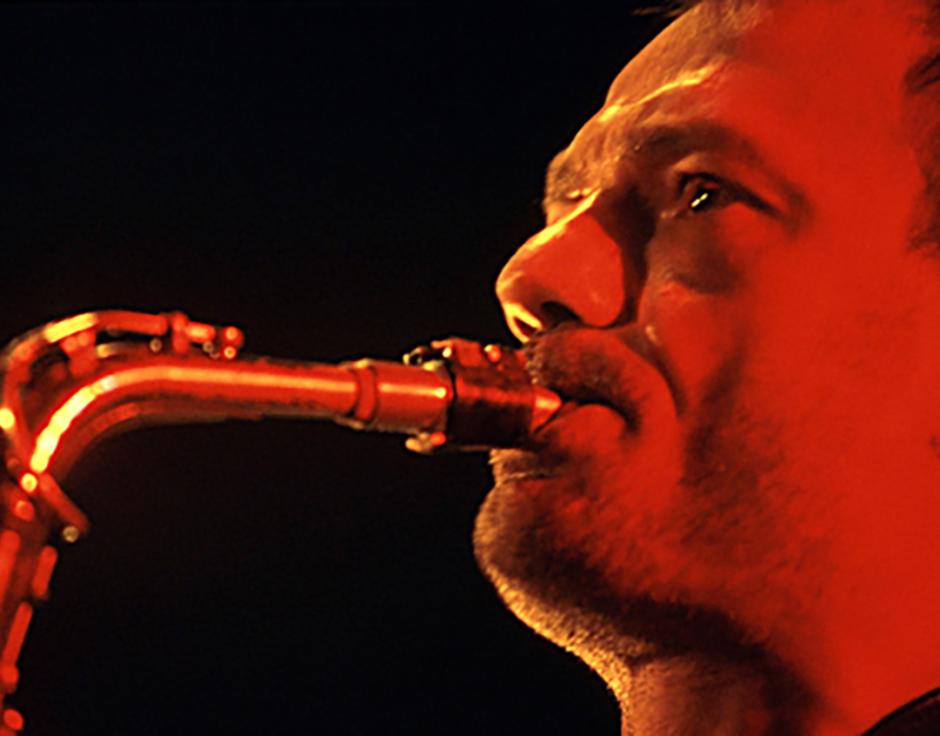
Jean-Luc Guionnet
In The Wire 503/504, Seymour Wright appraises the hardcore saxophony of French musician Jean-Luc Guionnet
Jean-Luc Guionnet
Per Sona
Empty Editions DL/LP
L’Épaisseur De L’Air Live
Potlatch CD/DL
French multi-instrumentalist, composer, philosopher and visual artist Jean-Luc Guionnet has been a globally influential figure for several generations of creative peers. He is also one of the great living saxophonists, with an alto voice that uniquely consolidates strands of the instrument’s sonic and conceptual history into something powerfully distinct, rigorous, instantly recognisable and future-fit.
In 2021, after 30 odd years of solo performance, he released his first full-length alto saxophone solo recording on Los Angeles label Thin Wrist. Recorded in a semi-open barn in 2018 in Brittany, L’Épaisseur De L’Air (The Thickness Of The Air) was concerned fundamentally with the texture, materiality and ideas of saxophone, sound and space. Here, four years on, are two more solo alto recordings. Though not officially released as a pair, they appeared almost simultaneously. One offers two live realisations of the L’Épaisseur De L’Air material on the French label Potlatch, the other private studio recordings made in Hong Kong and released via Empty Editions.
These sets consolidate Guionnet’s voice in documentary form, containing years of situated work. Here, it’s possible to hear his playing as the kernel/nexus of a sort of Francophone school of saxophone innovators that includes Daunik Lazro, Christine Abdelnour, Stéphanes Rives, Bertrand Denzler, Patrick Martins, Pierre Borel and Pierre-Antoine Badaroux. It is also possible to find traces of other alto techniques: the M-Base ways of Steve Coleman and Gary Thomas, the lyrical power of Arthur Blythe, the whimper-gnash of Anthony Braxton’s Composition 99G, Arthur Jones’s Scorpio.
A consistent ambiguity and variety of scale twists, inflates and crushes complex sonic details, dense knots, abrupt nothingnesses across the two discs. Both recordings document astonishingly visceral and cerebral instrument technique, into which musical/philosophical traditions are tied very tight: the saxophone stuff, plus for example study with Iannis Xenakis, workshops with Don Cherry, deep engagement with philosophy (a dialogue with tools in the ideas of Gilbert Simondon in particular feels at the tip of saxophone-homunculic fingers and tongue), mark-making and lines – are all in here, bound up with haptic ways of getting at, and beyond, the saxophone as technology, or back, via bagpipes and other ancient breathed-into, manually worked tools of transformation.
Dedicated to Miguel Garcia, L’Épaisseur De L’Air Live includes two longish in concert solos recorded in Montreuil, in the eastern suburbs of Paris – the first in summer 2024, the second in winter 2023. The alto saxophone fizzes, furry, flinty, furied, fuzzy, hard and soft, large and small sounds accruing and decaying in and out of phase with the force and stress Guionnet applies. The Parisian ghost fuel of the saxophone – from Adolphe Sax’s speculative patent to Lester Young’s memory palace (and absinthe) – are part of the air through which he forces his ideas, via the horn, into the ears of his listeners.
The longer first piece evolves episodically, in slabs, trickles and eruptions/implosions of ideas as sound that grow, decay and grow again as mouldy blooms, alto alliums of bulbous, pungent forces that sizzle and linger. The heavy, hot sonic reactions that begin the second shorter piece collapse into a long dusty tail of embers. The liveness is salient – we can hear the rooms, the other people there, making and listening, the world in this music.
Per Sona presents 11 exquisite studio solos recorded in Hong Kong, all of them short – between 90 seconds and seven minutes, almost miniature études. These are close, detailed recordings of close, detailed sounds: pied sounds that contain pockets and layers of different types of sonic activity, in different places in the saxophone, mouth and ear at once. Rippling sounds made up of multiple bits emerge out of simultaneous interactions and qualities of the saxophone qua machine. The first piece is a series of giant ascending blocks of complex sonic chunks; the second a cloud-cypselae, blown almost ney-like across reed/mouthpiece tip; the third a columella of growl about which the piece spirals. Sounds of skeleton-feathered lichens ripple in the final track’s nutty sonic butter – halfway in, a gargle ends with spat-breath of husk.
In accompanying notes, Guionnet writes, tellingly, of the saxophone, “It was invented; invent music for it in return; always remember that when it falls, its fall does not sound like a saxophone. If it happened to fall, it makes the muffled sound of a ductile metal sheet, or of a bad hardware shop; its body is not sonorous – in which it is a machine; virtually, see by playing it the three dimensions of the metamorphoses of the air column, under the influence of the action; an unstable regime once grasped, maintain it by going with the wave.” This gives a sense of the intellectual and physical stuff of the work at play here. “By whom sounds what?” he concludes, “Through what sounds who? Person/per-sonare or this mask which carries in my place a mask that does not belong to me… nor to it.” Per Sona is an amplifier, definer and representer of character, identity.
Utterly hardcore and grown up in its humble enquiry and challenge, this is essential 21st century saxophony.
This review appears in The Wire 503/504 along with many other reviews of new and recent records, books, films, festivals and more. To read them all, pick up a copy of the magazine in our online shop. Wire subscribers can also read the issue in our online magazine library.
Leave a comment