Against the Stream
December 2025
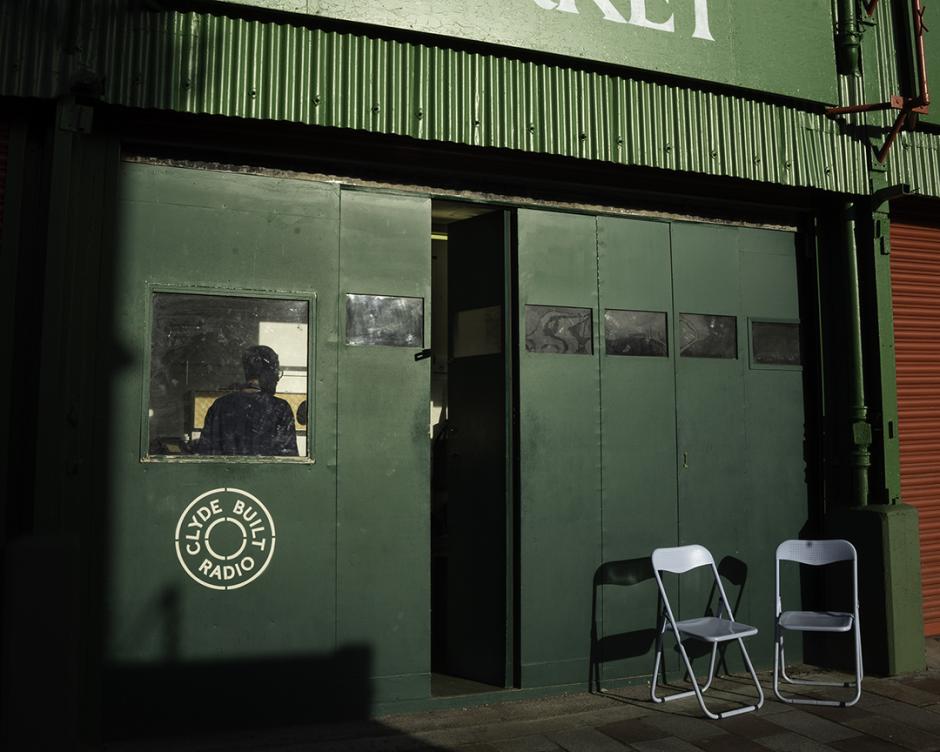
Clyde Built Radio studio. Photo by Izzy Leach
DIY online radio stations allow humanity and personality to surface in a tide of soulless and reductive algorithmic playlists, argues Paul Rekret in The Wire 503/504
For all their horrors, the Covid years were oddly good for radio. With gigs shuttered and the usual circuits of nightlife abruptly choked off, artists and audiences moved online in search of somewhere to gather. Live sets were broadcast from bedrooms, performances surfaced from empty venues, local scenes tried to keep themselves going through the ether.
DIY online stations didn’t suddenly emerge during the pandemic. The 2010s had their benchmarks: Amsterdam’s Red Light Radio (now gone), London’s NTS (long since outgrown its Dalston cubbyhole), and New York’s The Lot (still recognisable from its early days). But around the lockdowns of 2020–21, dozens of small stations appeared or flourished and have carried on since, from Clyde Built Radio in Glasgow to Budapest’s Radio Lahmacun or Seoul Community Radio, forming a loose but persistent network through which underground music continues to circulate.
They survive through volunteer labour and improvised arrangements: intermittent broadcasts, borrowed rooms, a corner of a cafe or a market stall. The remit is whatever sits outside the cleansed margins of the dominant culture, “music misfits, amateurs, and seasoned DJs”, as Clyde Built Radio puts it. A minor infrastructure, but one in which local underground cultures quietly persist.
Meanwhile, music is drawn ever deeper into platform capitalism’s limitless digestive system, in which everything is processed into frictionless, mildly flavoured playlists; musical wallpaper, as one description has it, but with the walls closing in. Enough has been written about what this has meant for artists and listeners: the recursive shaping of taste, incomes collapsing, the sorting and harvesting of data through interfaces increasingly less like portals and more like chutes.
What these small stations offer isn’t only the presence of a human voice rather than an algorithmic proxy – “no playlists, no ads, just the people”, to borrow Bristol based Noods Radio’s phrasing. Again and again, producers and hosts describe the space itself as crucial: the low-level drift of people coming and going, an unexpected conversation with someone finishing a set, the idle time before another begins. In the context of ever more solitary, smooth and inward online music consumption, such spaces become an increasingly important wayward impulse, even if a fragile one, that keeps slipping out of the platform’s prescribed channels.
The boundary between mainstream and alternative cultures, however it’s understood, has thinned further as more of social life is subsumed into the circuits of a few monopolistic tech firms. Bandcamp’s sale to Epic Games in 2022, absorbed with barely a ripple, made this plain. Stations depend on the very machinery that might one day render them obsolete: social media’s opaque visibility regimes, cloud platforms whose terms shift without warning, digital archives whose survival hinges on conditions no one local can influence.
All of which places today’s DIY stations in a longer, bittersweet lineage: the recurring struggle between autonomous cultural practices and the forces that seek to regiment, rationalise and monetise them. The ham radio enthusiasts forced off the dial by regulators in the 1920s; the format-radio monocultures that smothered unaffiliated broadcasters in mid-century America; the stifling of freeform FM by the 1970s; the pirates that threaded across Europe, moving through whatever cracks regulators and the police had not yet sealed. The antagonists have changed, but the basic plot remains.
Economic survival, always precarious, has become still more so. Running costs accumulate, revenue rarely does. Many stations endure only through their attachment to other small institutions, cafes, bars, art spaces, themselves little more secure. EHFM is entwined with Ground Floor cafe in Edinburgh; Noods operates from Mickey Zoggs; Slack’s is woven into the Lubber Fiend venue in Newcastle. In the wider context of rising rents and dwindling jobs, none of this is guaranteed. Yet the sheer abundance of such stations, and the social worlds that gather around them, should give one pause. With so many alternatives already in existence, the idea of paying for yet another streaming subscription seems rather perverse.
This essay appears in The Wire 503/504 along with many more critical reflections on 2025. To read them, pick up a copy of the magazine in our online shop. Wire subscribers can also read the issue in our online magazine library.
Leave a comment