Extended Play
December 2025
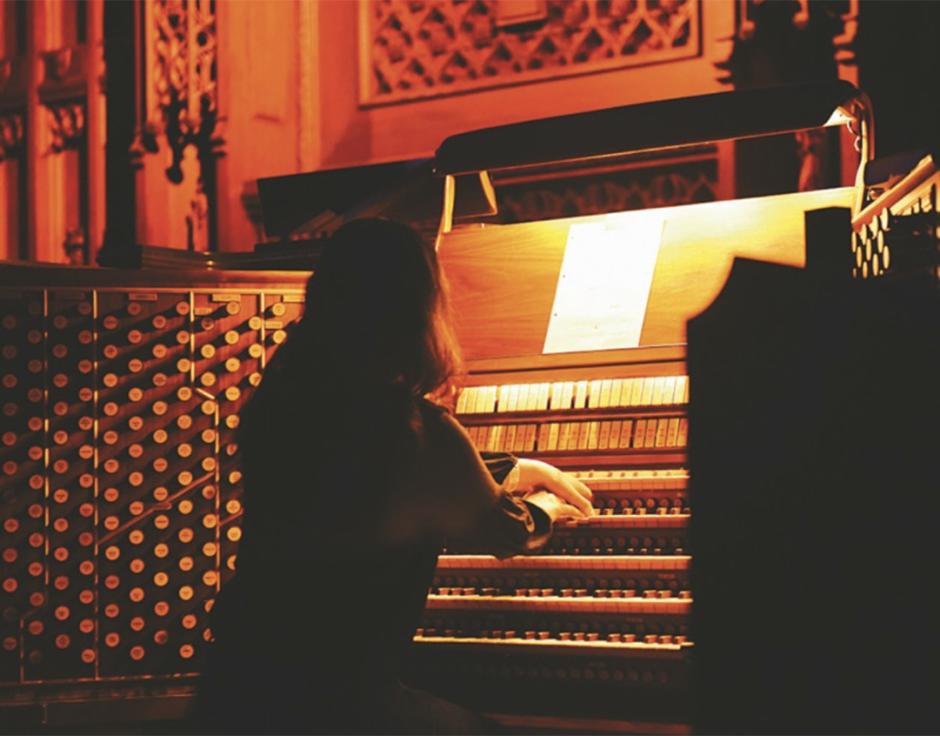
Sarah Davachi performing in 2018. Photo by Michael Melwani
In The Wire 503/504, Xenia Benivolski writes that as the speed of events and information flows increases, drone based slowness offers another mode of perception
The prehistory of drone music begins with the recognition of sound as a temporal event. In ritual, chant and natural acoustics, drones mark ambience and continuity. Ancient instruments such as horns and bells produce extended vibrations that transform time into a perceptual field, and this stretching of temporal experience is as much social as musical. These instruments and others have proliferated into the rhythms of the human world. Each moment of sustain provides a window into what infinity might be, and in a sense, a base note to reality.
Sometimes this moment takes shape in literal ways: for me it’s taking hangover naps at La Monte Young and Marian Zazeela’s Dream House while seeking refuge from the scorching sun of Lower Manhattan. Or on a plane, sitting with your ear pressed against the window, listening to its engines, feeling like a flimsy little speck in a big loud universe. Almost always, a drone bumps against some sort of border between an inside and an outside that you have to mentally overcome in order to allow your mind to touch the humming current and fill in the blanks. Maryanne Amacher defined this by treating the listener’s perception as the compositional site, the “third ear”, where the active listener is an experimenter. You could say the same about Pauline Oliveros and many others of that generation who worked with extended improvisation and deep listening where the politics of sustained listening resist the fragmentation of sound and experience.
Information, true and false, is manufactured at neck-breaking speed. As one advert blends into another, a horrifying news story is blocked by a pop-up, and on top of it an online digital productivity ad. We ignore the noise, but it doesn’t disappear. It fades into the background with all the other noises, the ones we’ve already put away. Works that feature wind, children and rivers are all over my devices, in my ears, as if trying to reassemble the texture of physical reality as opposed to the frantic haptic continuum that haunts us.
Catherine Christer Hennix, Cosey Fanni Tutti and other composers who populate my playlist link tone to perception. Suddenly it seems that time doesn’t advance. It pools in certain scenarios, drains in others. So lately I’ve been gravitating towards artists and composers who sustain sound. Listening to the long notes in Sarah Davachi’s music brings a memory: I’m doing the dishes while looking out of the window in the spring. The eye follows a mundane scene while the mind syncs with the slow modulation of tone, and the distinction between environment and composition fades. In such moments, time seems to stretch to stillness.
A contemporary turn in music to a sort of slowness is audible in the works of Davachi, Lucy Railton, Catherine Lamb, Lawrence English, and Kali Malone and Drew McDowall’s recent Magnetism. The drone absorbs noise without cancelling it, integrating ambient sound, interference and nuance. Composition collapses into impossible chaos, then the chaos flattens into a note, perhaps a single drone: some form of reality.
In the mid-20th century, drones re-emerged as part of a broader response to industrial acceleration and the politics of perception. After the Second World War, sound artists and composers used duration to counter the compression that characterised mass communication and the automated society. The same continuous tone that evokes meditation has its evil twin in the endless hum of drones in Gaza, the mechanical resonance of generators in Beirut, and the punishing dial tone of tinnitus.
Modernity has introduced new forms of sustained sound. Jordan Tannahill’s novel The Listeners describes a mysterious hum that binds together a group of strangers who cannot identify its source. It’s difficult to identify the source of the hum, because every environment hums, so the phenomenon becomes a form of communion. Hydrofields, electrical lines and data servers that sustain daily life produce an uninterrupted haptic soundscape, an endless clang. To hear them is to hear an index of the present.
It’s been said that time slows down when you experience a life changing event; the moment is fractal, both compressed and suspended into infinity. Perhaps the base frequency of the world is modulating, and in the process, reshaping continuity itself.
This essay appears in The Wire 503/504 along with many more critical reflections on 2025. To read them, pick up a copy of the magazine in our online shop. Wire subscribers can also read the issue in our online magazine library.
Leave a comment