“A myth can often be more stimulating than actuality”: Love Magic Power Danger Bliss reviewed
April 2026
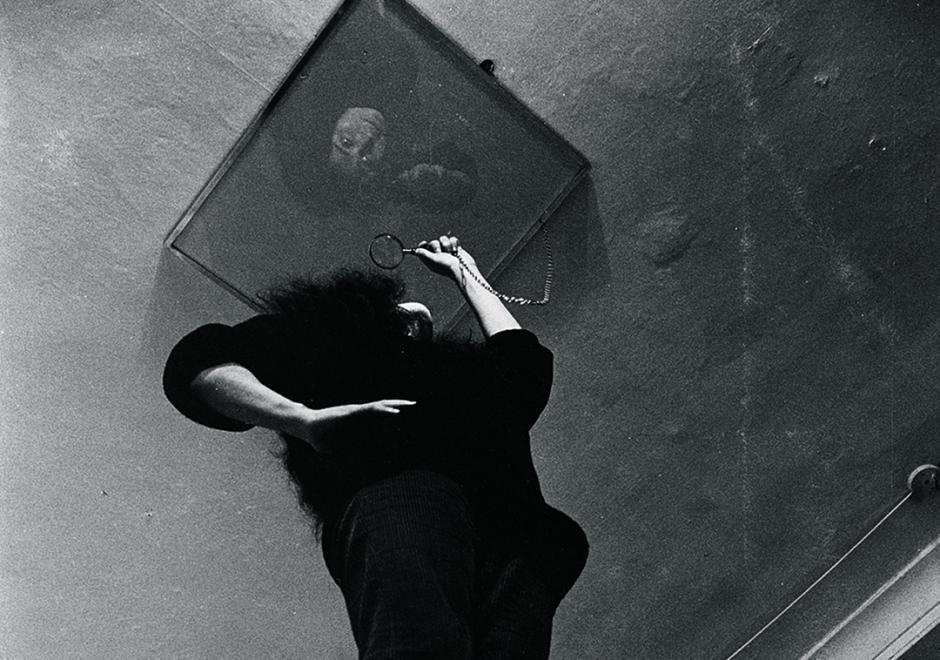
Yoko Ono with Ceiling Piece (Yes Piece), Indica Gallery, London, 1966. Photo by Graham Keen
The story of Yoko Ono’s life and work provides a lens for examining the catalytic avant garde art movements of the mid-20th century, writes Mark Webber in The Wire 507
Love Magic Power Danger Bliss: Yoko Ono And The Avant-Garde Diaspora
Paul Morley
Faber Hbk 496 pp
The last time I saw Paul Morley in person, at an event for his recent book Far Above The World, I mischievously (or misguidedly) asked if the world needed another book about David Bowie. It was more a witless conversation opener than a provocation, because I love Bowie as much as Morley does, but he graciously took the prompt and ran with it.
Now he’s written about one of the most widely known but underappreciated and misunderstood contemporary artists. You might wonder if another book about Yoko Ono is necessary, but Love Magic Power Danger Bliss isn’t only about her. Biographical details are threaded through the text, but this is more a creation myth around the fermentation of avant garde/conceptual/minimalist art that blossomed mainly in the US, particularly New York, as the 1950s became the 60s.
A foundational moment for this milieu was the concert series organised by La Monte Young in Ono’s Chambers Street loft from December 1960 to the following June. The list of participants is a roll call of those who have since become recognised as some of the most original and influential artists, composers and performers of the last century: in addition to co-conspirators Young and Ono, Richard Maxfield, Terry Jennings, David Tudor, Jackson Mac Low, Bob Morris, Henry Flynt, Simone Forti, Dick Higgins, and Ono’s then-husband Toshi Ichiyanagi. This coterie was later immortalised in Young’s book An Anthology of chance operations, concept art anti-art indeterminacy improvisation meaningless work natural disasters plans of action stories diagrams music poetry essays dance constructions mathematics compositions. The concert series was the zero point of a rich seam of creativity that was echoed and amplified by Fluxus, the Judson Dance Theater, happenings, intermedia and expanded cinema.
These events, promoted with the epigram “The Purpose Of This Series Is Not Entertainment”, were the first to take experimental music out of the uptown concert halls (where early pioneers like Cage still had to prove themselves) and resituate it downtown in the kinds of alternative spaces that we romantically associate such endeavours with, an ideal continued today by the likes of London’s Cafe Oto. Such buildings in Lower Manhattan were then accessible to penniless artists but are now the penthouse playgrounds of the super-rich – an outcome that was possibly not the intention of Fluxus leader George Maciunas, who was the first to convert Soho’s all but abandoned factories into live-work units.
Details of what actually occurred during these evening concerts are still murky, so for me this was the most necessary part of the book. Most participants are no longer with us, and it’s unclear if Morley spoke to any of the survivors. All we are left with are the names, lists of works which may or may not have been presented, scant memories, and a few enigmatic photos by Minoru Niizuma. Like one of the instructional art pieces of this vintage, a black and white photo leaves plenty of space that can be filled by our imaginations. Sometimes this is for the best: a myth can often be more stimulating than actuality.
Before we arrive at the loft, Morley traces the genesis of the avant garde in 19th century France (the humorously captioned monochromes by Alphonse Allais were new to me). Breezing through dada, all roads inevitably lead to Duchamp and Cage, mentors and exemplars who inhabit some of the book’s most engaging passages. Glimpses of Ono’s early life – the foundational experiences of growing up in war torn Japan, retreating into fantasy as a coping mechanism, then studying philosophy and phenomenology – offer clues as to the origins of her dreamlike, text-based artworks. Following the loft concerts, Ono’s conceptual and performance works flowed in earnest, further encouraged by the evolution of Fluxus, eventually taking her to London.
Having cultivated a strong, uncompromising character, Ono was always willing to appear foolish in order to make a point. She established herself as a compelling, original artist, but she was also – whether by luck or design – a champion networker, managing to associate with important figures at just the right time. Cage, Young and Maciunas were part of a trajectory that ultimately led her to Beatle John, found up a ladder in the Indica Gallery, squinting through a magnifying glass at the word “Yes”. It’s not an easy task to tell the Yoko Ono story without addressing her symbiotic relationship with John Lennon, but she was already an artist of significance before they met, and he only makes an appearance in the final few pages. For what happened next, I’m not sure the world needs another book.
This review appears in The Wire 507 along with many other reviews of new and recent records, books, films, festivals and more. To read them all, pick up a copy of the magazine in our online shop. Wire subscribers can also read the issue in our online magazine library.
Leave a comment